
15 Sept 2026
Andy Durham BVSc, BSc, CertEP, DEIM, DipECEIM, MRCVS discusses the importance of early detection and use of therapeutic agents for this challenging disease.

Andy Durham
Job Title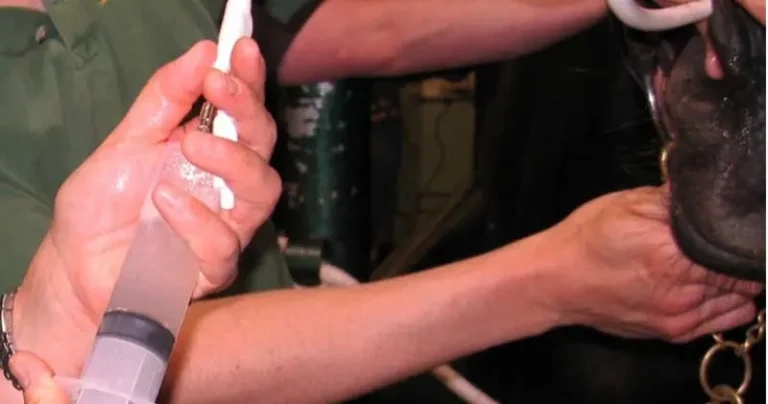
Figure 1. Collection of bronchoalveolar lavage (BAL) from a horse using an inflatable, cuffed BAL catheter.
Equine asthma is seen commonly in equine practice, primarily in two forms known as mild and severe equine asthma.
Severe equine asthma tends to affect mature horses (older than seven years) and shows significant clinical signs comprising a persistent cough and increased respiratory effort at rest. Mild equine asthma affects sports horses of any age and demonstrates subtle to absent respiratory signs, with poor performance being the main clinical consequence, although mild or intermittent coughing may be noted.
Mild and severe equine asthma are regarded as two separate disease entities rather than stages of progression of the same disease. Both conditions tend to be recurrent unless effective managemental changes or prophylactic treatments are successful.
Persistent coughing in horses should prompt consideration of equine asthma, although, as mentioned, this is inconsistent in the mild form, where poor performance may dominate presentation.
Bronchoalveolar lavage is undoubtedly the best method of detecting early cases of asthma (Figure 1). By definition, equine asthma is a disease of the lower airways and, therefore, requires bronchoalveolar lavage for diagnosis.
Although tracheal wash cytology may be supportive of asthma, it is by no means diagnostic, as many other causes exist. In contrast, few other conditions cause bronchoalveolar lavage neutrophilia in a systemically well horse.
Undoubtedly, bronchoalveolar lavage is a little more challenging to perform than tracheal wash and also more upsetting for the horse and owner. However, in the majority of cases, it provides important information that cannot be obtained via other means and the additional trouble is worthwhile. However, severely dyspnoeic cases are probably best not subject to bronchoalveolar lavage, as the procedure may be unreasonably distressing and such cases may be better diagnosed based on clinical suspicions – and perhaps tracheal wash – until signs recede somewhat.
Diagnostic interpretation of airway secretion samples in horses focuses on the presence of granulocytes (neutrophils, eosinophils and mast cells/basophils), with little meaning attached to the relative presence of macrophages and lymphocytes (Table 1). Unlike other species where eosinophilic airway disease typifies asthma, the vast majority of equine cases demonstrate airway neutrophilia, with occasional cases demonstrating increased presence of eosinophils or mast cells. Bronchoalveolar lavage has the additional advantage of having narrower reference intervals for the cytological patterns obtained, with normal horses rarely showing more than 5% to 10% neutrophils in samples. Severe asthma cases may sometimes be seen with as many as 95% or more neutrophils in tracheal wash and bronchoalveolar lavage samples. This should not be mistaken for evidence of infection and the clinical picture should help establish this.
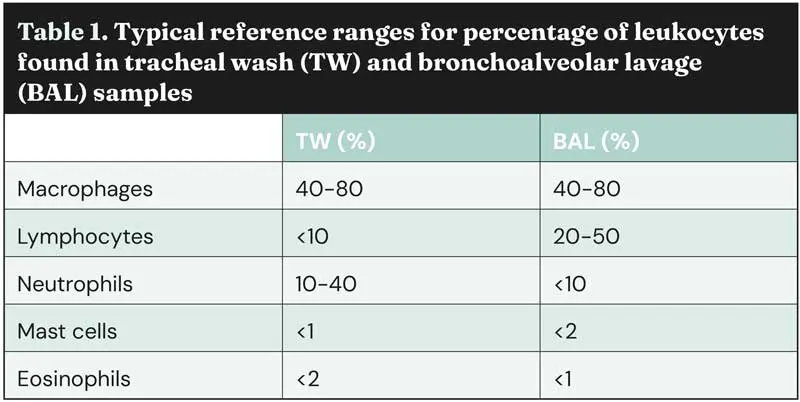
Tracheal wash samples show more variability, with some horses showing as much as 40% neutrophils despite having healthy lower airways. In most equine asthma cases, inflammatory biomarkers such as circulating neutrophilia, serum amyloid A and serum iron tend to be normal; therefore, signs of systemic inflammation should prompt consideration of other conditions such as contagious airway diseases (for example, equine influenza virus, equine herpesvirus, equine rhinitis virus), bacterial bronchopneumonia, interstitial lung disease, and so forth.
Horses with a known history of equine asthma will be prone to recurrence, and disease is predictable at times when airway challenges arise (for example, winter forage or spring pollen season). Traditionally, asthma was associated with poor air hygiene in stables – especially with respect to poorly conserved, moulded hay – but also straw bedding and other noxious gases within the stable. Although such examples still occur, a greater awareness of the necessity for good stable air hygiene has been associated with a relative decline in stable-associated asthma cases – especially in the severe asthma category. Seasonal pasture-associated severe asthma cases have been recognised increasingly in the past few decades and now tend to be the predominant form of severe equine asthma in many regions. The precise allergens and inflammagens are generally not recognised, but are often assumed to represent airborne pollens and pollutants. Undoubtedly, pasture-associated asthma cases create greater challenges compared with those that are stable associated.
The fundamental requirement for resolution of asthma is to avoid inhaling the inciting allergens and inflammagens. Evidently, this is far easier to achieve with stable-associated cases, and nowadays the use of dust-free preserved forages such as haylage or steamed or soaked hay is commonplace. Additionally, an array of alternatives for straw bedding are available, meaning that such cases are far easier to manage. In contrast, seasonal pasture-associated equine asthma cases cannot reasonably be prevented from inhaling the inciting causes. We might still offer medical therapies, but have to accept, and communicate to the owner, that success might be limited due to treatment in the face of ongoing airway challenge. By analogy, a human patient with seafood allergy will not achieve optimum respiratory health if they persist with eating seafood alongside prescribed medication.
Therapy for recurrent airway obstruction should always be administered in association with improvements in air hygiene. It is the author’s experience that detailed and specific advice regarding ventilation and possible sources of airborne allergens and irritants cannot be overemphasised.
Many horse owners do not act appropriately to immediately correct all potential problems (such as forage/bedding, stable ventilation, adjacent stables, hay stack, muck heaps, and so forth) which can sometimes lead to a perception of misdiagnosis and/or treatment failure. A further source of confusion may arise due to a misunderstanding of the major and long-standing pathogenic impact of even a brief exposure to airway allergens/irritants (for example, a temporarily available haynet in the horse box or while being groomed).
Several pharmaceutical agents and other therapeutic strategies have been used to improve respiratory dynamics in asthma cases, although consideration of their relative benefits and risks is an important first step. Wherever possible, any therapeutic intervention should be regarded as a short-term effort to reduce airway inflammation while managemental influences on air hygiene are scrutinised and improved appropriately, although this may sometimes prove impossible, as previously noted.
A limited number of products exist carrying equine product licences that may be useful in the therapy of equine asthma, although not all of these carry a licence specifically for use in respiratory diseases. These include a beta-2 adrenergic agonist (clenbuterol hydrochloride), anticholinergics (atropine, hyoscine), a diuretic (furosemide), glucocorticoids (such as prednisolone and dexamethasone) and mucolytics (such as dembrexine). However, many more products carry product licences for use in human respiratory diseases that may also be of benefit to horses suffering from asthma – especially via inhalation. In addition to the drug classes listed previously, these include miscellaneous types of anti-inflammatory drugs including mast cell stabilisers and other cytokine modulators. The clinical use of alternative therapeutic strategies such as immunotherapy, allergen neutralisation and homeopathy, remain controversial.
Glucocorticoids are potent anti-inflammatory drugs that have several potentially beneficial actions in asthma cases and are the cornerstone of therapy. They inhibit neutrophil migration into the airways, reduce histamine release from mast cells, inhibit prostaglandin and leucotriene synthesis (countering bronchoconstriction), suppress allergy, and upregulate and increase the sensitivity of beta-2 adrenoceptors (facilitating bronchodilation). This makes this drug class very attractive in asthma, although the onset of action of glucocorticoids is not as rapid as with anticholinergic agents or adrenergic agonists.
Despite some poorly designed studies suggesting the contrary, it is clear that glucocorticoids increase the risk of laminitis in horses, which is the main factor that should be balanced against their therapeutic benefits. Systemic use of prednisolone (for example, 1mg/kg every 24 hours) or dexamethasone (0.05mg/kg to 0.10mg/kg every 24 to 48 hours) are often used for initial therapy after assessing laminitis risk. Where longer term therapy is required (for example, seasonal pasture-associated asthma), then inhaled glucocorticoids are often considered to mitigate against the risk of laminitis.
It is important in this regard that glucocorticoid drugs specifically designed for inhaled application are used rather than products designed for systemic use via an inhalational route; for example, several studies have confirmed that inhalation of a small quantity of dexamethasone (such as 2ml, 4mg) is therapeutically equivalent to intramuscular injection of that same small (subtherapeutic) dose, which would, therefore, appear unlikely to be helpful. In contrast, certain glucocorticoids are specifically designed to be surface acting rather than being rapidly whisked away by the circulation, but few such products are currently available. Ciclesonide has been available as an equine licensed product that has now been withdrawn, although two human-licensed nebulisable products are still available comprising budesonide (1mg every 12 hours) and fluticasone (1mg every 12 hours), as well as metered-dose inhalers containing fluticasone (for example, 1mg every 12 hours) or beclomethasone (2mg to 4mg every 12 hours), which may be administered via a spacer device.
The practice of inhaling a bronchodilator prior to glucocorticoid inhalation is used by some as a means of increasing the amount of inhaled drug and increasing potency. However, it is not well established yet as best or even suitable practice in horses, as the increased air flow velocity associated with bronchodilation might prove counterproductive as more drug impacts, and is effectively lost, on nasopharyngeal mucosa.
Selective beta-2 agonists may be given systemically or by inhalation. They are effective bronchodilators as well as for stimulating mucociliary clearance, reduction of mucus viscosity, stimulation of surfactant secretion, modulation of cholinergic transmission and they have anti-inflammatory properties including inhibition of mast cell degranulation. These include short-acting agents such as salbutamol, fenoterol and terbutaline, and longer acting agents such as salmeterol and clenbuterol. Only the latter carries an equine licence and is given orally or intravenously. Initial therapy of asthma with beta-2 agonists (especially when administered intravenously) has been shown to transiently increase hypoxaemia, which can lead to acute deterioration of the clinical condition in severe cases. This paradoxical effect is due to potentiation of ventilation-perfusion mismatching, and it may be wise to avoid intravenous boluses of clenbuterol in severely dyspnoeic horses.
Clenbuterol is the main systemically acting beta-2 agonist used as a bronchodilator in the horse. The agent is generally efficacious in asthma cases, although efficacy may be limited in some cases. When administered orally, a considerable reduction in the absorbed dose may occur following removal by the liver on “first pass”, and so intravenous use is preferable when practical. Also, long-term (more than one month) use of beta-2 agonists may result in receptor downregulation, leading to reduced efficacy. Adverse effects such as tremoring, sweating, nervousness and colic are occasionally seen, but generally pass uneventfully.
Evidence indicates that inhaled beta-2 agonists may lead to clinical improvements in asthma, although none are currently licensed in horses. Note salbutamol (human licensed) is very short acting, whereas salmeterol has a longer duration of action. The intravenous preparation of clenbuterol can also be administered by nebulisation, although this represents off-label use. Combination products are also available in metered-dose inhalers containing beta-2 agonists along with a glucocortioid, cromoglycate or an anticholinergic.
Parasympathetic hyperactivity is the prime cause of bronchospasm in asthma, and several products are available that have the clinical effect of bronchodilation via competition with acetylcholine at muscarinic motor endplates on bronchial smooth muscle. The main indications for these drugs include initial therapy of acute severe asthma cases with significant breathing difficulty and also diagnostically as an assessment of the contribution of bronchoconstriction to the clinical picture of an asthma case. Side effects, most notably ileus and colic, limit their systemic use, however.
Atropine, unlike other anticholinergic drugs, may also inhibit mucociliary clearance. Anticholinergic agents may well be superior to other drugs such as beta-2 agonists in relieving acute bronchospasm, but they have limited additional clinical benefits in the horse with asthma. Atropine is a rapid-acting and potent anticholinergic bronchodilator that can be administered intravenously to horses at 0.01mg/kg to 0.02mg/kg (5mg to 10mg per 500kg).
Long-term clinical use is to be avoided, however, due to the outlined risk of colic. Similar benefits can be achieved with hyoscine. Failure to respond to an intravenous bolus of atropine or hyoscine within 15 to 30 minutes suggests processes other than bronchoconstriction are producing the clinical signs (for example, mucosal swelling, airway secretions). Ipratropium is a highly charged anticholinergic drug that is not absorbed systemically following inhalation and is, therefore, not associated with untoward side effects. Although not licensed in the horse, ipratropium has been used with success for acute bronchodilation at a total dose of 1mg per horse. The drug has maximal effect by 15 minutes, but is fairly short acting and should be given every four to six hours.
Breakdown of respiratory mucus has been proposed to be of benefit in cases of obstructive pulmonary diseases in horses. Some evidence suggests that a decrease in mucus viscosity enhances mucociliary clearance. The most commonly used systemic mucolytic licensed for use in the horse is oral dembrexine. Many further products with claims of mucolytic efficacy have been administered by nebulisation to horses, including acetyl cysteine, water and saline.
Inhibition of mast cell degranulation may be considered in asthma cases with significant mast cell presence in bronchoalveolar lavage fluid, although no equine licensed products exist. Nedocromil sodium is licensed for use in humans and has been used effectively in horses.
In addition to potentially beneficial effects in cases of pulmonary oedema and exercise-induced pulmonary haemorrhage, the loop diuretic furosemide has been shown to have a significant bronchodilatory effect in horses with asthma. This effect is prostaglandin mediated and may, therefore, be abolished if NSAIDs are used concurrently. Furosemide may be administered intravenously, orally or by nebulisation at a dose of 1mg/kg to 2mg/kg.
Asthma presents a significant challenge to equine health and to the veterinary profession.
Early detection via bronchoalveolar lavage following clinical suspicion is reasonably successful, although therapeutic interventions have become more challenging, as seasonal pasture-associated asthma takes over from its stable-associated predecessor, making parallel managemental changes less effective.
Use of some of the drugs in this article is under the veterinary medicine cascade.
Andy Durham qualified from the University of Bristol in 1988 and worked initially in the midlands, where he gained a postgraduate qualification in equine practice before joining Liphook Equine Hospital in 1994. After a brief period away, he returned to Liphook in 1999 and became a partner in 2001. He gained the RCVS Diploma of Equine Internal Medicine in 2003 and the Diploma of the European College of Equine Internal Medicine the following year. Andy is also a visiting professor at the University of Surrey and acts as a consultant for internal medicine, providing a referral service for referring vets, and runs the diagnostic laboratory at Liphook. He has more than 90 peer-reviewed publications and textbook chapters on a wide range of equine medicine subjects, and lectures frequently both in the UK and abroad.