
10 Nov 2026
Kate Loomes BVSc(Hons), MSc, CertAVP(EP), CertAVP(VA), CertAVP(EM), DipECVAA, MRCVS looks at factors influencing perioperative mortality and morbidity, as well as in and standing sedation, in the first of a two-part article.

Kate Loomes
Job Title
Image: kwadrat70 / Adobe Stock
The horse stands alone as being one of the most challenging of the common species that are anaesthetised (Muir and Hubbell, 2010).
Perianaesthetic mortality rates tend to be significantly higher in horses compared to the other commonly anaesthetised species. In dogs and cats, recent large-scale multicentre studies investigating perianaesthetic mortality found overall mortality rates of 0.69% and 0.63%, respectively (Redondo, Otero et al, 2024; Redondo, Martínez-Taboada et al, 2024).
In those studies, when the American Society of Anaesthesiologists Physical Status (ASA-PS) Classification score was stratified, dogs with an ASA I or II status had a perianaesthetic fatality rate of 0.08% and 0.24%; in cats, the rates were 0.07% and 0.25% (Redondo, Otero et al, 2024; Redondo, Martínez-Taboada et al, 2024). In horses, the latest Confidential Enquiry into Perioperative Equine Fatalities (CEPEF4), reported findings from 47,396 equine general anaesthetics and found an overall fatality rate of 1.2% (Gozalo-Marcilla et al, 2025). When colic and “non-colic” procedures were separately analysed, the risk of fatality was 4.2% and 0.6%, respectively (Gozalo-Marcilla et al, 2025).
Encouragingly, the modern equine perianaesthetic mortality rate has decreased from figures previously reported, where horses undergoing procedures other than colic surgery had a reported mortality rate of 0.9% (Johnston et al, 2002; Dugdale et al, 2016); however, the risk of general anaesthesia (GA) in equines still remains significantly higher than in dogs and cats.
Assessment of the risk associated with equine GA can be based on a number of factors. Studies have identified both horse-related and procedure-related risk factors, but no validated, equine-specific, accurate risk assessment tool exists that can be applied before induction of GA (Brumund et al, 2024).
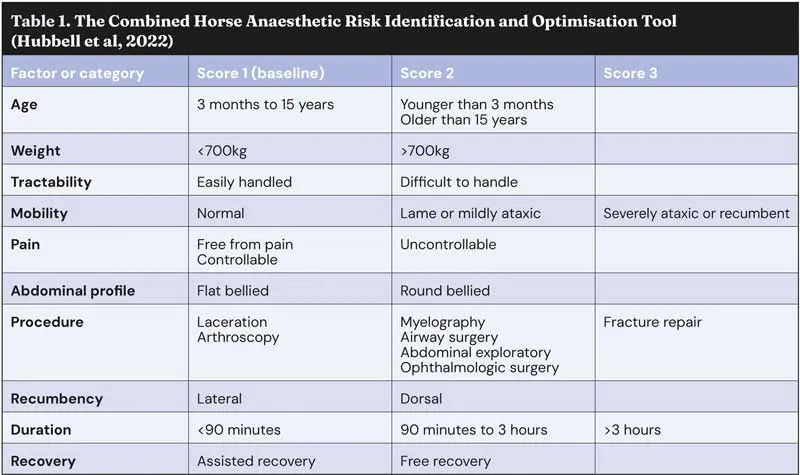
The ASA-PS classification score has traditionally been applied to veterinary species, but was designed for use in humans. This method has been re-evaluated using an equine-specific rubric system to complement the existing ASA-PS classification system. The Combined Horse Anaesthetic Risk Identification and Optimisation Tool (CHARIOT) has been developed with the goal of identifying horses at increased anaesthetic risk prior to induction of GA so that measures might be implemented to potentially reduce mortality and morbidity (Hubbell et al, 2022). The first part of CHARIOT focused on the adaptation of the ASA-PS score by proposing the inclusion of equivalent equine conditions to indicate eligibility for each of the classifications I to V. The adapted ASA-PS-Equine system includes equine heart conditions, laryngeal pathology, respiratory conditions, neuromuscular disorders, endocrine disease and gastrointestinal conditions of varying degrees of severity applicable to each risk category (Hubbell et al, 2022).
A small number of studies have investigated the use of the adapted system and one study found that the addition of exemplary diseases to generate the ASA-PS-Equine, improved inter-observer reliability compared to traditional ASA-PS assessment and allowed for a more precise differentiation of the mortality risk in horses (Brumund et al, 2024).
The second part of CHARIOT is a rubric score that uses 10 factors, which are patient characteristics or procedural aspects that have been identified to impact anaesthetic mortality or morbidity in published studies (Table 1). The rubric system was designed using a consensus of experienced anaesthetists to compile information to aid the estimation of relative risk of a given horse being anaesthetised for a given procedure prior to induction (Hubbell et al, 2022). Factors considered in the CHARIOT came as a result of an opinion survey of equine anaesthesiologists on pre-anaesthetic assessment of risk. The scores indicate the relative risk compared to baseline item risk of one (Hubbell et al, 2022).
While the process of producing general anaesthesia in horses is similar to that of other species, the unique equine temperament, size, bodyweight and anatomical relationships may influence risk of specific perioperative complications compared to other species.
Many horses are flighty or nervous in unfamiliar circumstances and tend to have high levels of circulating catecholamines, which are not good for safe anaesthesia. (Dugdale et al, 2020).
Horses may be less accustomed to being recumbent or lying down compared to other species and may immediately try to stand soon after regaining consciousness in recovery (Dugdale et al, 2020). Their large size and ability to kick and barge may also hinder our attempts to help horses during induction and recovery from GA.
The equine diaphragm is domed and, in the standing horse, a large portion of the lung lies dorsal to the diaphragm and the abdominal cavity (Hubbell and Muir, 2015). In dorsal recumbency, the relatively large and heavy abdominal cavity and contents may produce compression atelectasis resulting in ventilation:perfusion disturbances and a negative effect on oxygenation.
The relatively heavy mass of the abdominal viscera may also compress the caudal vena cava and compromise venous return to the heart. In horses, the response to alterations in arterial carbon dioxide (PaCO2) and oxygen (PaO2) tension are different compared to other species. At maximal exercise, horses tolerate relatively large alterations in PaCO2 and PaO2 without compensatory hyperventilatory responses, and while this may act to allow higher levels of performance and less fatigue at exercise (Hubbell and Muir, 2015), it may also impact the compensatory response to hypoxaemia and hypercapnia during GA.
The timing of mortality or serious complication occurrence may also be different between species. In horses, the recovery phase tends to attract the highest frequency of complications, in part due to the restricted ability to be able to safely and effectively assist horses in the recovery phase from recumbency to standing.
The results of CEPEF4 showed that most fatalities in “non-colic” cases occurred during recovery (48.5%) while 10.1% occurred during maintenance of general anaesthesia (Gozalo-Marcilla et al, 2025).
Other studies have reported higher rates – between 92% and 100% of the deaths recorded – occurred in the recovery phase or as a result of a recovery complication (Dugdale et al, 2016; Laurenza et al, 2020). These findings highlight that the risk of poor recovery and the risk of fatality may be intertwined; therefore, prompting investigation into factors which may influence quality of recovery after equine GA.
It is also true that important predictors of recovery quality such as body mass, ASA physical status, anaesthetic duration and time of day of surgery are outwith the control of the anaesthetist and surgeon, and most of the variation in recovery quality remains unexplained (Dugdale et al, 2016). It has also been discussed if the flighty nature of the horse, often suggested to have the greatest influence on recovery quality, will limit future improvements (Dugdale et al, 2016).
In recent years, an increasing number of surgical procedures have been performed under standing sedation. While risk associated with GA is often discussed and regularly investigated, the risk associated with standing sedation is less well documented.
Preliminary findings from CEPEF4 documented a mortality rate of 0.2% in 1,955 horses undergoing standing sedation (Gozalo-Marcilla et al, 2021). Performing procedures under standing sedation avoids the administration of general anaesthesia agents; however, these procedures may incur higher doses of sedative agents over a longer time period, therefore increasing the risk of dose-dependent adverse effects of agents such as alpha-2 adrenoreceptor agonists (Thibault et al, 2019). One of those adverse effects may be the detrimental effect of alpha-2 adrenoreceptor agonists on gastrointestinal motility.
In horses undergoing procedures under standing sedation provided by detomidine, the prevalence of post-anaesthetic colic was 1.4% (Thibault et al, 2019). However, the factors which are thought to be involved in the development of colic or gastrointestinal dysmotility such as management changes during hospitalisation, pain due to injury, sedatives and opioid administration are common to both standing sedation and GA.
In the horses undergoing standing sedation during the CEPEF4 preliminary data collection, fatal complications observed included postoperative colitis, postoperative colic and re-fracture in the stable (Gozalo-Marcilla et al, 2021). The nature of these complications indicates that morbidities experienced can also be related to the surgical procedure itself as well as the agents used to provide sedation.
In addition, some adverse events have been reported that are associated with locoregional techniques used during standing procedures. Moderate to severe ataxia progressing to recumbency was experienced in 2 of 25 horses undergoing standing sedation, and epidural anaesthesia for tail or perineal melanoma excision in one case series (Bird et al, 2019).
Potential adverse effects and complications associated with epidural anaesthesia and analgesia in horses has been comprehensively reviewed by Rønnow Kjærulff and Lindegaard (2022). One retrospective study documented a 2.96% complication rate associated with locoregional techniques of the head for dental procedures performed under standing sedation (Tanner and Hubbell, 2019). Complications in that study included supraorbital haematoma, local haematoma, lingual self-trauma and nerve block failure to desensitise (Tanner and Hubbell, 2019).
Other challenges that may be faced during standing procedures include horse movement, difficulties in maintaining surgical field sterility and effective haemostasis – particularly in situations when the working position of the surgical team is uncomfortable or physically demanding. Not all horses are amenable to standing procedures.
Patient temperament and the specific nature of the procedure should be considered to ensure that the safety of both the horse and the surgical team are prioritised.
Kate Loomes qualified from the University of Sydney and worked in large animal practice in the UK before undertaking a residency in veterinary anaesthesia at the University of Liverpool. Kate is a European specialist in veterinary anaesthesia and analgesia, and joined the team at Rainbow Equine Hospital in 2017.