
14 Jul 2026
Genevieve Tomlinson BSc (Hons) RVN PgDip VetPhys advises on treating these creatures in practice in the first part of this series.

Genevieve Tomlinson
Job Title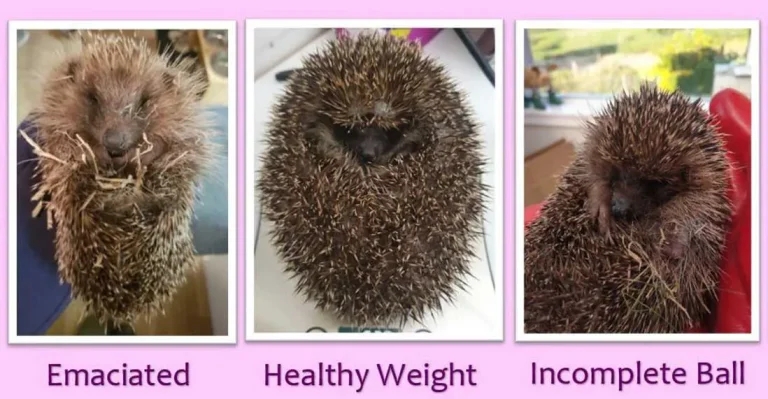
Figure 1. Assessment of body condition using ball shape.
The medical needs and comparative physiology of hedgehogs are frequently misunderstood. Combined with increasing time pressures and limited funding for wildlife care, this can result in suboptimal initial management, with implications for both patient welfare and wider public perception of the profession.
As veterinary teams are often the first point of contact for injured or unwell hedgehogs, effective triage and early decision making can significantly influence clinical outcomes.
With a structured triage approach, many common conditions can be identified promptly, allowing appropriate stabilisation and timely referral to a wildlife rehabilitation centre for ongoing care. Wildlife care can also be invaluable experience for students, providing opportunities for the development of exotic skills and an increased sense of role satisfaction.
An essential part of assessment is understanding the circumstances in which the hedgehog was found. Details recorded by the front of house team should include the location and circumstances in which the hedgehog was found, the time of discovery, and any known or suspected injuries (for example, dog attacks, strimmer injuries). Many practices will already have a wildlife admit sheet, which should include this information.
Hedgehogs that are active during daylight hours warrant clinical attention, even in the absence of obvious injury or disease. Daytime activity is commonly associated with underlying disease, injury or disturbance of the nest. Hedgehogs experiencing pain commonly exhibit behaviours such as increased activity, erratic movement and an apparent inability to settle. Therefore, the time and context of discovery can provide valuable insight when interpreted alongside clinical findings.
Of course, an exception to the rule exists: nesting mothers, often seen in early spring and late summer, will occasionally forage for nesting materials in the daytime. This is made apparent by an active demeanour, running from A to B, and the carrying of twigs, leaves and any other bedding materials in her mouth. In this instance, the client should be instructed to leave the hedgehog alone prior to handling, and to monitor from a distance.
During initial telephone triage, the following findings should be considered indicators for urgent assessment:
First appearances are telling, and it is important to visually inspect the hedgehog as it arrives, taking note of its size, shape, skin and spine condition, and to identify any obvious signs of illness and injury. Body condition scoring can be achieved by assessing the shape of the hedgehog when it is curled into a ball (Figure 1). A hedgehog with an ideal body condition should be evenly rounded, with all limbs secured within the ball. Underweight or emaciated hedgehogs will form a more peanut shape, with a pinch at the “waist”.
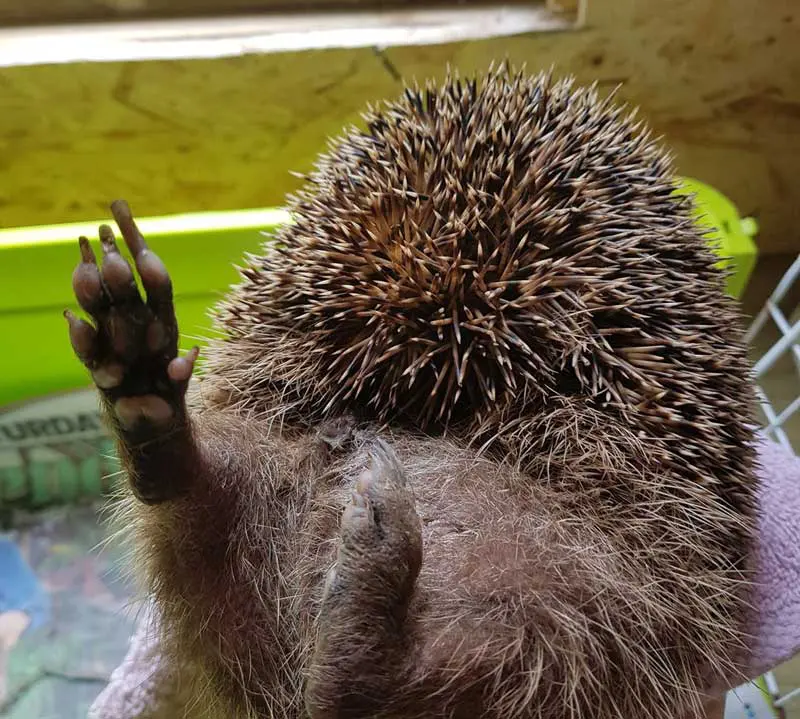
Overweight hedgehogs will be apparent from their overall size and are often unable to form a tight ball with all limbs and face covered. When limb injury has occurred, the limb may partially or completely protrude from the ball (Figure 2).
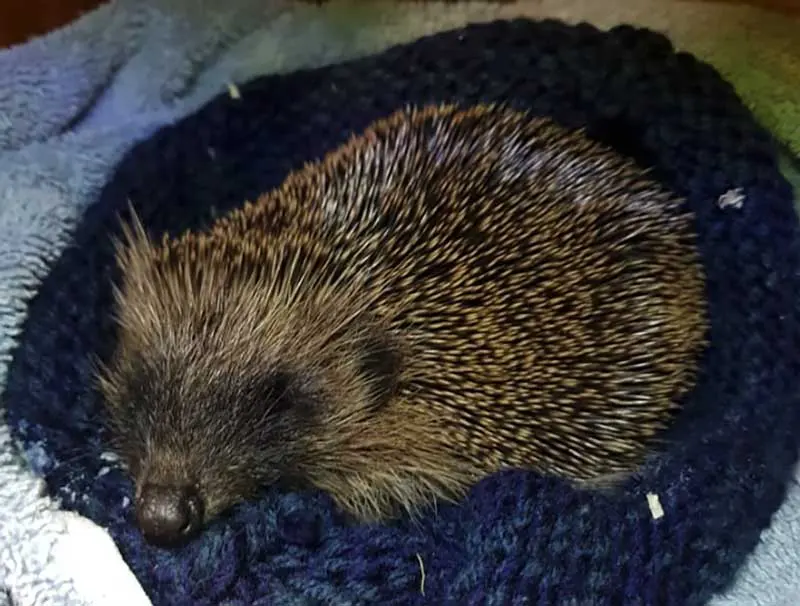
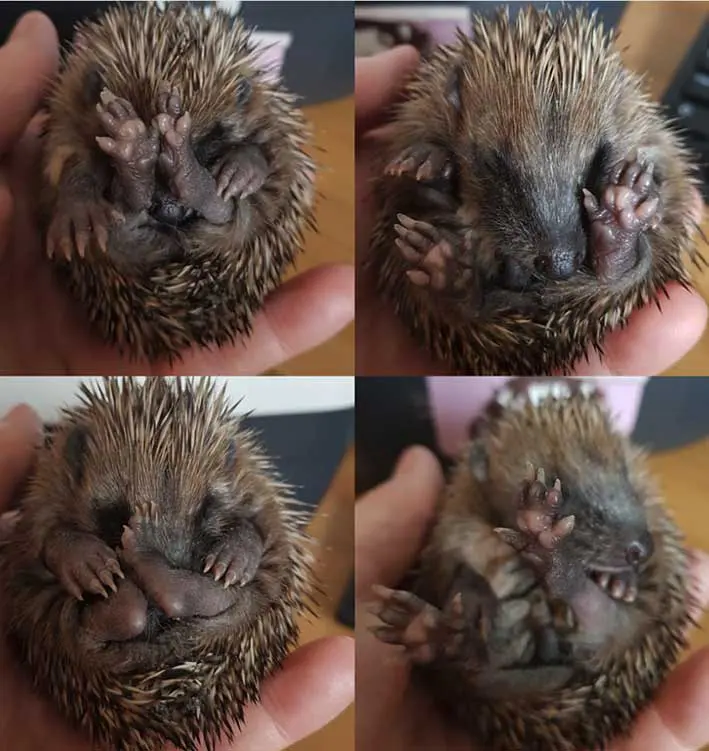
Hedgehogs should form a strong ball when startled, which cannot be easily prised open. Lethargic hedgehogs may still form a weak ball, but not furrow their brow to protect their face. In many cases, severely compromised hedgehogs will not attempt to form a ball and will remain recumbent (Figure 3). Juvenile hedgehogs younger than six weeks of age may struggle to form a complete ball initially, as their muscles need to strengthen, and are often seen with limbs sticking out as they try to settle (Figure 4).
Upon arrival, assessment of the spines and skin should be carried out, checking for hair loss, rashes, wounds, evidence of flystrike, or other parasites such as fleas or ticks. Hedgehogs are generally clean, well-groomed creatures, and medium to heavy flea or tick infestations can be indicative of an underlying condition. Common conditions and parasitic burdens will be covered in the next article in the series.
Determining the age of the hedgehog is not an exact science, but can be estimated based on the size, weight and appearance. Pink-skinned hedgehogs with softer white or intermixed brown spines are neonates, and will require intensive nursing (Figure 5). Neonatal care will be covered in an upcoming article.
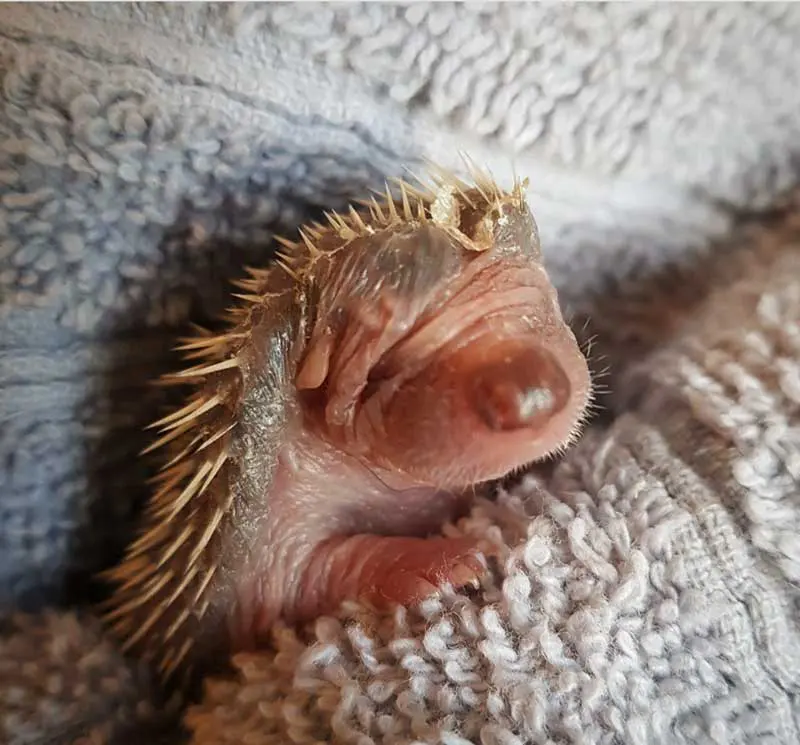
Small, brown hedgehogs that resemble miniature adults, usually around 100g to 400g in weight, are juveniles, born in the most recent spring or late summer months. Adult hedgehogs can reach up to 1.5kg in weight but often average around 600g to 700g. Dentition can occasionally give away the more geriatric hedgehog, as the protruding canines appear worn down, but this cannot give an accurate age.
Hedgehogs do not possess a distinct fight or flight reflex. Instead, they will instinctively defend themselves by rolling into a tight ball, which they can hold for a prolonged time. In a busy, noisy environment, hedgehogs may remain balled from around 30 minutes to an hour.
Before unfurling, you may notice an increased respiration rate, as the hedgehog begins to sniff the air to check for nearby predators. Juvenile hedgehogs are naturally more inquisitive and often only ball up when startled.
Hyperactivity is commonly overlooked and often mistakenly deemed a sign of good health. Hyperactivity, erratic pacing, and climbing with little to no rest is indicative of significant pain. These hedgehogs require urgent assessment and care. In many cases, these hedgehogs may collapse shortly after arrival, once the effects of increased adrenaline from being caught and transported begins to wear off.
On the other hand, a hedgehog that presents as recumbent and lethargic is equally as urgent, often being in the later stages of illness or dyspnoea.
Temperature, pulse and respiration are not commonly measured during triage, often due to the inability to access the underside of the hedgehog; however, they can be valuable in certain circumstances and are certainly worth knowing.
Due to the relative strength of the orbicularis panniculus (the large, powerful muscle that spans the topside of the hedgehog, enabling it to ball up) respiration may not be immediately apparent, and the hedgehog can appear perfectly still. As the hedgehog begins to relax, the respiration rate can be assessed visually and will often range from 20 to 25 breaths per minute. Respiration sounds may be audible in cases of lungworm or pneumonia, often accompanied by nasal discharge and bubbling. This is not to be confused by the hedgehogs growl/warning sound which will be momentary, in response to a stimulus, and accompanied by increased ball tension and erection of the spines across the back.
Open mouth breathing indicates respiratory emergency. The colour of the mucous membranes can be measured via the gums or underside of the paws.
The heart rate of a hedgehog ranges from 200 to 280 beats per minute. If you can easily access the underside to auscultate the heart of a hedgehog, then this is probably more telling of an underlying condition than the measurement itself.
Measuring rectal temperature is not likely to be achievable. The normal body temperature of a hedgehog ranges from 33.5°C to 36.8°C.
Hedgehogs which are preparing for or have undergone torpor (hibernation) will have drastically lowered physiological parameters (a heart rate of around 20bpm, a temperature of around 10°C or less, and a faint breath once maybe every few minutes). Torpor is triggered in the winter months when the nights are consistently colder than 4°C, which will vary between regions. It is important that a state of torpor is recognised and the hedgehog is not deemed dead, and subsequently disposed of.
A balled-up hedgehog can be difficult to fully assess. In the past, it has been suggested that placing the hedgehog face down into a container with shallow warm water in the bottom can shock it into unballing.
Although this can be effective in an emergency, it is not recommended, as significant risk of water inhalation is present – particularly in the more stubborn or anxious hedgehog – and it is not a particularly sporting husbandry technique.
Hedgehogs have poor eyesight, but excellent hearing and are particularly sensitive to rustling and high-pitched sounds such as plastic bags, keys, ultrasonic cleaners, cages banging, tin foil and such. Placing the hedgehog in an area away from these kinds of sounds, without further handling can encourage the hedgehog to relax and unball.
Once unballed, you need to be fast, gentle and efficient when handling to discourage it from balling up again. Start by placing your hands either side of the hedgehog, just behind the elbows, and run them backwards along the skirt (where the fur meets the spine covered skin) towards the back end.
Once you reach the hindlimbs, gently lift the hedgehog’s back end up into a “wheelbarrow” position to inspect the underside, limbs and bottom. Allowing the hedgehog to walk forward as you do this can increase the amount of time it lets you hold it in this position. Take care to inspect under the arms and legs, around the anus, penis or vulva, and along the skirt line, as these areas are commonly afflicted with flystrike, prolapse, or skin infections.
On occasion, a hedgehog may allow you to inspect the mouth by lifting the lips, at least the buccal sides. For more riled hedgehogs, encouraging them to bite on to a 1ml syringe can help you to visualise the teeth more closely; however, in many cases, sedation will be required for a full dental inspection.
To inspect the underside of the hedgehog, place it into a secure, clear container, such as a plastic storage box. Once the hedgehog has unballed, you will then be able to view the limbs and underside without startling it, which can be useful when checking for flystrike, obvious limb injury, and gender.
Genevieve Tomlinson is an RVN, veterinary physiotherapist and wildlife rehabilitator. Outside of clinical practice, she specialises in veterinary communication as a writer and illustrator, translating complex scientific information into engaging, accessible content with a particular interest in anatomy, animal welfare and one health.