
29 Sept 2026
A very special physical congress
Graham Duncanson FRCVS recalls this fantastic event near Hull – when he finally arrived there.

Graham Duncanson
Job Title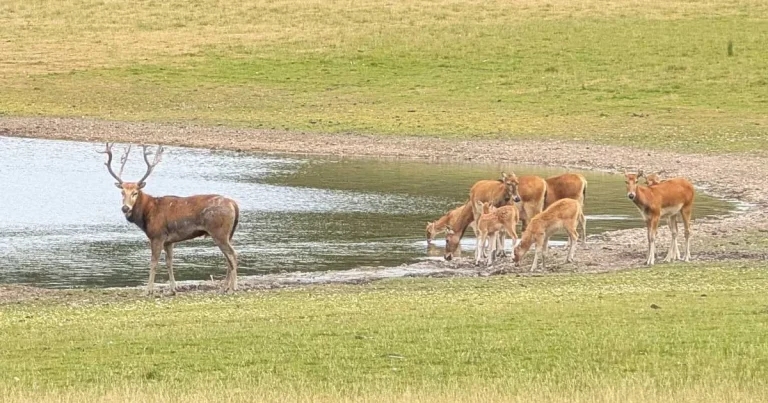
Pere Davids deer.
When I saw the Goat Veterinary Society (GVS) annual congress was at Brough in June, I thought that was the Brough on the A66 near Appleby between Carlisle and Newcastle.
I have a veterinary colleague who lives just north of the border, who I have not seen for more than a year, so I decided to go up to see her. We had a good catch up over a couple of days. When I came to leave, I found that the congress was at Brough near to Hull. So sadly, I missed the afternoon visit to a large goat herd. This farm visit, according to several other delegates, was excellent value.
Venue
The venue was excellent, as was the meal. Being a cautious man, I was wary of using the lift as last year after the meal, six of us spent two-and-a-half hours in the one at the venue in Swindon waiting for an engineer to arrive.
I have a tip for all Vet Times readers. The fire brigade has a ruling that unless there is a “danger to life” they will not attend until the occupants have been stuck for at least four hours. If I had known that I might have been very tempted to lie. I wonder if, in such a situation, the RCVS hearing this type of falsehood would have deemed it unprofessional behaviour?
Lectures
As always, the lectures were of a very high standard. I am very grateful to David Harwood who makes an enormous effort in collecting the presentations into the annual GVS journal. Being an old fool, I tend to miss many salient points that I then find when reading the journal later. I must admit that much of the information I do not reflect upon when I am recording the CPD for the RCVS, but I do try to acknowledge the references when I am writing my textbooks.
After a very quick annual meeting I thought the talk by Graham Fry set the scene with an interesting review of the state of the goat industry. I had always wondered how milk processors can tell if water has been added to the milk. They just record the difference in freezing temperature.
I was very interested to hear Oliver Danel talk from a French man’s perspective on goat keeping. His talk was followed by a very useful presentation by Phillipa Page about nutrition in goat herds in the UK.
I am normally very wary of talks given by medicine suppliers, but I thought Emily Collins-Wingate’s talk was well worthwhile. I have already recommended the use of the barrier cream Ambugreen made by NoBACZ to a friend who has two pet sheep.
Yasmine Cooper was very brave in tackling the very difficult topic of internal parasitism in goats. I listened to her talk with interest. I have worked with hair-sheep and goats kept together in many other parts of the world. It seems as if it is only in the UK where we are so concerned about the dangers.
Karin Mueller always gives excellent lectures on all ruminants and pseudo-ruminants. Her lecture on the goat neurological case was worth four-and-a-half hours of driving to hear. It was most interesting. I will look forward to reading it in this year’s GVS journal.
The final presentation by Phoebe Smythe, a final-year student at the RVC, on the opinions of small herd goat keepers on the role of vets in goat health and husbandry was well worth delaying my onward journey for. As was Vanessa Swinson’s observations on the use of the “Madigan squeeze” in struggling goat kids at parturition, which she passed on to me as we had a final cup of tea. I have used it in suffering foals and calves, but never in small ruminants or pseudo-ruminants. I will certainly try it when an opportunity arises. These interactions between delegates can only occur when one meets other clinicians.
Sadly, virtual congresses are useful, but I am glad the GVS has a physical meeting at least once a year. I will be listening to the virtual meetings scheduled to be held in the first two afternoons in November.
Learning
My learning did not finish then. I had booked in for the joint British Deer Veterinary Association (BDVA) and the British and Irish Association of Zoo and Aquaria (BIAZA). Unfortunately, once again, I had missed the first day of lectures on nutrition, antler biology and disease management of deer, but the second day was brilliant with talks in the morning on culling techniques, CPD and best practices in deer management, planning.
After a very good lunch we all spent the afternoon in the Watatunga Wildlife Reserve in west Norfolk. This was particularly special for me as the reserve contains a bongo, which we saw at close range. I had spent many hard days walking on Mount Kenya, Marsabit Mountain and The Kula Hills trying to find this illusive antelope. I was also delighted to see so many species of deer that I have never seen before, for example, Père-Davids and a Philippine sambar.
- This article appeared in Vet Times (29 September 2026), Volume 56, Issue 39, Page 8
Graham Duncanson has been a veterinary surgeon for 59 years and has had a great life working all over the world. He has two children of whom he is immensely proud, and they have picked two partners who he finds good fun and very interesting. Graham has three grandchildren whom he finds exhausting, but delightful. He goes walking every day. His hobbies are watching rugby, soccer and athletics, writing textbooks and fiction, travelling and attending veterinary clinical meetings.