
24 Mar 2026
Emma Fishbourne BVSc, DBR, BSc, PhD, MRCVS, discusses the latest information on a disease once endemic in the tropics that has now spread much closer to home.

Emma Fishbourne
Job Title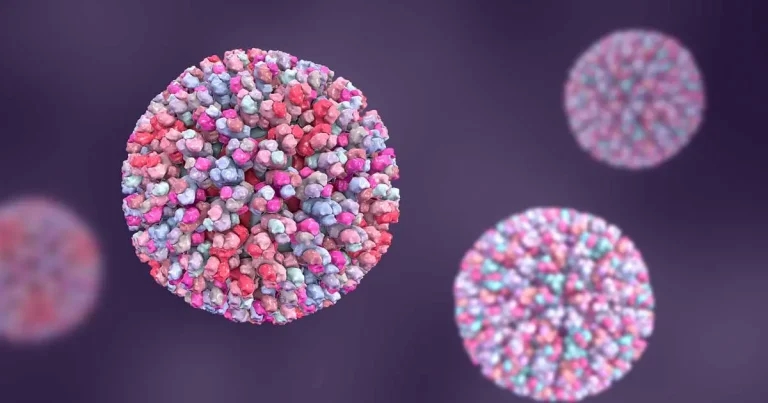
Image: Dr_Microbe / Adobe Stock
The virus that causes bluetongue (BTV) is spread by biting midges, but also movement of infected animals and animal products, and transmission can occur during pregnancy from infected dams to their young.
Biting midges that can transmit BTV are found throughout the UK and can be blown by the wind over long distances. How quickly, and how far, biting midges can spread depends on time of year, weather conditions and distance between farms.
Historically, bluetongue has been endemic in the tropics and subtropics where ideal conditions for the vector exist. In the late 1990s, we began to see outbreaks in the Mediterranean basin and southern Europe before it headed north – most likely due to increasing global temperatures enabling the vectors to survive in new areas (Barua et al, 2025).
Between 2007 and 2010, 58,000 bluetongue outbreaks were reported in 28 European countries. In September 2023, we had the emergence of BTV-3 in the Netherlands and subsequently the UK. Between November 2023 and March 2024, Defra confirmed 126 BTV cases on 73 premises involving 119 cattle and seven sheep.
BTV causes severe haemorrhagic disease in domestic and wild ruminants, and can cause high levels of morbidity and mortality. Cattle have traditionally been considered reservoir hosts and, therefore, are less likely to show the severe clinical signs usually seen in sheep.
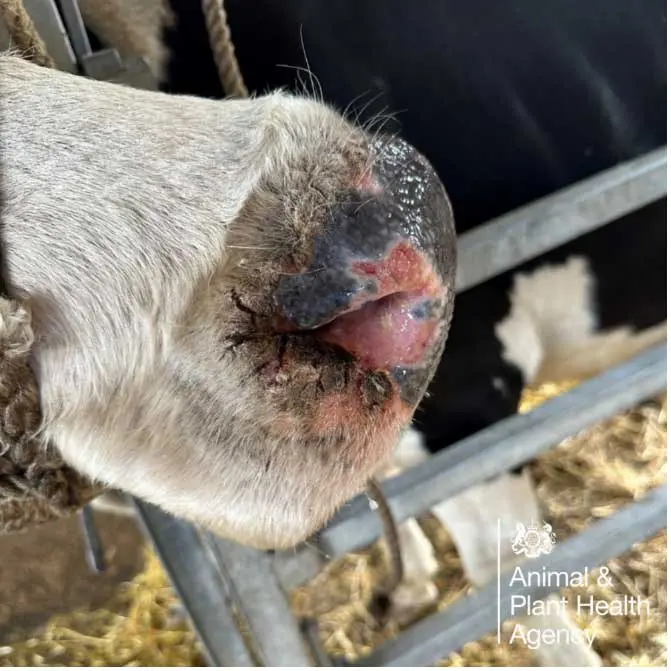
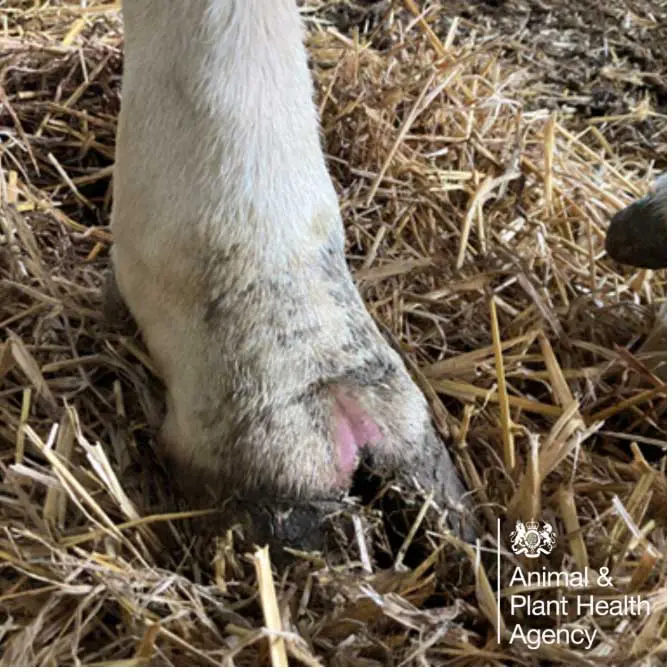
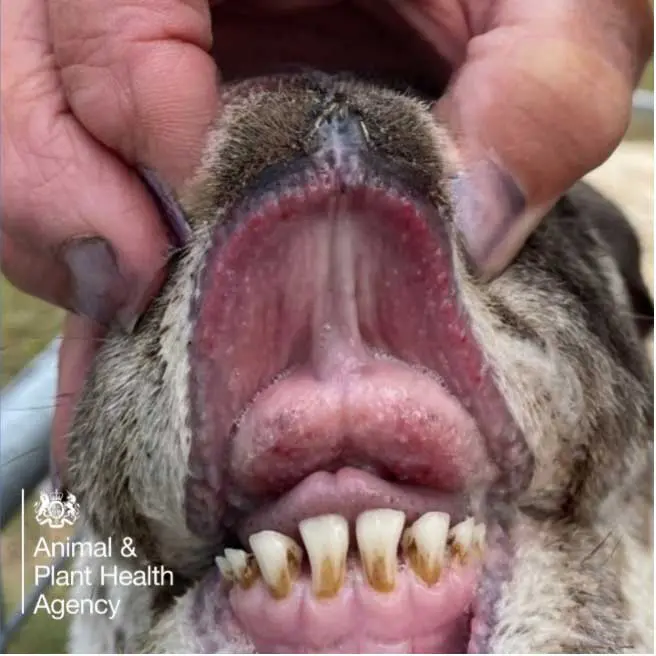
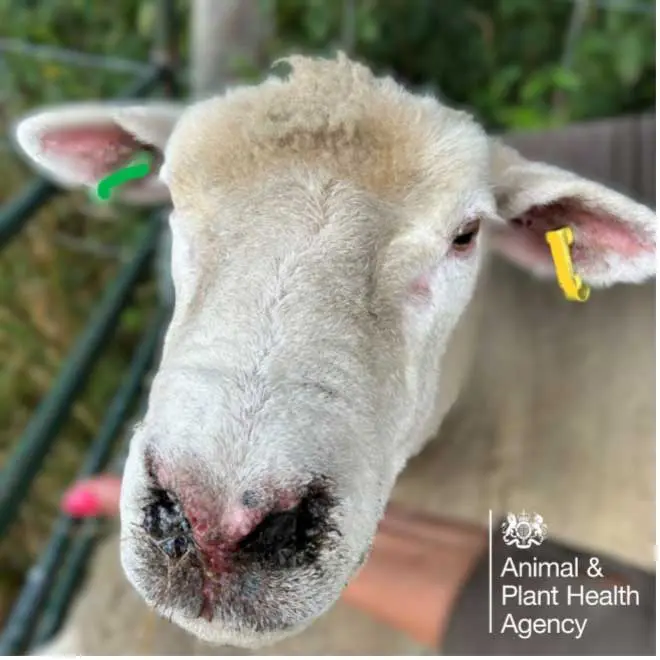
Clinical signs include pyrexia, inappetence, milk drop, hyperaemia of mucosal membranes, lameness, oral and nasal lesions, nasal discharge, and swelling of the face, lips, nose and/or tongue, which can lead to difficulty breathing and drooling, and abortion or deformities in lambs or calves.
In the cases reported so far in the UK in 2026, most have been confirmed following abortions in cattle, with milk drop, dull calves or brain abnormalities in calves. Clinical signs in older cattle include lameness, swollen muzzle and nasal ulcers, which have been reported in two cases. The AHDB website has a useful link to images of bluetongue clinical signs in cattle and sheep, with examples in Figures 1 and 2 for cattle and Figures 3 and 4 for sheep.
Data from the World Animal Health Information System shows the movement of BTV and highlights the growing concern around the effect of increasing global temperatures on the spread of vector-borne diseases more generally into temperate regions.
Vets can also sign up for email updates to keep abreast of emerging diseases. One of particular concern is epizootic haemorrhagic disease virus (EHDV), another vector-borne disease causing similar symptoms to BTV, with more severe disease seen in cattle.
Changes in our weather have also led to an increase in the length of the transmission period for BTV, with biting midges becoming active earlier and continuing their activity later in the year. Other than vaccination, very few control measures have been consistently shown to be effective.
A study in Dutch sheep looking at seroprevalence of BTV-3 and associated risk factors found that flocks kept indoors were less frequently seropositive, and within seropositive farms shearing in the summer (between July and September) was associated with a higher proportion of affected sheep compared to sheep sheared in the winter.
This study also found that using insecticides was not significantly associated with either the farm-level BTV infection status or the percentage of BTV affected sheep, and highlighted that the evidence to support insecticide use has varied in other studies (Santman-Berends et al, 2026).
An added challenge with BTV is more than 36 serotypes have been identified, with vaccines against one serotype offering no protection against another. However, vaccines remain the most effective control measure. It can be confusing, as different sources quote different numbers of serotypes. This is mainly because some of the later serotypes recognised are atypical, with 27 being notifiable. EHDV has multiple serotypes, with seven identified so far (Barua et al, 2025).
Another challenge with BTV and EHDV is that they are segmented RNA viruses. If different strains replicate within the same cell, this can give rise to new strains that may affect vaccine efficacy. We have had a small number of outbreaks in the UK involving two serotypes, but our main concern currently is BTV-3. However, BTV serotypes 1, 4, 8 and 12 have been reported in several European countries (2023-25), posing the risk of further incursions of different serotypes into the UK, and we have also seen a small number of outbreaks with BTV-8 and BTV-12 since August 2024.
EHDV serotype 8 is also circulating in Europe, having thought to have entered via wind-borne midges from Africa. EHDV-8 was first detected in Sicily and Sardinia in October 2022 (Lorusso et al, 2023) and has since spread to Spain, Portugal and France.
In September 2024, the first vaccine in Europe against EHDV was licensed for exceptional use in France. The vaccine, Hepizovac, was provided by a partnership between Ceva and CZ Vaccines.
Three BTV vaccines are available in the UK. These are Bluevac-3 (distributed by Ceva Animal Health), Syvazul BTV 3 (distributed by Virbac UK) and Bultavo 3 (distributed by Boehringer Ingelheim). Vaccine comparison guidelines have been provided (Battle Bluetongue, 2025).
A study looking at the effect of bluetongue serotype vaccines on the probability of viraemia and NSAID usage in 1,114 Dutch dairy cattle herds concluded that herds fully vaccinated (double vaccination) with Bultavo had a significant reduction in the probability of detecting BTV-3 compared to non-vaccinated herds. This study also used NSAID usage as a proxy for morbidity and found a significant increase in NSAID usage in non-vaccinated herds during July, August and September 2024 compared to previous years.
Increased NSAID usage was also seen in vaccinated herds, with a significantly smaller increase seen in herds vaccinated with Bultavo (Everts et al, 2025).
The effect of vaccination for BTV3 in Dutch sheep flocks in 2024 has shown vaccination was associated with a significant reduction in excess mortality in adult sheep and lambs, but mortality was still higher than pre-epidemic baselines. This study acknowledged that the true protective effect of vaccines may have been underestimated and highlighted the importance of the requirement of high-quality data; that is, vaccine registration and the importance of timely access to effective vaccination strategies as being critical to control future incursions (Santman-Berends et al, 2026).
The ruminant health and welfare hub has information for vets including links to useful webinars and recordings (Ruminant Health and Welfare, 2026). AHDB has useful interactive cost calculators to help your clients calculate how much it will cost them to vaccinate and what it could save, and a vaccine decision-making tool to understand risk factors (AHDB, 2026). The same website also has an interactive movements checker tool to help your clients find the correct advice and licensing requirements for moving animals within or across a border within Great Britain.
It is important to stay current with the requirements, as they can change and vary by region. At the time of writing, the whole of England is in a bluetongue restricted zone, and animals can be moved within England without a specific bluetongue licence.
On 10 November 2025, the Welsh government announced an all-Wales BTV-3 restricted zone allowing free movement between England and Wales. In both regions, a specific licence is required, with testing of donor animals before freezing germinal products (semen, ova and embryo). Keepers are responsible for any associated testing costs. Remember, bluetongue is a notifiable animal disease. If you suspect it, you must report it immediately and failure to do so is an offence. You can telephone the Defra Rural Services Helpline on 03000 200 301. In Wales, telephone 0300 303 8268, while in Scotland, contact your local Field Services Office.
Testing for BTV is undertaken at the UK bluetongue national reference laboratory at The Pirbright Institute and is currently funded by the Government through APHA if clinical signs are reported. Private testing is also possible; that is, if producing and freezing germinal products. At the time of writing, discussions were being held about testing and the ability to carry out additional investigations to prevent delays in disease diagnosis for other diseases.
Vets and stakeholders are being urged to support the industry campaign – Battle Bluetongue – which encourages farmers to speak to vets about vaccination. Three key messages are promoted, including assessing the risk using the vaccine calculators and the decision-making tool, safeguarding businesses from restrictions by managing all identified risks on holdings, and defending stock by vaccinating the right animals to reduce transmission and stop the spread.
Having seen bluetongue in a beef suckler cow in 2007-08 when we had BTV-8 in the UK, the author saw the devastating consequences of the disease. She was an older cow with a calf at foot, outside with no prior health concerns. She presented with severe respiratory distress, lameness with coronitis on all four feet and hyperaemia of the oral mucosa and udder, with teat, oral and nasal lesions.
She was a considerable distance from previously reported cases, but did test positive and was subsequently euthanised on welfare grounds. Back in 2007-08, many UK farms did not experience the losses seen on the continent, and the author worries that because of this the impact the disease can have has not been fully recognised.
As a vet, it is made trickier that so many serotypes exist which many clients do not fully understand the implications of. Just because animals have been vaccinated or exposed to one serotype does not mean they are protected against another – even though it is still bluetongue.
The author also worries about animal movements, and it is important clients are made aware of the risks. Multiple movements of animals from the continent into the UK occur. Many clients do not fully appreciate what their purchase may bring with it – especially if animals have moved from different regions within the same country where different serotypes of BTV, or even EHDV, may be present.
For the latest situation, check out Defra’s dedicated pages on GOV.UK. In the UK since August 2024, BTV serotypes 3, 8 and 12 have been identified.
As of 11 March 2026, since July 2025, 318 cases have been reported in Great Britain, 296 of them in England, including 287 cases of BTV-3, two cases of BTV-8 and seven cases of BTV-3 and BTV-8. In Wales, 22 cases of BTV-3 have been reported, five confirmed cases of BTV-3 have been reported in Northern Ireland, and no cases have been reported in Scotland.
Cases reported so far this year have been in cattle herds across England, with cases identified in West Sussex and East Sussex, Greater London, Cornwall, Devon, Shropshire, Cheshire, Kent, Lancashire, Derbyshire, Staffordshire, Oxfordshire and Cumbria.
Unfortunately, it looks as though we are going to have to learn to live with BTV, and vaccination is crucial to help control the disease. We need to ensure our clients are properly informed to help them make decisions to protect their flocks and herds, and we need to be aware of changing clinical signs which may suggest new incursions of BTV or even EHDV or a recombination event.
Emma Fishbourne has a wide range of research interests including ruminant nutrition, fertility, animal behaviour and infectious diseases. Emma graduated from the University of Liverpool in 2002 after doing an extra year at the University of Leeds on nutrition and a project at The Pirbright Institute on rinderpest. After graduation, she went straight into farm practice in the midlands before moving down south to continue working with livestock. Emma returned to Pirbright to complete a PhD on African swine fever and, after finishing, went into farm practice in the south-west. After a few years, she returned to Pirbright, working with commercial companies and overseas governments before coming back to Liverpool, where she is senior farm animal lecturer.