
6 Oct 2026
David Charles CertHE(Biol), BVSc, CertAVP(Sheep), PGCertVPS, MRCVS discusses transition period interventions and assessments that can impact the incidence of this issue.

David Charles
Job Title
Image: Oliver / Adobe Stock
The majority of bovine metabolic disorders present clinically within the first four weeks after calving and, for that reason, may often be referred to as “transition cow diseases”.
However, the true definition of “transition cow diseases” has a wider remit than just metabolic disorders, as infectious conditions such as metritis should also be considered transition cow diseases. As this article will show, though, many of the infectious transition cow diseases have metabolic origins. The notable exception to this window would be hypermagnesaemia – colloquially known as “grass staggers”.
The major metabolic disorders can have wide-ranging and long-lasting impact at both the individual and the cow level – impacting animal health, milk yields, calf health and farm business profitability.
This article will consider practical approaches to the screening, detection and management of metabolic disorders on-farm, before concluding with some practical tips and approaches to reducing the impact of metabolic disorders on-farm.
The impact of transition cow diseases is vast, with one-third of dairy cows having at least one clinical disease (metabolic and/or infectious) and more than half having at least one case of subclinical disease within the first 90 days (Caixeta and Omontese, 2021).
Borchardt (2023) found the average cost of a transition cow disease (excluding mastitis) to be £457.80/affected cow – a cost that most farm businesses cannot afford to keep having to pay. With recent cost-of-living prices, high inflation and increased cull cow prices, the 2026 equivalent value is expected to be much higher.
Broadly, we can detect these cows using two ways: “before the event” or “after the event”.
Table 1 shows some of the methods of detection implemented at farm and vet level, while some farms will take a blanket approach and prophylactically treat all cows at a defined stage of the production system (for example, all cows receiving exogenous calcium following a vet-led protocol to reduce the risk of hypocalcaemia).
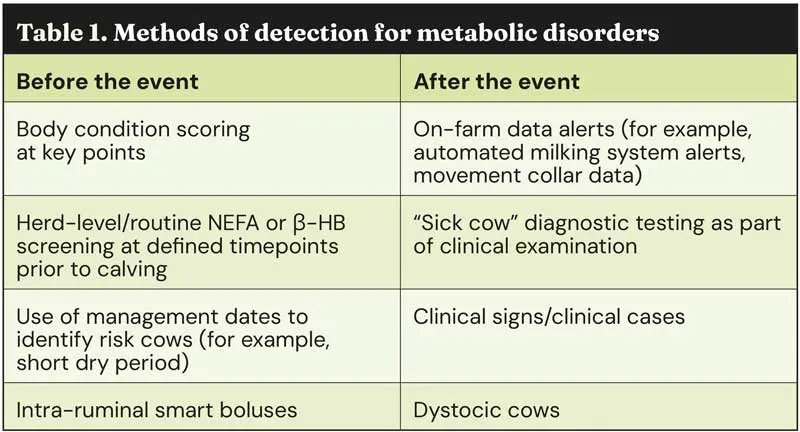
If a shift away from “after the event” detection to “before the event” detection can be implemented then economic impact, clinical and subclinical disease prevalence can be reduced.
It is important for both vets and their clients to remember that when considering metabolic disorders, more is at stake than the individual sick cows that may present for treatment.
The impact of metabolic disorders are widespread; the following paragraphs summarise their impact on calf health, milk yield, and fertility.
Clinical or subclinical ketosis and hypocalcaemia have both been shown to reduce the quality and quantity of colostrum. When more than 80% of IgG is provided to calves from colostrum, the impact on calf health is vast: one 2024 study demonstrated that calves with serum IgG of more than 25g/L at seven days of age were 82% less likely to die than those with “poor” IgG (defined as less than 10g/L; Pereira et al, 2024).
It will not be a surprise to practitioners or dairy farmers that milk yield is impacted by metabolic disorders. Often, reduced milk yield triggers further investigations that lead to detection of metabolic disorder. Research lately has sought to quantify this, showcasing that hypocalcaemia reduced yields by 2.19kg/d to 3.2kg/d; increased serum non-esterified fatty acid (NEFA) concentration drove mammary cellular apoptosis reducing yields; and retained fetal membrane-related losses exceed £220 per affected cow (Borchardt, 2023; Liang et al, 2017; McArt and Neves, 2020; Venjakob et al, 2018).
A third area that is notably impacted by metabolic disorders is fertility. Cows with subclinical hypocalcaemia (SCH) have an average of 9% lower conception to first service rates, and were found to be 5.3% less likely to be pregnant at 150 days in milk (DIM), averaging 16 days longer to positive pregnancy diagnosis than their normocalcaemic counterparts in Seely and McArt’s (2023) study involving 697 dairy cows across four farms.
Subclinical ketosis also impacts fertility, with affected cows 4.3 times less likely to conceive to first service; delayed time to display observable oestrus activity; and an average of 10 days longer to first service. Using an average cost of £5/cow/empty day after the voluntary wait period, the economic impact of metabolic disorders on fertility is clear.
Of course, the three areas described are not the only ways by which metabolic disorders affect dairy farms: culling risk increases with incidence of metabolic disorders, and more widespread economic impacts occur including treatment/veterinary costs (estimated at 21% to 25% of costs; Borchardt, 2023) and time/labour costs, to name two.
However, the problem is one that self-perpetuates, as cows affected by a metabolic disorder have increased risk of other transition cow diseases.
During the transition phase, cows experience an increase in energy demand, changes in the ruminal microbiome and function, ethological changes due to pressures of entering or re-entering the milking herd, and, as colostrum begins to be produced, a significant increase in calcium requirements (as high as 525% compared with dry cow requirements).
Changes to the rumen during the transition period have a vast impact on the cow’s ability to manage the increased energy demands. As cows move back on to the total mixed ration or lactating cow diet, stressors of calving, dystocia, surgical intervention or even just entering the milking herd can reduce dry matter intake and negatively impact the ruminal microbiome. Additionally, the ruminal surface area impacts directly the absorption of volatile fatty acids (VFAs).
Dry cows average a 19% lower ruminal surface area than cows in the milking herd (Dieho et al, 2016), due to dry-cow diets often providing fewer VFAs. Therefore, the cow quickly requires an extra 20% ruminal surface area to reduce the risk of entering a state of negative energy balance, and this can be manipulated through the use of the “close-up” dry-cow diet as a way to provide high energy, high forage and some concentrates to increase VFA availability and, therefore, increase ruminal papillae surface area. Targeting 115MJ ME/day to 120MJ ME/day, 40% fibre and 13% to 14% crude protein provides a useful starting point to work from.
A role for magnesium butyrate may exist in the transition cow diet, with claims that using 150g of a 70% magnesium butyrate product increases ruminal epithelial blood flow, rumen wall surface area, and the number of ruminal VFA transport proteins. The author has no experience with such a product; however, results of a small-scale trial (Fébel et al, 2023) were promising, although larger trials are needed.
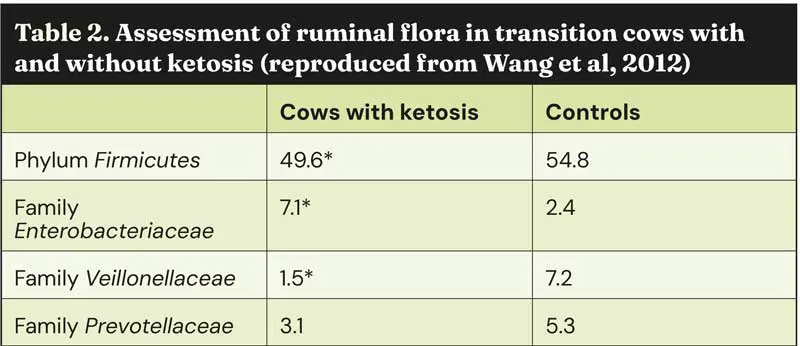
Considering the information regarding the rumen of transition cows, it is no surprise to see that cows with ketosis are in a state of ruminal dysbiosis.
Herd-level screening is as close to “asking the cows” as we can get. Learning how to read or understand what the transition cow is telling us, and then picking an appropriate outcome and using this data to inform policies and protocols, is an essential tool to aid and assist our clients in reducing the risk of metabolic disorders.
Not all screening has to be invasive or expensive; Table 3 details useful screening tools and tests for use in the all-year-round dairy herd, alongside suggested timings for the screening.
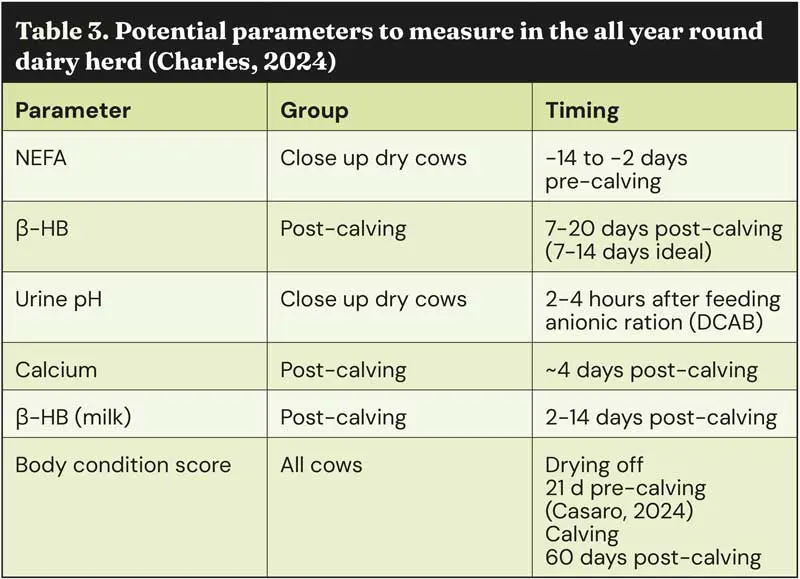
NEFA targets should be less than 0.35mmol/l pre-calving and less than 0.6mmol/l post-calving. Cows with higher serum NEFA concentration have greater risk of cell death, and increased IL-1β concentration at calving drives an increase in pro-inflammatory cytokine release.
Urine pH is an often underutilised on-farm test; target pH two to four hours after feeding an anionic ration is 6.0 to 6.5. A mild metabolic acidosis mobilises calcium from the bone pool into the circulating pool, reducing the risk of hypocalcaemia, whereas a mild metabolic alkalosis does not trigger the same effect – leaving calcium locked away.
Research (McArt and Neves, 2020; Seely, 2026) has shown that assessing dyscalcaemia (low blood calcium at 4 DIM) is more useful for predicting herd-level impact and risk than calcium 0 to 1 DIM (as some of these cows will have a desired transient SCH, whereas a dyscalcaemic cow has a persistent or delayed SCH). It is these dyscalcaemic cows that are more than twice as likely to experience an adverse event (one or more of hyperketonaemia, metritis, displaced abomasum or herd removal diagnosis) compared to normocalcaemic cows.
An inverse relationship exists between serum calcium concentration and serum β-HB concentration, which is reflected by the fact that cows with SCH are 5.5 times more likely to suffer ketosis.
We are learning more and more about the impact of maintaining a “good” body condition score (BCS) in the periparturient period. Average daily milk yield during the first 28 days of lactation is strongly associated with BCS measured 21 days before calving, with peak performance observed at a pre-calving BCS of approximately 3.5. Casaro et al (2024) showed milk yield declines progressively in cows with higher BCS, highlighting the importance of achieving an optimal body condition before calving. Cows with a BCS of 4.0 or more are often already in negative energy balance from as early as 21 days pre-calving, indicating that excessive body condition increases metabolic risk before parturition.
The difference in milk yield between cows with a BCS of 3.5 and those with a BCS of 4.5 is approximately 4.4kg/day, equating to around 116kg less milk over the first 28 days of lactation (Casaro et al, 2024).
The economic and production benefits of maintaining cows at an optimal BCS before calving are clear. When cows enter the transition period or calve over-conditioned, timely nutritional and management interventions at calving become increasingly important to help mitigate negative energy balance and recover potential production losses. Regular and reliable BCS assessment at (as a minimum) the intervals stated in Table 3 are essential on-farm screening steps.
Risk of metabolic disorder increases with age – especially from third parity onwards. For hypocalcaemia, the risk increases 9% per year after third lactation with an age-related loss of calcium channels and vitamin D receptors in the gut. Additionally, it is known that peak yield is hit later in life and, therefore, milk-related calcium demands increase, too.
For ketosis, the risk increase per year is similar at 8.8% increase per year, with some researchers hypothesising this is due to concurrent gestation and lactation occurring for each gestational period after the first. Gestation and lactational periods overlapping increase energy demand, and those cows with a short dry period see the greatest impact of this and an associated additional increase in risk of ketosis.
Each cow and each transition period is different, and one approach does not fit every cow. However, considering the changes that occur in the transition period, and using the information from screening and on-farm assessments, can allow protocols and defining criteria to be established to reduce risks and aid the selection of an appropriate intervention.
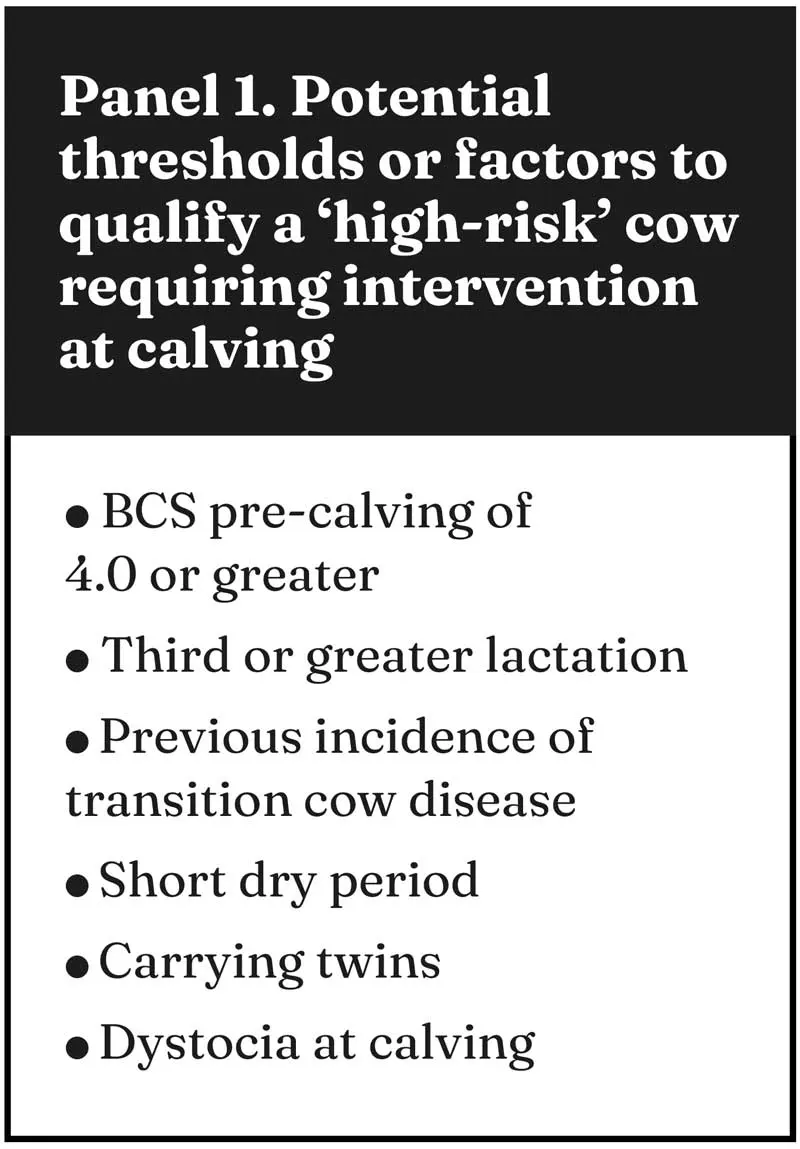
“At risk” cows may be defined by a number of factors, but those in Panel 1 would be prudent to consider. For these “at risk” cows, supplementation of exogenous calcium at calving, post-calving oral fluids alongside propionate and yeast to benefit the ruminal microbiome, and a drench providing glucose precursors would be beneficial in reducing the risk of hypocalcaemia and clinical or subclinical ketosis.
For cows of third lactation or greater that are in an appropriate BCS, with no history of transition cow diseases, exogenous calcium at calving will still be beneficial. However, it is important to consider that only products providing 50g or more of elemental calcium (such as the calcium component of the calcium salts exceeds 50g, not that there is 50g of a calcium salt provided) will increase serum calcium concentration. Also, consider which calcium salt is provided; some salts such as calcium chloride will not provide a sustained increase in serum calcium concentration, while others such as calcium propionate have the added benefit of providing a glucose precursor alongside the ability to provide a sustained increase in serum calcium concentration.
Clients should be advised not to provide intravenous exogenous calcium after calving; it will increase the serum concentration but in a short-lived way, and will not encourage the uptake of calcium from the diet nor mobilisation from the bone pool.
The risk of a rebound hypocalcaemia is high. Oral calcium provides the best route to supplement exogenous calcium after calving; coupling this with oral fluids will help correct calving-associated dehydration.
If regular post-calving NEFA or β-HB monitoring is implemented, the results should be reviewed at individual and herd level. If a 12-cow screen presents more than 40% cows with hyperketonaemia, then blanket intervention of all cows post-calving should be implemented (for example, glucose precursor-containing product for all cows post-calving, and for cows fourth lactation and greater, also exogenous calcium and oral fluids) until an urgent ration review can be conducted and changes made to the transition cow diet.
As practitioners, we need to ensure that we support clients’ enterprises by seeing the bigger picture, as well as the individual animals presented to us. This often means taking a step back and bringing all stakeholders together for a herd health or farm-level review. To drive change for transition cows and reduce metabolic disorders, it takes the whole team – not just the business owner and the vet. You need to engage with all the stakeholders: the entire farm team (you need the people doing the doing just as much as those making the decisions), the nutritionist and feed company, the team who serve the cows, practice vet techs, and so forth. And, importantly, a review should not just look at records of clinical disease, but also consider trends or changes in fertility, milk yield, calf health or IgG assessments – to pick up herd impacts of subclinical disease as well as clinical cases.
Take a farm walk with the nutritionist and the farm team to bridge the gap between the ration formulated and the sheet and the food that actually goes into the cows. Consider sorting, push up, the surface below the feedface, storage, moisture content, water exposure, and ensure a really dynamic look at the ration being presented. Look at what is left behind for tell tale signs, too.
Metabolic disorders are intrinsically linked to nutrition, so it is good practice that alongside screening done routinely, as per Table 2, to also do a blood screen two weeks after any major ration change.
Dairy Herd Health and Productivity Service recommends 17 cows with:
Additionally, fat:protein ratios, BCS changes, incidence of disease, medicines records, surgical records are all useful tools to record and monitor. However, data should then be utilised as the basis for conversations and changes where appropriate. Data that is collected but then not used is one of the leading causes of frustration with data collection in any system.
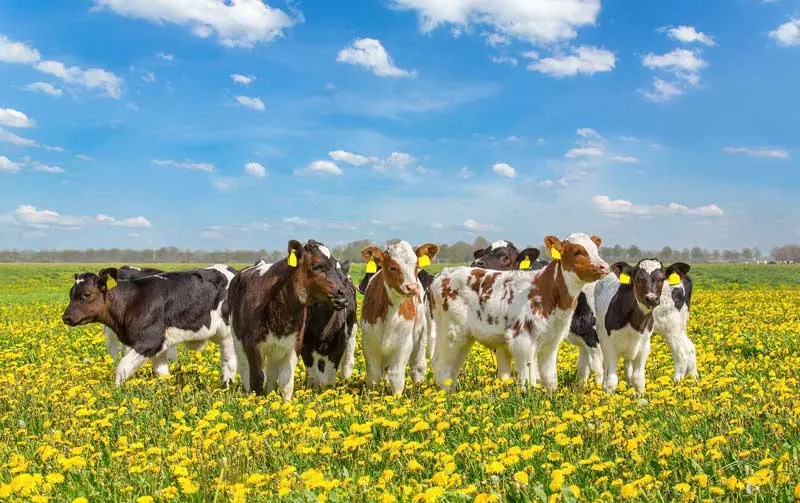
Metabolic disorders and transition cow diseases are not single-cow problems. It is important for practitioners to work with their clients to review transition cow health and management at a herd-level to reduce the occurrence of metabolic disorders.
Implementing appropriate screening and monitoring, alongside clear protocols driven by the results of these tests, can aid cow health and welfare, herd productivity and business profitability.
David Charles is an experienced livestock vet and an RCVS-recognised advanced practitioner in sheep health and production, one of just eight vets to hold such status. David now splits his time between NoBACZ Healthcare (as its international business development manager) and independent veterinary consultancy (with clients including farms, animal health companies, and educational institutions). He is a trustee of RCVS Knowledge, a ROSA advisor, and on the committee for Sheep Veterinary Society and the editorial board of UK-Vet Livestock journal. He was a member of the inaugural LVS30Under30. He was named the BVA Young Vet of the Year (2024).