
22 Sept 2026
Eleanora Po DVM, MSc, DipACVIM(LA), MRCVS, Phil Elkins BVM&S, CertAVP(Cattle), MRCVS and Michael Jarvis PhD provide an overview of calf populations at risk from the multifactorial disease in the UK, US and India.
Image: Seventyfour / Adobe Stock
Bovine respiratory disease (BRD) is a multifactorial disease associated with high calf morbidity and mortality across the globe.
Although the disease spans all geographies, differences in calf-rearing systems shape risk profiles across countries.
Herein, we provide an overview of calf populations at risk from BRD in the UK, the US and in the country with the largest cattle population, India.
In practice, BRD risk in the UK arises from two distinct management systems, dairy and beef, which create two epidemiological windows of exposure.
In dairy systems, calves are separated from their mothers within 24 to 48 hours and then artificially fed milk for 6 to 8 weeks until weaned.
During this period, calves are commonly group-housed, increasing their exposure to BRD pathogens and creating conditions conducive to their spread. Since calves have just received colostrum from their mothers, provided it is of good quality, they have maternally derived antibodies (MDA) against BRD pathogens (maternal immunity arising from vaccination, natural exposure or a combination of both). MDA provides partial protection during the first weeks of life, but wanes progressively and can interfere with vaccine responses, complicating early life vaccination strategies.
Understanding of the complex aetiology of BRD has evolved over time. In many cases, BRD is thought to be primed by a viral infection, such as bovine respiratory syncytial virus (BRSV), bovine herpesvirus 1, bovine parainfluenza virus type-3 , bovine coronavirus and bovine viral diarrhoea virus, followed by bacterial pneumonia.
If we use BRSV, a key viral priming agent, as an example, we can see the primary issues with BRD vaccination in this young calf population. Systemic administration (that is, through injection) of current commercial vaccines (killed or modified-live BRSV vaccines) can fail to provide robust protection in the presence of MDA.
A workaround has been nasal administration, which appears less susceptible to MDA interference, but has the downside of providing only short-lived immunity (around three months). For example, Nasym, a modified-live vaccine produced by Hipra, is approved for calves from 9 days of age via the nasal route, but only for calves older than 10 weeks when given parenterally1.
The second distinct cattle population within the UK is the beef cow-calf system2. In beef cattle, calves stay with their mothers until they are naturally weaned at five to eight months of age. Although calves continue to suckle, systemic antibody transfer occurs primarily from the initial colostrum bolus during the first 24 to 48 hours after birth.
These calves, therefore, have a profile similar to dairy calves, with high MDA levels that wane progressively over weeks to months. In the early days, BRD is generally less of an issue than in dairy calves, as beef calves are not in an environment conducive to BRD pathogen spread; they are typically out on pasture with their mothers. Instead, BRD incidence in beef cattle spikes at weaning (five to eight months), coinciding with heightened stress and increased mixing of animals as they are shipped and co-housed. Hence, the common name of BRD in the US as “shipping disease”.
In these older calves, MDA is less of a constraint for BRD vaccination. Rather, the strength and durability of protection become important, as a proportion of these animals – termed store cattle – are moved on to finishing farms for four to eight months (depending on the finishing system).
The beef system is considerably fragmented in the UK, with weaned calves either retained for on-farm finishing, which is associated with lower BRD risk, or sold as store cattle. The key BRD window of high morbidity and mortality in these animals is 30 to 60 days after arrival at the finishing location.
As a further level of complexity within the UK cattle rearing system, the division between dairy and beef systems is not clear-cut, with considerable crossover, as a large fraction of beef cattle are dairy-beef crosses or dairy-derived (male dairy calves and beef-cross calves from dairy herds). Similar to all dairy calves, these animals are artificially reared in group housing rather than suckled, resulting in their exposure to the early MDA risk of dairy calves and the later post-weaning risk window of beef cattle.
Given an absence of facilities at most dairies for on-farm fattening, most of the dairy-beef calves experience an additional early window of exposure through shipment to fattening farms and auction markets between 10 to 21 days of age2. Based on these systems, BRD should not be viewed as a single problem, but rather as two distinct timing problems created by differing management systems: an early life immunological window (MDA interference) and post-weaning stress amplification.
Regarding the number of animals susceptible to BRD in the UK (Table 1), based on 2025 government data, an around 3.14 million breeding herd is divided across approximately 1.85 million dairy and around 1.29 million beef-breeding females3. Assuming these breeding females produce on average approximately 0.85 to 0.90 calves per year, acknowledging that this value can be lower in some dairy herds, this amounts to 2.7 to 2.8 million calves annually. This represents an annual calf cohort derived from breeding females and annual calf output, rather than a point-in-time census.
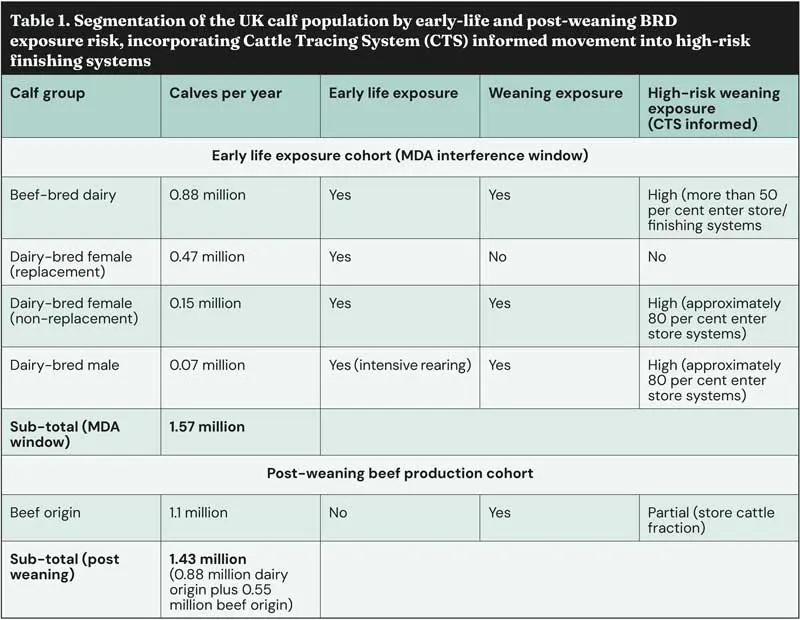
Based on the same 0.85 to 0.90 calves per year, this corresponds to an annual flow of 1.57 million dairy-origin calves and 1.1 million beef-origin calves. Layered on top of this is the increasing proportion of beef-bred calves born to dairy dams, reflecting the deliberate and increasing use of beef semen in dairy herds, which now directs the majority of calves from dairy herds (56% in 2023)4, or 0.88 million animals, into beef production. This leaves the remaining 44%, or 0.69 million calves, as dairy-bred calves.
Assuming these are generated predominantly using sexed semen with a 90% female bias, this corresponds to 0.62 million female dairy calves and 0.07 million male dairy calves. Since only around 30% of calves born to dairy dams are required for replacement, corresponding to 0.47M animals, this leaves 0.15 million dairy heifers and all 0.07 million male dairy calves destined for beef production. In total, this corresponds to 0.22M dairy-bred calves entering calf-rearing and beef production pathways; however, this should be regarded as an upper limit as most of the female dairy-bred calves that do not enter the dairy herd are those lost due to significant morbidity or mortality, primarily from diarrhoeal scour and BRD.
These changes in the UK dairy breeding programme have resulted in a growing population of calves that experience both early life exposure typical of dairy systems and later post-weaning exposure typical of beef production.
Bringing these numbers together, the UK cattle system now includes an annual flow of approximately 0.62 million female dairy-bred and 0.07 million male dairy-bred calves, 0.88 million beef-bred calves born to dairy dams and 1.1 million calves originating from the beef herd.
The final layer is the proportion of beef-bred dairy calves and beef-origin calves that enter the store cattle system, where animals are sold on to finishing units and experience increased exposure to BRD pathogens in environments characterised by transport, complex animal mixing and housing conditions conducive to pathogen transmission.
Due to limited resources for finishing calves destined for the beef supply on dairies, the vast majority (around 80%) of these calves enter the store cattle system5. A lower, but still substantial, proportion (more than 50%) of beef-bred calves also move through this pathway.
These data allow estimation of the UK calf population exposed to two major BRD risk windows: the early-life MDA-interference window affecting approximately 1.57 million dairy-origin calves annually, and the post-weaning stress and commingling window affecting approximately 1.43 million calves entering beef production systems. These estimates focus on the nascent calf population; the 3.14 million breeding stock represent an additional annual population with differing exposure profiles.
If this framework is expanded to additional geographies, the impact of BRD becomes apparent across much larger cattle populations, reflecting regional differences in herd management.
Compared to the UK, the populations at risk in the USA are around 10-fold higher. Based on USDA 2025 figures6, a breeding herd of approximately 38.1 million cows produced approximately 33.1 million calves, apportioned to around 8.2 million dairy calves and around 24.9 beef calves based on the relative sizes of the national dairy and beef cow inventories.
Dairy calves in the US are managed in a manner broadly similar to that in the UK, with early separation from the mother and group housing during the milk-feeding period. As a result, essentially all of the approximate 8.2 million dairy calves enter the MDA window, where interference with vaccine responses can complicate early-life vaccination.
Beef calves are managed differently in the US than in the UK. Most are raised on pasture with the mother until weaning, after which approximately 70% to 80% enter feedlot production systems, broadly analogous to the UK store cattle pathway, resulting in approximately 18.7 million beef calves entering feedlot systems post-weaning, where transport stress, commingling and environmental pressures create a well-recognised window for BRD outbreaks.
To help ameliorate the impact of the feedlot environment, multiple procedures have been implemented, including heightened attentiveness to BRD symptomology using state-of-the-art technology, handling of animals in ways to minimise stress, all combined with rapid treatment and isolation of BRD-affected animals7,8,9. The remaining approximately 6 to 7 million calves remain in lower-intensity systems, including grass-finished animals and breeding replacements, with a lower associated BRD risk.
Similar to the situation in the UK, although with notable differences, especially in the management of beef calves, the US system represents distinct epidemiological settings for BRD.
While post-weaning feedlot systems account for a large proportion of BRD morbidity, the principal vaccine gap remains the early life window, where MDA limit the effectiveness of conventional vaccination approaches.
India has the largest cattle population, at 193.46 million, with 145.91 million female cattle10. In contrast to Western cattle industries, where reproductive management typically targets close to one calf per cow per year, cattle in India are predominantly maintained within smallholder dairy systems characterised by longer calving intervals11. As a consequence, the effective annual calving rate is lower than in Western cattle production systems.
Applying a conservative reproductive rate consistent with these longer calving intervals, the annual cattle calf crop in India is an upper estimate of approximately 100 million calves per year.
Unlike the cattle industries of the UK or US, where dairy and beef production systems create distinct epidemiological windows for BRD exposure, cattle in India are predominantly maintained within smallholder dairy or mixed-use systems. Consequently, the susceptible population is concentrated primarily in the early life MDA calf cohort, rather than being divided between early life dairy calves and post-weaning beef animals.
In summary, regardless of geography, a consistent pattern emerges: BRD risk is structured around distinct temporal windows, with early-life MDA interference representing a persistent and globally relevant constraint for effective vaccination.
Eleanora Po is a farm animal clinician in the Department of Veterinary Medicine at the University of Cambridge, where she is associate professor in farm animal medicine and production.
Michael Jarvis is professor of immunology and virology at the University of Plymouth and technical founder and chief scientific officer of The Vaccine Group. His research spans herpesvirus biology, viral-vector vaccine development and livestock infectious disease. His current research focus includes developing vaccines for bovine respiratory disease, particularly for calves in the presence of maternally derived antibodies.
Phil Elkins qualified in 2005 from The University of Edinburgh and, following stints in Cheshire and New Zealand, spent the majority of his career in clinical practice in Cornwall, during which time he gained a certificate in advanced veterinary practice in cattle. Following 15 years in clinical practice and a stint working for an agri-tech company, Phil now works as an independent consultant to both farms and industry bodies.