
01 April 2026
Boehringer Ingelheim offer a look at the well-established schemes for BVD control, current prevalence and testing, and control measures.

How well do you know what your clients think and do around BVD control? The well-established schemes in Scotland, Wales and Northern Ireland set out testing, movement and culling policy, but don’t give guidance on vaccination which, in a cattle-dense nation such as the UK, is often a vital element of success. In England testing and veterinary advice can be sought and funded through the animal health and welfare pathway but eradication is yet to become mandatory.
Bovela®, the market-leading BVD vaccine, offers a simple single primary dose and booster regime, key features which make it user-friendly for farmers and something that many producers cite as their main reason for choosing it, after chatting through options with their vet1.
In all four nations, the most common reasons behind an “unexplained” BVD breakdown in a herd, are breaches to biosecurity and preventive measures. This could be missing a tag and test, inadequate testing or quarantine when bringing stock onto the farm, nose-to-nose contact with neighbouring stock or not sticking to vaccine timings of the more complex dead BVD vaccine that is available.
Having a BVD control plan on-farm, as dictated by national schemes in some areas, and ensuring vaccination is in-place is the best way to protect stock . Striving for a naive, unvaccinated herd, given what we know about the spread of the virus, is a very risky strategy. Incursion of BVD into such a herd can have devastating clinical and production effects.
The video gives an at-a-glance look at how BVD can spread.
In February 2026, Defra opened a consultation under England’s Animal Health and Welfare Pathway looking at moving from voluntary guidelines to mandating key aspects of the scheme, including being part of a new BVD eradication scheme as well as requiring producers to have annual veterinary reviews.
Anyone in England from producers to vets and academics to those involved with farm assurance schemes can participate in the consultation by visiting Defra’s Animal Health and Welfare Pathway website.
The 2024 National BVD Survey gathered responses from 673 cattle farmers across England, Wales, Scotland and Northern Ireland, representing approximately 65,000 dairy cows, 22,000 beef cows and 90,000 youngstock. The findings provided an updated picture of BVD incidence, biosecurity practices, testing approaches and vaccination habits across the UK.
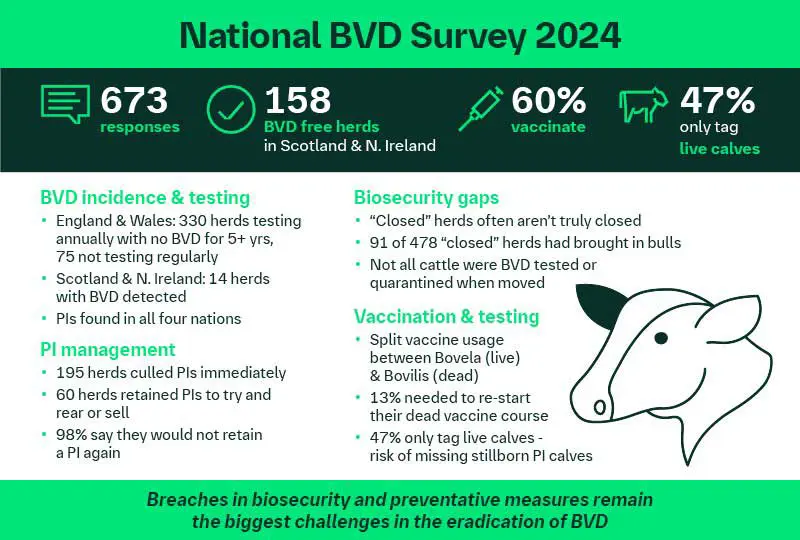
In England and Wales, where testing remains voluntary, 330 herds reported being free of BVD for more than five years. However, 75 herds said they were not testing regularly. Scotland and Northern Ireland, both operating mandatory schemes, reported 158 herds with confirmed BVD‑free status and 14 that had found evidence of BVD infection.
Persistently infected (PI) animals continued to be found across all four nations. England recorded the highest number at 53. A number of herds reported evidence of BVD without identifying a PI, most likely reflecting gaps in PI hunting or the presence of transient infection.
Biosecurity weaknesses remained a recurring theme. Although 478 respondents described their herds as closed, 350 of these still brought animals on to their farms.
Of the 673 respondents 189 bought bulls in. Concerningly, 91 of the herds that purchased bulls still identified as closed. In many cases, quarantine and testing behaviours did not align with cattle movements, leaving clear opportunities for BVD introduction.
Approaches to PI animals varied widely. A total of 195 herds reported that they culled PIs immediately, in line with recommended practice. Sixty herds had retained PIs in the past, often because the animals appeared outwardly healthy or because farmers were unsure about the accuracy of test results. Eleven farms knowingly sold PI animals, contributing to wider national risk.
Encouragingly, 98% of farmers who had previously kept a PI said they would not do so again, suggesting a shift towards better understanding of the disease’s impact.
Attitudes towards eradication reflected the differing national approaches:
Of responding farmers, 60% used vaccination as part of their BVD control strategy. Usage was split fairly evenly between the dead vaccines (Bovilis BVD) and the live vaccine (Bovela) available in the UK.
The main drivers for vaccine choice were:
However, 13% of dead‑vaccine users reported having to restart a course because of incorrect timing, highlighting the challenges associated with multi‑dose schedules.
Testing behaviour varied regionally. In England, tag‑and‑test was the most common method at 38%. Welsh farmers used a higher proportion of youngstock and Gwaredu‑supported testing methods.
A consistent theme across nations was incomplete tagging. Only 43% of farmers using tag‑and‑test said they tagged all calves – including those born dead or weak. In comparison, 47% tagged only live calves. This represents a significant risk, as undetected PI calves may be missed at birth.
The 2024 survey indicated that while significant progress had been made, particularly within mandatory schemes, several issues continued to undermine eradication efforts nationwide. Biosecurity remained the biggest vulnerability, especially where herd‑closure claims do not reflect actual buying and quarantine practices. Vaccination was widespread but not always delivered in a way that ensured full protection. Meanwhile, testing approaches varies, with inconsistent calf tagging representing a significant concern.
Continuing education around biosecurity, PI removal and adherence to vaccine protocols remains essential for maintaining momentum towards national BVD eradication.
To learn more about the UK’s market‑leading BVD vaccine¹, visit the Make BVD History website.
¹ Kynetic 2024, BVD sales data by value.
BOVELA® lyophilisate and solvent for suspension for injection for cattle contains modified live BVDV-1, non-cytopathic parent strain KE-9 and modified live BVDV-2, non-cytopathic parent strain NY-93. UK: POM-V. Further information available in the SPC or from Boehringer Ingelheim Animal Health UK Ltd, RG12 8YS, UK. UK Tel: 01344 746960 (sales) or 01344 746957 (technical). Email: [email protected]. BOVELA® is a registered trademark of Boehringer Ingelheim Vetmedica GmbH, used under licence. ©2026 Boehringer Ingelheim Animal Health UK Ltd. All rights reserved. Date of preparation: March 2026. RUM-0061-2026.
Prescription decisions are for the person issuing the prescription alone.