
21 Jul 2026
Nicola Gladden BVM&S, DipECBHM, PhD, PGCHE AFHEA, MRCVS and Jessica Reynolds BVM, BVS, DipECBHM, MRCVS discuss factors impacting on the early life of dairy calves and how vets and farmers can work together to ensure they achieve optimum health.
Early life health has long-term effects on welfare, productivity and survival and is key to the future success of dairy calves.
Adverse early life health events such as diarrhoea and bovine respiratory disease (BRD) are negatively associated with future survival and productivity of dairy calves, with negative productivity effects being reported to extend as far as the third lactation (Hou et al, 2026; Hurst et al, 2022).
Considering that heifer rearing costs are typically not recovered until the end of their second lactation (Dallago et al, 2024), early-life calf mortality and morbidity represent an important loss of economic potential for dairy farms, in addition to more direct costs (for example, treatment costs) and the associated welfare and sustainability implications.
This article explores the importance of some factors affecting early life health in dairy calves and how farmers and vets can work together to optimise calf health.
The importance of optimising newborn calf immune defences through effective colostrum management is well established (for example, Godden et al, 2019). Due to the synepitheliochorial ruminant placenta, calves are born agammaglobulinaemic and development of neonatal acquired immunity depends on effective gastrointestinal transfer of colostral immunoglobulins (Geiger, 2020). Failure of transfer of passive immunity (FTPI) is associated with increased calf mortality and morbidity (Godden et al, 2019); therefore, by working together to improve colostrum management farmers and vets can improve early life calf health.
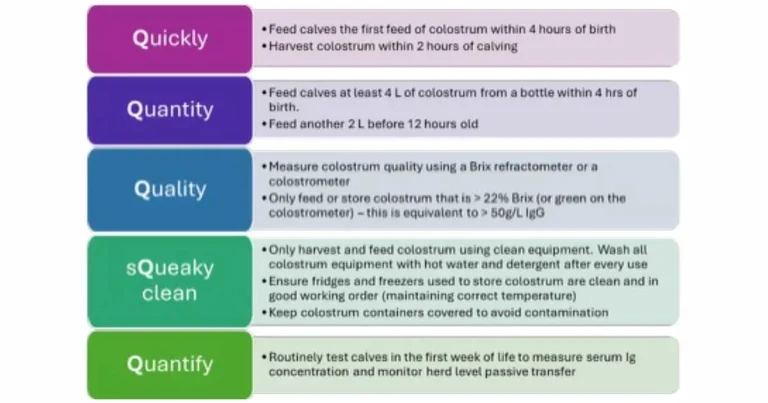
Vets and farmers can work together to develop and implement an effective colostrum management protocol, and vets can also provide staff training to facilitate consistent implementation of protocols if needed. Existing frameworks such as the “Five Qs” (Figure 1) can be a useful starting point around which to develop an evidence-based farm protocol.
The first three Qs (quickly, quantity, quality) are straightforward to measure and record on farm, with calf-rearers being ideally placed to work with vets to collect these data. The volume and time after birth calves are fed can be recorded in a format that best suits the farm team; ideally the method of colostrum feeding and the time after calving the colostrum was harvested should also be recorded. Colostrum quality can be readily assessed on farm using a Brix refractometer or a colostrometer and results recorded alongside the other colostrum-related data.
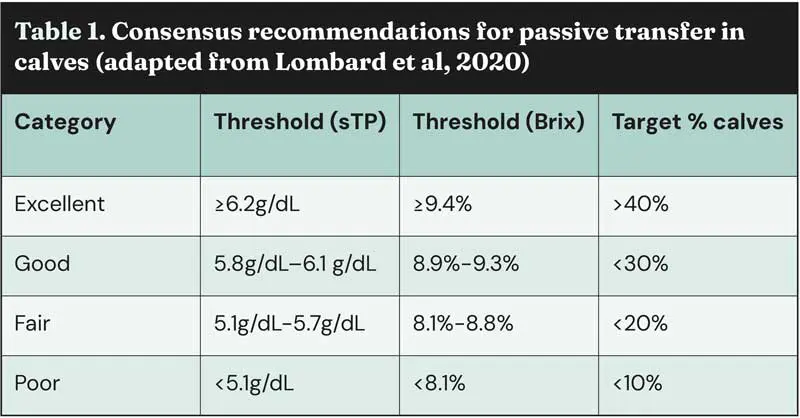
When an effective colostrum management protocol has been implemented, vets can work with farmers to instigate routine monitoring of FTPI to enable progress to be reviewed at regular intervals. Routine monitoring is associated with a lower within-herd prevalence of FTPI (Beam et al, 2009), leading to improved calf health. Benchmarking data against established recommendations (Table 1) can indicate whether further investigation is warranted, while analysis of the colostrum management data collected by farm staff can identify where problems are occurring and enable targeted interventions.
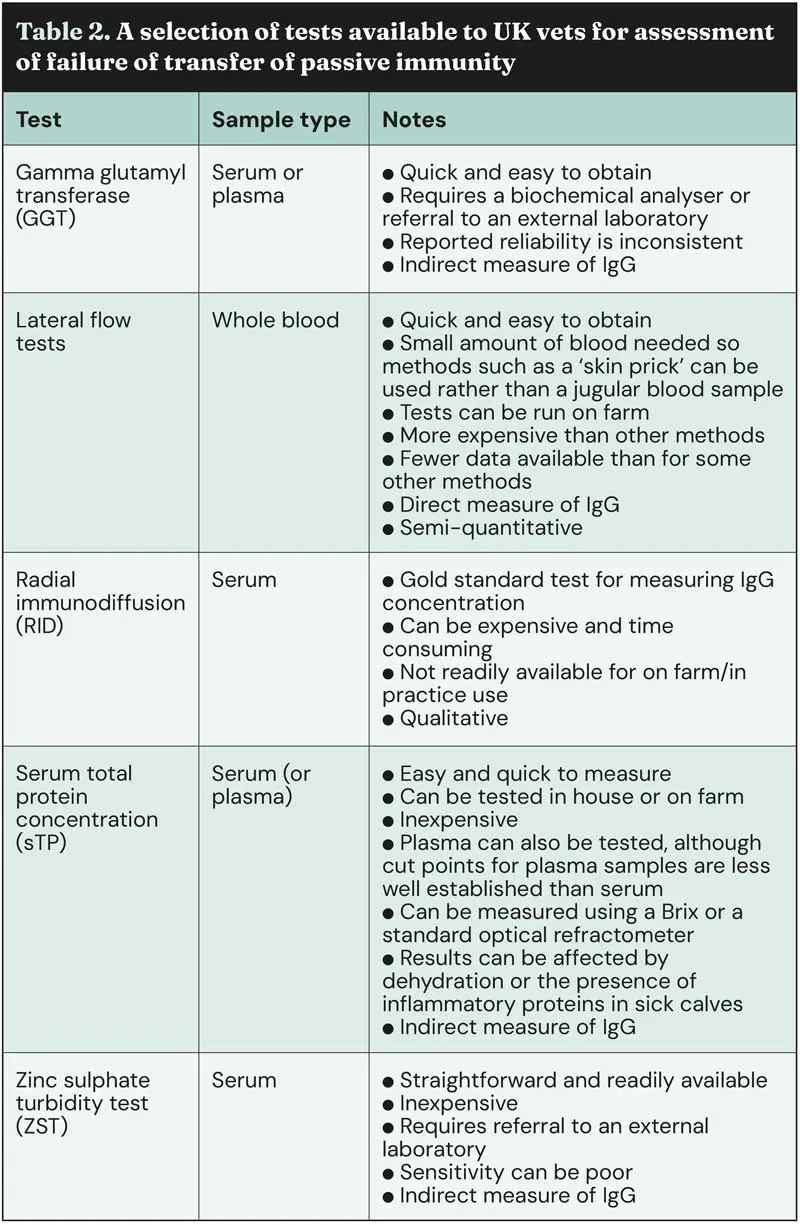
Representative numbers of calves need to be sampled to accurately assess herd-level FTPI – a minimum of 12 healthy calves has been proposed as an appropriate sample size (McGuirk and Collins, 2004). Vets need to work with farmers to establish a suitable frequency of sampling calves for their herd that balances the practicalities of regular sampling with achieving a representative sample of calves. Ad hoc sampling is not recommended, so if herds are small with few calves born, or regular sampling is not possible, serum can be separated and frozen until 12 samples have been collected for analysis as a single group. Several tests are available in the UK for measuring passive transfer (Table 2), but serum total protein measurement is a good choice as it is straightforward and inexpensive to perform in practice and has been extensively validated as a suitable proxy measure for serum IgG concentration (Godden et al, 2019; Souza et al, 2021), showing a high degree of accuracy (Zakian et al, 2018).
Housing has an important influence on dairy calf health with sub-optimal housing environments in early life potentially being a source of disease and negatively impacting welfare. Awareness of contributory factors and collaborative effort from the farmer-vet team, housing can be optimised to maximise calf health, welfare, and productivity.
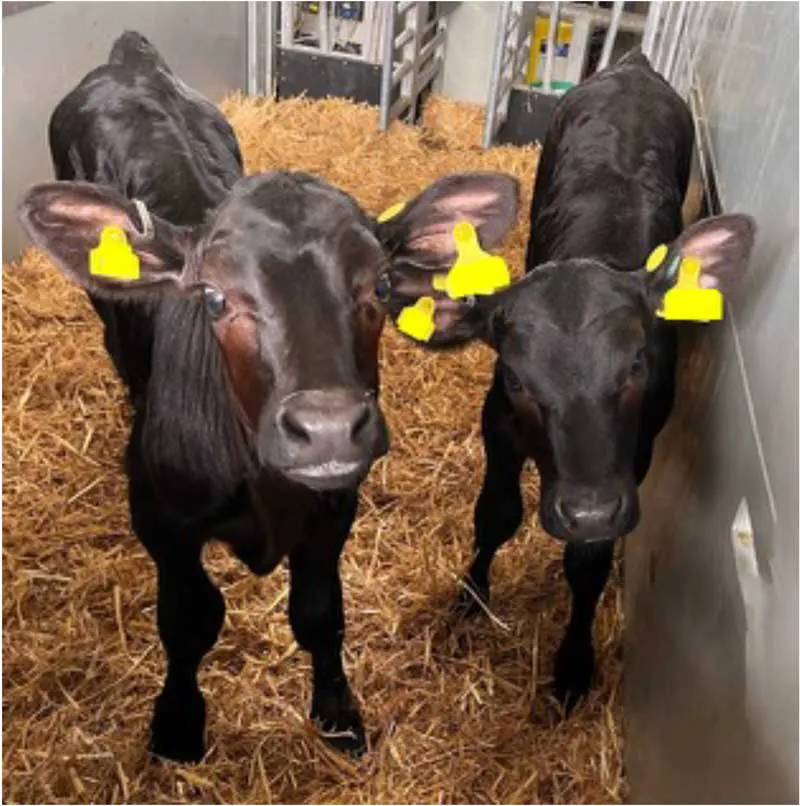
Social housing of pre-weaned calves has been positively associated with long and short-term measures of calf health, behaviour and productivity, compared to individual housing. Calves paired in early (Figure 2) have been demonstrated to consume a greater volume of starter feed (Costa et al, 2015; De Paula Vieira et al, 2010), with an associated higher pre-weaned daily liveweight gain compared to individually housed calves (Costa et al, 2015; Jensen et al, 2015).
Social interactions between young calves encourage solid feed intake and also promote play behaviour – a recognised indicator of positive welfare (Špinka et al, 2001). Socially housed calves form bonds with pen-mates in early life (De Paula Vieira et al, 2010; Lindner et al, 2022), improving calf resilience and their ability to cope with social, environmental, and nutritional changes (Costa et al, 2014; De Paula Vieira et al, 2012; Duve and Jensen, 2012). In the longer term, cattle housed socially when they were calves have been demonstrated to adapt more favourably to changes in the milking herd environment as adults. For example, heifers socially housed as calves engage in fewer cubicle displacements and show increased feeding time in a novel milking environment, compared to herd mates that were individually housed (Clein et al, 2024).
Although positive effects on social interactions and future behaviours are consistently found, results of studies investigating associations between social housing and future productivity are more variable and warrant further study (Mahendran et al, 2024; Valníčková et al, 2020).
Historically, group housing of calves was hypothesised to be associated with an increased disease incidence, and a recent UK survey found many dairy farmers still perceive the use of individual pens to be associated with a reduced spread of disease (Mahendran et al, 2022). The available data challenges this view, suggesting that housing calves in groups is not associated with an increased incidence of diarrhoea or respiratory disease (Medrano-Galarza et al, 2018; Reiten et al, 2019).
Social housing can be associated with an increased risk of cross sucking, a non-nutritive sucking behaviour of the navel, immature mammary gland or other body parts of other calves. Mahendran et al (2024) found that this might be associated with an increased risk of udder health events in the first lactation compared to individually housed calves, but not all factors associated with udder health were accounted for in this work, so results need to be interpreted with caution and further study is merited (Mahendran et al, 2024).
Pre-weaned calf housing systems are variable throughout the UK and Europe, ranging from pasture-based systems and individual or group hutch style accommodation that may be indoors or outdoors, to individual or group pens within different styles of buildings.
In the UK, regardless of housing system, building design of early life calf housing can be categorised as sheds, hutches, or polytunnels. Both building design and how calves are managed within the building have potential to negatively impact early life calf health, welfare and growth, potentially having long-term negative effects on future heifer health and performance. Additionally, calf microenvironments exist in all types of housing used in the UK, and the temperate climate means that warm, wet summers and cool, wet winters must both be navigated, leading to additional challenges when designing calf housing.
Air quality is determined by air temperature, relative humidity, velocity, and dust, gas and bacterial concentration (van Leenen et al, 2020; 2021), and is reduced in buildings with poor ventilation. Recent work on dairy farms in the south of England found air quality factors vary significantly and have potential for both direct and indirect impacts on calf health and welfare (Mahendran et al, 2023). The same study demonstrated that all housing types (shed, polytunnel and hutch) exposed calves to heat stress (defined as Temperature Humidity Index greater than 71) for a minimum of two weeks in the summer months.
Additionally, calves housed in hutches alone spent 86% of their time during winter exposed to cold stress (temperatures below 10°C) (Mahendran et al, 2023). Mahendran et al (2023) also found that the presence of airborne fine particulate matter (particle size less than 10µm) and bacteria count were higher in sheds compared to hutches and polytunnel housing, although these results were not significantly different from external environmental readings. These findings highlight limitations of the most commonly used UK calf housing systems that have potential to impact early life calf health and welfare.
The thermoneutral zone of neonatal calves is thought to be between 10°C and 20°C (Mahendran et al, 2023). Exposure to temperatures below this range is reported to be associated with increased calf mortality from 0 to 3 months (Hyde et al, 2020) and decreased calf growth rates (Bell et al, 2021; Hyde et al, 2021). However, the association between environmental temperature and disease incidence is less clear. Colder air disrupts the mucociliary escalation mechanism in cattle (Caswell, 2014), and the limited available evidence suggests that low ambient temperatures are associated with increased BRD risk (Donlon et al, 2023b; Johnson et al, 2021), but thermal stress is also associated with increased risk of calf mortality and morbidity and decreased growth rates (Roland et al, 2016).
Interestingly, studies have also found BRD risk is increased by thermal stress (Louie et al, 2018; van Leenen et al, 2020). Although these findings seem to contradict the results of Donlon et al (2023a), it is important to note that the considerable variability in available calf-level data makes interpretation of results challenging. In particular, lack of separation between environmental temperature and other factors that impact air quality, alongside inconsistencies in climate type or length of temperature measurement (particularly in cross-sectional work) between studies, make definitive conclusions difficult to draw (Donlon et al, 2023b).
Further longitudinal work able to characterise associations between environmental temperature and disease at both warmer and colder temperatures is required to ascertain the optimal temperature of the housed environment for calves (Donlon et al, 2023b).
Increased (greater than 80%) relative humidity (RH) in any cattle housing can result from climatic conditions and housing ventilation levels, sources of moisture and drainage availability (Mahendran et al, 2023). High relative humidity is often associated with increased airborne bacterial survival (Donlon et al, 2023b), and has been associated with pulmonary inflammation, characterised by increased basophil count (van Leenen et al, 2020).
Association between humidity and disease incidence is less clear, with challenges experienced in separating the relative impacts of temperature and humidity. Increased RH has been associated with increased Wisconsin calf health scores, but reported effects on BRD incidence or lung consolidation are more variable (Louie et al, 2018; Nonnecke et al, 2009; van Leenen et al, 2020).
Several studies have examined airborne factors such as bacteria, endotoxins, ammonia and dust particles in calf housing, as these factors are considered to have a direct effect on the health of calves, particularly BRD risk. However, study design and measured outcomes frequently differ between studies, making establishment of guidelines for optimal air quality in calf housing challenging (Donlon et al, 2023a).
Prolonged exposure to ammonia concentration in air from soiled bedding and urine breakdown has been demonstrated to be associated with increased risk of lung consolidation in group housed calves (van Leenen et al, 2020), with levels at greater 10ppm associated with increased antibiotic usage in veal calves (Schnyder et al, 2019). Additionally, exposure to plumes of fine dust (lower than 10µm and below 1µm diameter) have been associated with lower respiratory tract damage and increased risk of BRD in feedlot cattle (Urso et al, 2021), and group-housed calves respectively (van Leenen et al, 2021).
Vets and farmers can work together to monitor the impact of environment on calf health and identify areas for improvement. Temperature and humidity monitors are inexpensive and enable farmers to continuously monitor environmental conditions in calf housing.
Vets can analyse data collected by farmers to enable identification of problem areas and introduce targeted improvements to the housing environment; data can also be analysed to assess the longer-term impact of any changes made. The value of these data can be augmented further by collating it with other calf data that can be collected on farm, for example weight, disease incidence and treatment records. Analysing these different types of data alongside environmental data can help to identify the impact of environmental conditions on calf health, and aid in client compliance in effecting environmental change on farm.
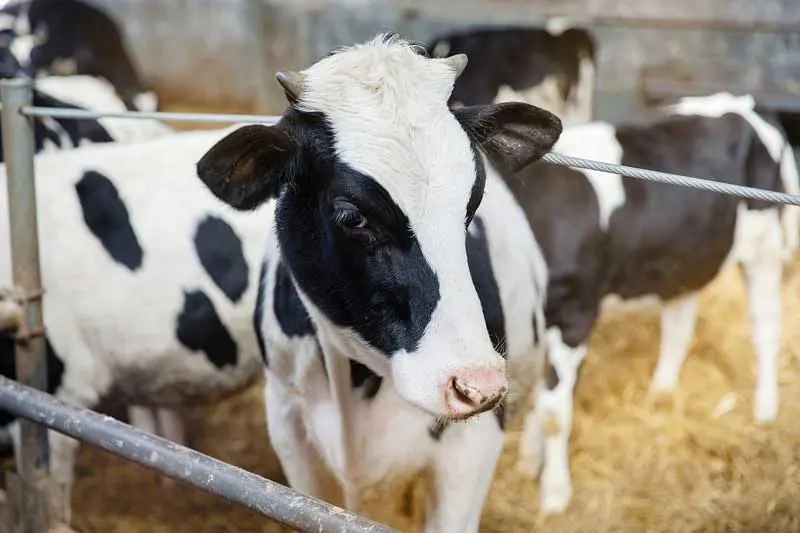
Adverse health events in early life can have long-lasting negative effects on the future health, welfare and productivity of dairy calves; therefore, optimising early life health is key to their future success in the milking herd.
A collaborative herd-health approach with farmers and vets working together to collect and analyse calf-related farm data allows for regular herd-level monitoring of calves. This can subsequently lead to improvements in calf health by identifying problems early and enabling targeted interventions to be made and progress to be assessed.
Nicola Gladden qualified from The University of Edinburgh in 2006 and worked in mixed clinical practice before taking up a position as senior clinical scholar in production animal health at the University of Glasgow School of Veterinary Medicine in 2014. Nicola qualified as a diplomate of the European College of Bovine Health Management in 2019 and completed a PhD in 2021. She is a European and RCVS specialist in bovine health and production and works at the University of Nottingham School of Veterinary Medicine and Science teaching farm animal practice to undergraduate veterinary students, as well as continuing to do some clinical work.
Jessica Reynolds is an RCVS and European recognised specialist in bovine health management, currently working as clinical assistant professor in farm animal practice at the University of Nottingham, with particular clinical interests in management of dairy herd fertility, lameness and youngstock health.