
24 Mar 2026
Vet James Breen, BVSc PhD CertCHP DCHP MRCVS, cattle health and production specialist with Map of Ag, on how vets can use data to help lead decisions on farm.

James Breen
Job Title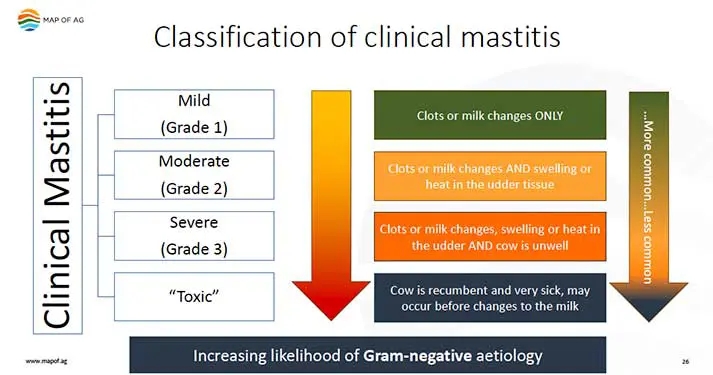
Figure 1.
What does a good clinical mastitis cure look like? Yes, treatment with intramammary antibiotics is likely to deliver rapid improvement to any clinical signs in the udder and milk itself, but how effective has that cure actually been?
Is this the first case of clinical mastitis in this lactation, and how well are the client and you tracking subsequent cases? And what about the likely aetiology? What level of testing is being carried out, and how accurate and reliable is it? On-farm testing giving bacteriology results within 12 to 24 hours is a huge step forward, but as practitioners, it is important that we lead clients through the appropriate checks and balances to help ensure they are of value, and being acted on accordingly.
It is also important to note that, as there is a range of tests available to producers and vets, there are also differences in methodology, specificity and sensitivity, efficacy and accuracy and, perhaps most importantly, the potential for a delay in treatment while the farmer waits for results. A delay could lead to an impact on cure rates for clinical mastitis, cell counts as well as recurrence.
In addition, we should probably, as a profession, all acknowledge that a significant number of milk samples being taken for testing are contaminated, rendering them unusable.
Frequently, during on-farm visits, a farmer will share that they detected some clinical mastitis, but that symptoms were mild, so the decision was made not to treat using antibiotics. Are we okay with that? While published research evidence suggests antibiotic treatment of mild clinical mastitis events caused by the Gram-negative pathogen Escherichia coli may not be required, in practical terms what is the impact on cure rates and recurrence rates1? There is also a risk that, if no antibiotic therapy is used, the case is not reported on-farm; something that is less than helpful when trying to understand subsequent infections and cure rates.
We know that antibiotic mastitis treatments account for a significant proportion of antibiotic use in a dairy herd, and we also acknowledge that antimicrobial resistance has been reported to be a growing threat to human and animal health. As vets, we need to remember the RUMA (Responsible Use of Medicines in Agriculture Alliance) aim of “as little as possible, as much as necessary”. It is also worth remembering the importance of “choosing the right drug for the right bug”, but without records and evidence, this is an impossible task.
Taking a step back, it is worth taking a brief look at why mastitis control is important – namely cow welfare, financial losses, staff morale, milk quality, sustainability and antibiotic use.
Looking at sustainability – something that is becoming increasingly important and high profile in commercial discussions with buyers, processors and even consumers – work has been done that examined the impact of clinical mastitis on greenhouse gas emissions (GHGs) in a modelled case study. It stated that emissions of cows with clinical mastitis increased by 57.5 (6.2%) kg CO2e/t FPCM compared to cows without clinical mastitis. This increase was caused by removal (39%), discarded milk (38%), reduced milk production (17%) and prolonged calving interval. It also modelled that GHG emissions increased by 48kg CO2e/t FPCM for cows with one case of clinical mastitis and by 69kg CO2e/t FPCM for cows with two cases of clinical mastitis and 92kg CO2e/t FPCM for those with three compared to cows without clinical mastitis2.
Currently, additional projects are underway, including AHDB’s environmental baselining study and the UK Dairy Carbon Network project, all aiming to shed further light on this area.
Looking more at antibiotic use and the goal of reducing antibiotic use and specifically cutting the use of highest priority critically important antibiotics (HP-CIAs), as a sector we can take recently published data as a good sign. The 2025 RUMA Targets Task Force report published a total antimicrobial use for dairy cows of 12.7mg/PCU (2024 data), well below the target of 17.9mg/PCU for 2024. The target for the use of HP-CIAs was set as below 0.1mg/PCU for the 2025-2028 period3.
This is an ever-evolving process on-farm and the building blocks for behaviour change when reducing and refining antibiotic use in mastitis control are:
So, revisiting the conversation with a client about a recent mild to moderate case that was not treated, it is always worth stressing the importance of recording all cases. It can also be of value to remind farmers how mild to moderate clinical cases can sometimes escalate to something much more severe (Figure 1).
When it comes to encouraging clients to report, record and also detect it can be worth running through:
Going back to on-farm testing or on-farm culture (OFC), these can be hugely helpful but bear in mind:
It is worth remembering the buck stops with us as the vet. Acknowledging that the majority of clinical mastitis events will be mild and moderate, management and treatment protocols must be set by the prescribing vet and implemented by the farmer. The vet’s role, having set the treatment protocols in the health plan, is then about monitoring cure rates and treatment outcomes. It is also important to guide clients through the role of NSAIDs and the importance of pain relief for all clinical mastitis events detected.
When prescribing intramammary antibiotics to treat mild and moderate clinical mastitis events in a dairy herds, we can ask ourselves the question:
Herd somatic cell count is an important factor in aetiology and easily overlooked. Research 20 years ago reported clinical mastitis events caused by E coli infections were significantly associated with the presence of a short peak in SCC in that cow, while clinical mastitis events caused by S aureus infection were associated with a longer increase in SCC4. Some time spent reviewing herd data around this could be very beneficial when making prescribing decisions
Remember, every first case of mastitis is a failure of control. How did we get here? What is the likely source of the infection causing this new case? How effective is the record keeping? All important points to raise with clients during annual herd health planning conversations with data analysis to hand (and more regularly for those of us that are delivering routine visits to clients). And while it is appropriate that herd health plans strive to reduce and rationalise antibiotic use through improved mastitis control, as clinicians there is an important role to play in leading decision making on-farm and instilling a culture of both robust record keeping and the regular review of this evidence.