
24 Mar 2026
Sara Pedersen BSc, BVetMed, CertCHP, DBR, MRCVS discusses, as a wet winter gives way to a hopefully drier spring and summer, measures to mitigate against the detrimental impacts on cow welfare and productivity of higher temperatures.

Sara Pedersen
Job Title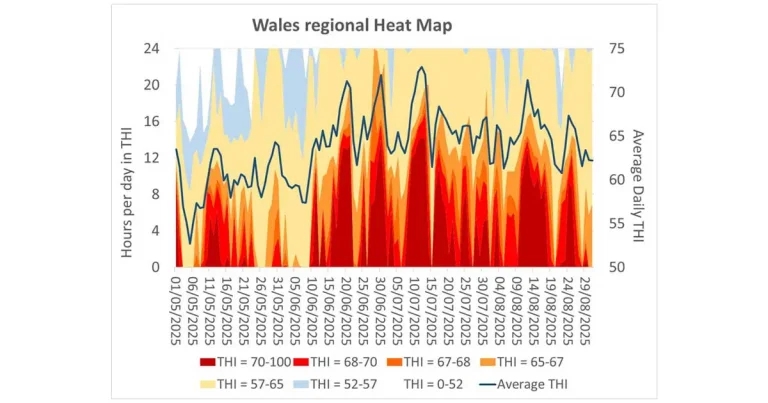
Figure 1. Heat map showing the daily temperature humidity index (THI, percentage) in the Usk area of south Wales from 1 May to 31 August 2025. The dark blue line shows the average daily THI. Graphic: Galebreaker
With the uncertain weather of late and a later turnout for many, it may seem strange to be thinking about heat stress. However, spring is just around the corner, and with it comes the threat of hot weather.
Our changing climate means that heat stress is set to become an ever-increasing challenge and so planning ahead to keep cows cool will be essential to mitigate the detrimental impacts it can have on welfare and productivity. We often consider heat stress to only impact housed cows. However, it is also an increasing concern in grazing cattle, especially as we see more extreme temperatures.
While the term “heat stress” infers temperature is the focus, this is not the case since humidity also plays a role. The combination of ambient temperature (°C) and the relative humidity (as a percentage) creates the temperature humidity index (THI), which estimates the level of thermal (dis)comfort and is used to assess the impact of heat stress on dairy cattle (Figure 1).
The THI is scaled from 0-100 and the first signs of heat stress are usually present at a THI of 68 (note this is lower than the threshold 72 previously used). As the THI rises and duration above 68 increases, so do the impacts of heat stress.
A dairy cow’s thermal comfort zone (TCZ) is the temperature range between which she is not expending energy to either keep warm or to cool down. However, outside of this range she will have to alter her basal metabolic rate to maintain normal body temperature, thus directing energy away from production. Various different TCZ ranges are reported in the literature, and it is also likely each individual cow will have her own range too. However, -5°C to 15°C is commonly referenced in the UK.
The reason for varying TCZ ranges is the impact of humidity. The higher the humidity, the lower the temperature threshold before a cow starts to be impacted by the environment around her. Therefore, as humidity rises so does the threat of heat stress as the higher humidity negatively impacts her ability to lose heat through evaporation.
Heat exchange between the cow and environment occurs bidirectionally through two mechanisms: sensible (that is, convection, conduction and radiation) and latent heat transfer (namely, evaporation and condensation). The balance between sensible and latent heat transfer is dependent on the difference between ambient and skin temperature.
Below 20°C, heat exchange is evenly distributed between sensible and latent pathways. However, above this temperature there is an increased reliance on latent heat transfer as the cow’s ability to use sensible pathway decreases. This is why panting is a sign of a heat-stressed dairy cow – at this point she has to actively try to reduce her body temperature.
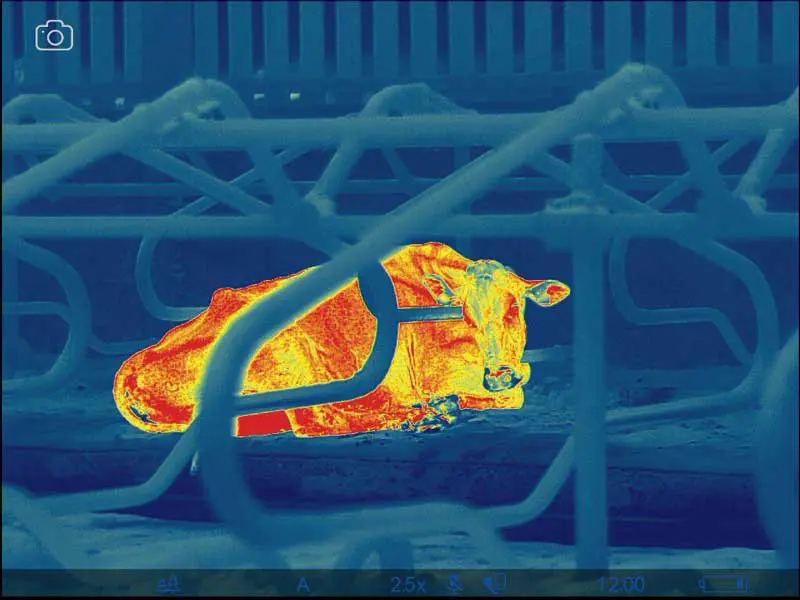
The impacts of heat stress have the potential to be significant, ultimately also affecting profitability. A strategic approach to mitigation is needed to ensure maximum impact from the intervention. Therefore, understanding the relative risk on an individual farm is important, as well as identifying key areas of the farm that are higher risk, as the impact of heat stress will not be uniform across all areas.
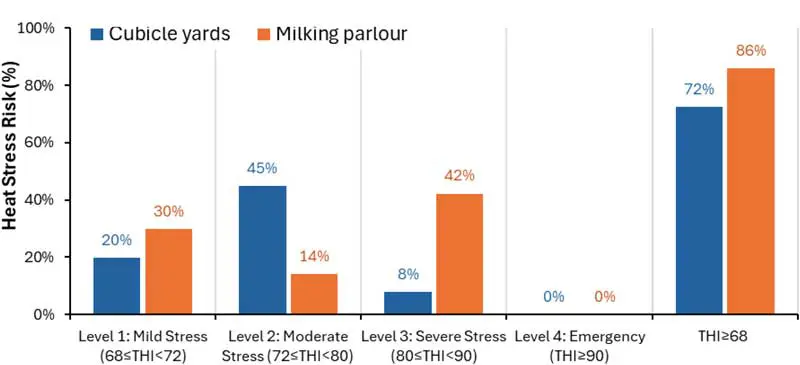
As an example, a study by the University of Reading (Liu et al, 2025) reported a much higher risk of heat stress in the milking parlour compared to the cattle housing. In the milking parlour, the THI exceeded 68 for 86% of milking time and reached a more severe level of heat stress compared to the cubicle buildings, where THI was greater than 68 for 72% of the time with a more moderate stress level (Figure 3).
A number of mitigation measures can be implemented, ranging from management changes to mechanical ventilation, which are either focused on cooling the environment around the cow, cooling the cow herself or a combination of both.
In housed cattle, the roof plays an important role in determining how much heat reaches the cow. A roof that reflects rather than absorbs heat will keep cows cooler and simple actions such as using solar-reflective roof paint have been found to be the most effective, single passive strategy for reducing heat stress (Liu et al, 2025). In terms of absorptive capacity, typical fibre cement roofs have an absorptivity of 70%, in comparison to solar paint at 30%. The more solar radiation absorbed by the roof, the warmer the shed inside and also the longer it takes for the shed to cool down.
For grazing herds, shade is often the single most effective first step, alongside reducing daily walking distances. The provision of natural shade from trees is a beneficial, but long-term, strategy. However, planting position needs careful consideration to avoid excessive detrimental impacts on air flow around cows and the promotion of bunching behaviour, which can lead to poaching of ground and increases in mastitis. Shorter-term options include the use of solar shades, but practically this can be difficult to implement where cows are moving to different paddocks. In these situations, shade over an open collecting yard can provide some relief.
Maximising air movement is important to promote convective and evaporative heat loss. A simple action, such as opening doors and replacing with a bar, is very effective and easy to do. Air outlets can often be a pinch point, so making sure ridges are of sufficient width and a design to maximise their ability to draw air up and out of a hot shed is crucial.
Where ridges are over passageways and not beds, removing them and leaving the ridge completely open can have a dramatic impact on improving natural ventilation.
Where natural ventilation isn’t sufficient, mechanical options can be used to increase air flow around the cow. Where fans are used, consideration must be given to where they are positioned to ensure that they are directing air at the cows and not simply recirculating hot air. To avoid the cost of multiple electrical fans, positive pressure tube systems over cubicle beds are now becoming more common. These reduce the energy requirements and also ensure fresh air reaches every individual cow, regardless of whether cows are standing up either side of her.
Active cooling is another useful mitigation strategy in high-risk areas, such as the collecting yard. For it to be effective, there must be a combination of both wetting and air flow. Cows must be soaked rather than misted, as when the droplet size is too small it can result in an insulating layer forming on the cow. Therefore, large droplets that soak the cow are required, with fans then used to ensure evaporation and cooling of the cow. If water is added to the environment in the absence of sufficient air flow, then it can raise humidity and exacerbate heat stress.
During periods of heat stress, dry matter intakes decrease significantly (especially in freshly calved cows), while water intakes increase dramatically, up to 200 litres per day per cow.
To try to avoid many of the knock-on effects of reduced intakes, it is important to try to maintain intakes where possible by adapting feed times or feeding more regularly to keep feed fresh.
Water provision can be a pinch point on farms and this is exacerbated during heat stress when it is critical cows have sufficient access to clean, fresh water at all times.
For grazing herds that are housed at night, one management strategy to mitigate against heat stress is grazing at night instead of the day, which not only allows cows to feed while it is cooler, but also allows the shed to cool down at night when the cows are outside.
Stocking density has a significant impact on THI, and therefore keeping stocking densities low (if feasible) can help. Even where this isn’t possible in housing, avoiding overfilling the collecting yard during milking time to allow cows plenty of space to prevent further temperature rises helps. As mentioned earlier, the collecting yard can sometimes be the area of the farm where cows are more exposed to heat stress due to the lack of ventilation and bunching of cows together.
The potential impacts of heat stress on dairy cows are clear and continue beyond the high-risk period itself. As the climate continues to change and we are set to experience hotter weather for longer periods of time, now is the time to assess current and future risk and to start to put in mitigation measures. A number of different options are available, but it is important to ensure these are targeted for maximum benefit and are sustainable in the longer term.