
22 Sept 2026
Fiona Lovatt BA, VetMB, DipECBHM, PhD, MRCVS, Rachel Clifton VetMB, PhD, MRCVS and Rachael Tarlinton BVSc, PhD, DipECVM, MRCVS preview a BCVA Congress session, in which results from a survey of sheep farmers on a range of issues will be presented and discussed
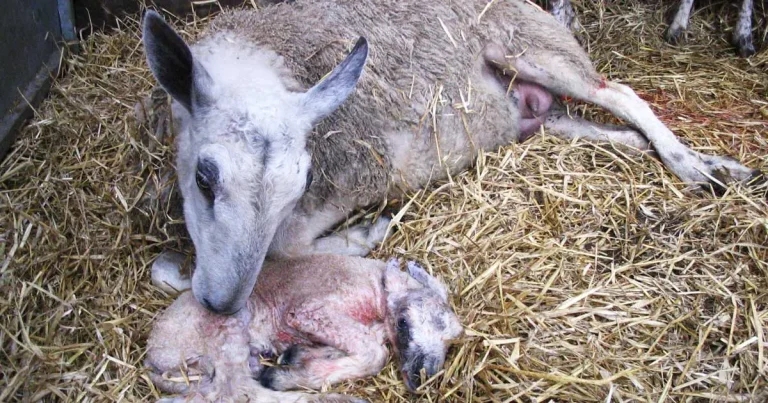
The highs and lows of lambing time lay the foundations for the flock’s yearly output and the sheep farmer’s income. With it all taking place over just a month or so of long days, high stress and little sleep, it is important that everything runs to plan.
The collation of nationwide farmer-reported data is invaluable to establish baseline figures against which the sheep sector can defend reputation and monitor progress, as well as to document the effects of weather conditions and additional threats such as Schmallenberg (SBV) or bluetongue (BTV) viruses.
In the RUMA Targets Task Force (TTF) 3 report1, published November 2025, the sheep sector committed to running an annual UK-wide lambing survey to include an assessment of current practices and attitudes with respect to responsible antibiotic use at lambing time.
Since 2016, it has been a goal of both the Sheep Antibiotic Guardian Group and the RUMA TTF sheep team to consider antibiotic stewardship in neonatal lambs. Various reports indicated that routine prophylactic use was widespread, with evidence that a large proportion of flocks were using antibiotics (68% oral, 26% injectable) on a “just in case” basis in 20162 and that one-quarter of flocks were giving oral antibiotics to every lamb born3.
In 2016, 11 million doses of oral antibiotic were sold in the UK, predominantly given to neonatal lambs. This had reduced to 6 million doses in 2021 and subsequently all authorised products were withdrawn from the market. Since 2021, there has been no easy way to measure antibiotic stewardship within the sheep sector at lambing time.
The findings presented come from the 2025-26 lambing survey, which was open online from March to July 2026. The last response was submitted on 30 June 2026. The survey sought to capture prevalence of three lamb diseases (watery mouth, joint ill and scour), procedures performed on lambs (for example, castration and tail docking), antibiotic use in lambs and ewes at lambing time, as well as occurrence and impacts of SBV and BTV.
A total of 297 usable responses, representing 72% lowland and 28% upland or hill flocks, were submitted. Flock size ranged from 4 to 4,000 ewes with a median of 110 ewes put to the ram; of these, 46% of flocks lambed indoors, 19% lambed outdoors and 35% flocked both indoors and outdoors.
For each of three lamb diseases (watery mouth, joint ill and scour), approximately half of all the flocks reported at least one case of disease, although 83 (28%) flocks did not report cases of any of these three diseases.
In affected flocks, the median overall flock prevalence for watery mouth disease was 1.1%, although this was lower in outdoor lambing flocks. The maximum prevalence of watery mouth disease was 16% reported in an indoor flock.
The median overall flock prevalence for joint ill in affected flocks was 0.9%, although a maximum prevalence of 10% was reported in an indoor flock. The median overall flock prevalence for scours in affected flocks was 1.1%, although this was higher in indoor-only lambing flocks, with a maximum prevalence of 22% in a single flock. The median rates of these diseases are encouragingly low, but clearly some flocks with higher prevalence still exist and many flocks are still seeing a small number of cases.
One-quarter of farmers surveyed reported that they did not treat any lambs with antibiotics in the 2026 lambing season. However, some farms still treat very high numbers of lambs, with 10 respondents (3.4%) treating more than half of lambs with antibiotics, and one respondent treating every lamb born. Across all respondents, median of lambs treated with antibiotics was only 2%.
A total of 251 (84.5%) of respondents reported administering antibiotics to at least one ewe at or just after lambing. Across all respondents, median percentage of ewes given antibiotics was 4%, ranging from 0% to 100%.
Unsurprisingly, positive associations were seen between antibiotic use in lambs and prevalence of all three neonatal diseases.
Nearly one-quarter of respondents checked the quality of ewes’ colostrum on a refractometer, as recommended in the industry-wide “Colostrum is gold” campaign, and 87% of farmers gave supplementary colostrum (84% using powdered, 60% from ewes on the farm and 9% using cows’ colostrum).
All male lambs younger than a week old were castrated in 45% of flocks and some male lambs in 23% of flocks. All lambs were ear-tagged at less than a week old in 30% of flocks and some lambs in a further 10%. All lambs younger than a week old had their tails docked in 71% of flocks and some lambs in a further 18% of flocks.
Tail docking was significantly less frequent in outdoor lambing flocks. Tail docking was also positively associated with an increased prevalence of watery mouth disease.
Navels were treated in all lambs in 81% of flocks and some lambs in 13% of flocks. More indoor lambers treated navels than outdoor lambers, but no association was seen between navel treatment and lamb disease.
The University of Nottingham has previously run lambing surveys4,5 to consider the farm-level impact of SBV.
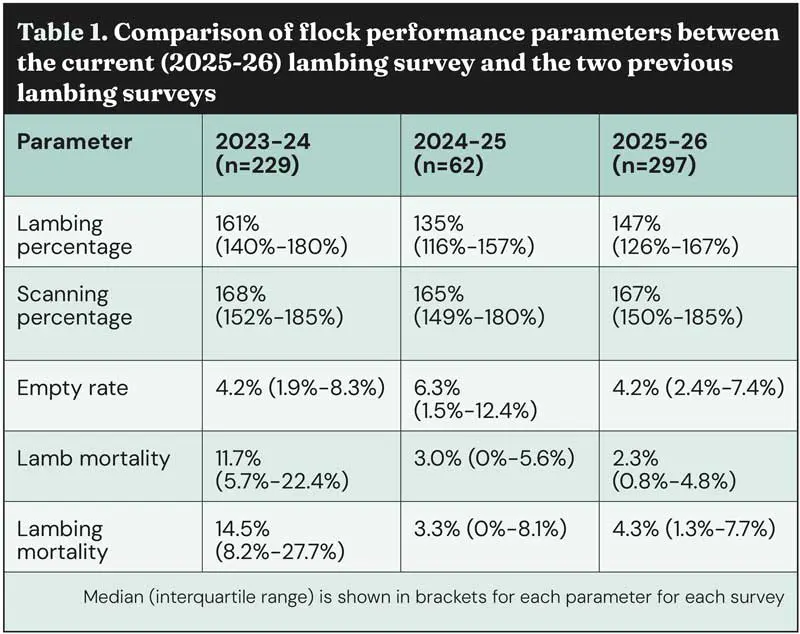
The data from this year’s survey has allowed for comparison of flock level parameters with the past two years (Table 1), although 2023-24 was a year with a large SBV outbreak and this will have affected responses from that year.
Lamb mortality is the number of lambs that died within one week as a proportion of the total lambs born alive, in contrast to “lambing mortality”, where the denominator is the number of non-empty ewes.
For the 2025 lambing period, the majority of respondents reported no financial or emotional impact of either SBV or BTV.
This research provides practitioners, wider stakeholders and consumers with information about lambing practices and insights into the challenges faced by sheep farmers.
Anecdotally, we assume that both vets and farmers are making better stewardship decisions at lambing time year on year and this survey provides documented evidence that the bulk of the farmers are following good stewardship practices.
However, some flocks still use high levels of antibiotics at lambing and those with high disease rates, and it is likely that these farmers need targeted veterinary support. The survey will be run as an annual event going forward and will provide a benchmark for veterinarians to compare the practices of their own sheep farmer clients, with a view to defending and improving sheep sector reputation and driving better stewardship practices.
Please get in touch with one of the authors if you would like to involve all your sheep farmer clients or your Flock Health Club members in future years.
The UK lambing survey 2026 was run as a collaboration between the Sheep Veterinary Society, the Sheep Antibiotic Guardian Group and the University of Nottingham, who thank all the farmers who contributed data, as well as supporting organisations: National Sheep Association, NFU, Ruminant Health and Welfare, RCVS Knowledge, RUMA, Boehringer Ingelheim, MSD Animal Health, NoBACZ Healthcare and Zoetis.
Rachel Clifton is an assistant professor in the Ruminant Population Health group. She qualified as a veterinary surgeon from University of Cambridge in 2010 and completed her PhD at University of Warwick in molecular epidemiology of ovine footrot (2013-17). She joined the University of Nottingham’s School of Veterinary Medicine and Science in 2021. Rachel’s main research interests are microbial communities – particularly the bacterial interactions involved in the initiation of polymicrobial diseases, and the application of advanced statistical and machine learning approaches to microbiome research.
Rachael Tarlinton graduated with a BVSc from the University of Sydney in 1999 and worked in mixed practice in Australia and the UK. She joined the University of Nottingham’s School of Veterinary Medicine and Science in 2007, where she teaches undergraduate and clinical phase veterinary medicine students, and runs a research programme in animal infectious diseases. Rachael is a European diplomate in veterinary microbiology.
Fiona Lovatt graduated from the University of Bristol in 1995 and until 2012 worked as a farm vet in a first opinion mixed veterinary practice serving 500 farms in the north-east.