
13 Oct 2026
Al Manning BVetMed, MVetMed, GCLT, DipECBHM, MRCVS breaks down a solid approach to investigating this common disease on farm.

Al Manning
Job Title
Image: Frédéric Prochasson / Adpbe Stock
Mastitis is one of the most common diseases in dairy cattle and a common reason for treatment and herd-health advice. This article discusses a logical approach to a mastitis investigation, with reference to the Mastitis Control Plan (MCP).
The first step to investigating mastitis is defining the problem. It is important to understand what motivates the farmer before giving strategies for treatment and prevention; for example, is the farmer concerned about the number of clinical mastitis cases treated in the parlour, their medicine spend or a penalty for high cell count milk from their milk purchaser? It is useful to review the different types of mastitis before investigating further.
Mastitis is commonly classified by severity (Smith, 1999).
Subclinical mastitis: inflammation without visible changes in the milk or udder. Elevated somatic cell count diagnosed on milk recording data or with a California Mastitis Test. A threshold of more than 200,000 cells/ml from a composite milk sample is most commonly used to define subclinical mastitis in the UK (Bradley and Green, 2005).
Mild clinical mastitis: changes in the milk (colour, consistency, clots) with no visible swelling of the udder.
Moderate clinical mastitis: abnormal milk (as described) with associated swelling in the udder.
Severe clinical mastitis: acute onset mastitis with systemic and local symptoms of inflammation. Local signs include changes in milk colour and consistency, and swelling, heat and redness in the udder. Systemic signs include pyrexia, depression, anorexia and lethargy.
Target figures for mastitis are commonly given by the incidence of clinical mastitis (less than 25 cases per 100 cows per year) and prevalence of subclinical mastitis (less than 20% of the herd infected). More detailed analysis of milk recording and on-farm data can be useful to identify patterns of infection – particularly new infections. It is important to ensure that all mastitis cases are being detected and recorded, as this may affect interpretation. One way to do this is to sense check tube sales against the reported clinical mastitis rate (More et al, 2012), though this assumes that all cases are treated.
Bacteriology can also be useful at the start of a mastitis investigation. Samples should be collected from representative cases (Laven, 2010). Where dealing with a clinical mastitis outbreak, samples should be collected from the latest clinical cases. If investigating a subclinical mastitis problem, sampling new and persistent high cell count cows may be of benefit.
Lastly, if the primary problem is severe or toxic mastitis, samples from those cases are going to be more useful. Farmers should be encouraged to collect an aseptic sample from every case of mastitis and keep it in the freezer – in the face of an outbreak, they will have a bank of samples for testing.
Vets and advisors should be aware that a proportion of milk bacteriology results will appear as “no growth”. This should not be interpreted as a poor sample, but should be considered along with the presentation. Where no bacterial growth is identified from a clinical case, this usually reflects infection caused by a bacterium that is no longer viable (Taponen et al, 2009).
Where no growth is detected from a subclinical case, this typically indicates intermittent shedding (Ruegg and Reinemann, 2002), and repeat sampling may be useful (Dohoo et al, 2011).

Modern veterinary work prioritises prevention over treatment – this approach is not only more ethical, but more cost effective for farmers. In the long term, prevention of mastitis is also an effective way of reducing antimicrobial use.
A huge amount of published research on mastitis prevention exists, and it is not feasible for a practitioner to review all this information every time they come to a mastitis investigation.
The first step is to make a diagnosis of the predominant mastitis epidemiology. Historically, mastitis pathogens were carried in the udders of infected cows and spread between cows on milking equipment (contagious spread). As contagious mastitis has become better controlled, the importance of “environmental” infections has increased (Klaas and Zadoks, 2018). In the UK, the majority of infections are now environmental rather than contagious (Hyde et al, 2020).
The timing of infections is also important: Green et al (2002) highlighted the importance of the dry period in mastitis epidemiology. Infections occurring in the first 30 days of lactation are more likely to have been acquired from the dry period, compared with infections occurring beyond 30 days, which are more likely to have been acquired during lactation (Green et al, 2007a). The diagnosis should be made based on the predominant route of infection – environmental dry period, environmental lactation, contagious dry period or contagious lactation.
Once an advisor has made the initial diagnosis, the next step is to implement a targeted action plan in that area; for example, if a herd has an environmental dry period pattern, improvements in dry cow management should be the priority. If a herd has a contagious epidemiology, the focus should be in identifying and treating cases promptly, and minimising spread in the parlour.
Following implementation of an action plan, it is important to monitor mastitis data to measure progress. Advisors should focus on new clinical and subclinical infections as a marker of improvement, as chronically infected cows and bulk cell count are unlikely to resolve quickly.
The three steps of “diagnosis”, “action plan” and “monitoring” are used in the MCP (Table 1). The MCP was developed through funding from the Milk Development Council (which later became AHDB) to help UK farmers better control mastitis. It is now managed through a partnership between Quality Milk Management Services and the University of Nottingham. The MCP incorporates the latest evidence on mastitis control and has been shown to be an effective way of reducing mastitis across a range of dairy herds (Green et al, 2007b). Where compared to control farms, farms that had a MCP reported a relative reduction in clinical mastitis incidence and new high cell counts of 20%. Furthermore, farms that complied with more changes reported greater improvements, demonstrating the value of follow-up monitoring and repeat engagement.
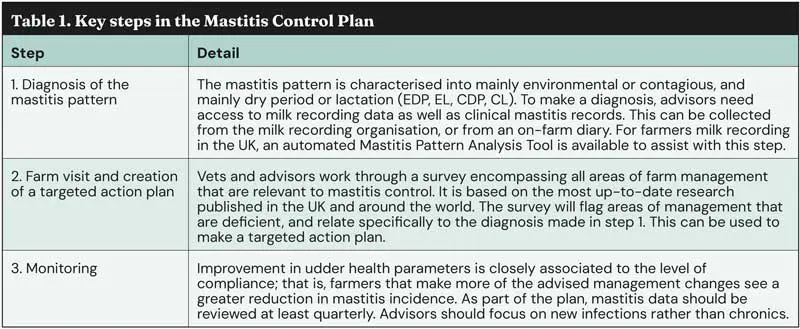
Advisors working with UK farms can utilise a Mastitis Pattern Analysis Tool to help with the first diagnosis step (Hyde et al, 2020). This tool was developed with support from the Biotechnology and Biological Sciences Research Council and the AHDB. Farmers who milk record with the Cattle Information Service, National Milk Records or Quality Milk Management Services can register for free online, and will receive a pattern report each time they record. The report diagnoses the predominant pattern and allows advisors to monitor progress over time.
Farmers can sign up for the report and nominate a veterinary advisor via https://cloud.remedy.farm/mpat
A key part of any mastitis investigation is some time spent in the parlour. Here, advisors can assess the cows, as well as the adequacy of the milking routine. Milking hygiene is important for controlling new infections, but can also impact milk quality. Panel 1 (end of article) shows the key steps of the milking routine and what they are trying to achieve.
It should be acknowledged that these steps are not always carried out by every milker at every milking. However, in the face of a mastitis outbreak, it is often helpful to come back to these principal steps.
For herds with a contagious epidemiology, it is essential that new cases are identified and treated quickly to minimise the risk of transmission (Keefe, 2012). In these herds, foremilking and effective post-milking teat disinfection are key priorities. In herds with an environmental epidemiology, early detection is still important for maximising cure, but parlour hygiene and pre-milking teat disinfection are likely to be more important in controlling new cases (Pankey et al, 1987).
Occasionally, cows will enter the milking parlour with gross visible contamination of the teats and/or udder. In these cases, it is important that teats are cleaned before foremilking and pre-milking teat disinfection is carried out. Where more than 10% of cows are visibly contaminated in the milking parlour, this is a clear indication of a poorly managed environment. Heavily contaminated teats and milking equipment are a risk for mastitis (Rowe et al, 2021), but also for elevated bulk milk bacterial counts/bactoscan.
A heavily contaminated milk filter sock indicates poor cow cleanliness or parlour hygiene (Figure 1). Advisors should also inspect cleanliness of milkers’ hands and controls in the parlour.

A high rate of clinical mastitis is often associated with high antimicrobial use (Preine and Krömker, 2022). Many milk processor schemes require vets to review antimicrobial sales data, as this can be an indicator of an underlying mastitis problem.
Ultimately, the best way to reduce antimicrobial use in mastitis is by reducing clinical cases and, therefore, the need to treat. However, it can also be useful to review treatment protocols to ensure that farmers are treating appropriately.
For mild and moderate mastitis, evidence that parenteral therapy reaches higher concentrations in the mammary gland than intramammary therapy, or that it enhances cure, is limited (de Jong et al 2023). Given that parenteral therapy constitutes a significantly higher dose of antibiotic (Hyde et al, 2017), intramammary therapy is considered a more responsible approach.
Where choosing intramammary therapy, practitioners are left with a choice between narrow (targeting mainly Gram-positive bacteria) or broad spectrum (targeting Gram-positive and negative bacteria). In the UK, narrow spectrum tubes typically contain penicillin or cloxacillin, and are considered a lower priority by the World Health Organization and European Medicines Agency. These category D antimicrobials are recommended on farms with a predominance of Gram-positive bacteria; for example, Staphylococcus aureus or Streptococcus uberis. For farms with a mix of Gram-positive and negative bacteria (more typical of environmental patterns), a broad-spectrum product containing a category C antibiotic may be more appropriate.
Mastitis cure rate is likely to be highest for the first presentation in a lactation (Glover et al, 2021). It is important, therefore, that farmers are identifying clinical mastitis cases and treating them as soon as possible. Cure rate is poorer for repeat cases in a lactation (Krömker and Leimbach, 2017), and so antibiotic use in these repeat cases is less justified.
Use of on-farm culture has been suggested as a means to reduce antibiotic use in mastitis (Lago et al, 2011). However, these kits should only be used under close veterinary guidance.
The majority of on-farm culture protocols delay time to first treatment, and so prescribing vets should consider the potential impact on first case cure rates.
Whenever making changes to a treatment protocol, it is important to monitor treatment outcomes. Low cure rates can be a result of inappropriate therapy, but may also reflect changes in pathogen profile. Declining cure rates can be an indication of an emerging contagious epidemiology.
In other infectious diseases, vaccination is often used as part of a control plan. In the UK there are mastitis vaccines available targeting Escherichia coli, S aureus and S uberis. Despite these vaccines being available for several years, published evidence from UK studies is limited.
A randomised control trial investigated the use of an E coli J5 antigen and S aureus vaccine in mastitis control (Bradley et al, 2015).
This study found no impact of vaccination on the rate of clinical mastitis; however, fewer severe cases were reported in the vaccinated group. This study also demonstrated a milk yield benefit of mastitis vaccination (1.9 litres per cow per day in the first 120 days of lactation); it was hypothesised that this benefit was related to less severe mastitis.
The evidence around S uberis vaccination is not as clear, and at the time of writing no published UK studies exist.
In a Spanish challenge study, vaccinated cows had less severe symptoms relative to those unvaccinated, and also had lower milk bacterial counts suggesting lower shedding (Collado et al, 2018).
However, no impact was reported on overall mastitis incidence or total milk production.
Vaccines should be considered – especially on farms with a high incidence of severe mastitis. However, they should not be the only tool used to control mastitis. A wider review of farm management and environment is likely to be more beneficial.
The first step in any mastitis investigation is in defining the problem and diagnosing the predominant pattern of infection. This enables advisors to give farm-specific, targeted advice.
Assessment of the milking process is a valuable part of a mastitis investigation, but also allows advisors to assess cow cleanliness and condition.
Prompt and effective treatment of clinical cases plays an important role – particularly in herds with a contagious epidemiology.
Vaccination is less evidence based, but should be considered in herds with a high prevalence of severe toxic mastitis.
Al Manning is an RCVS and European-recognised veterinary specialist vet. He has been a trainer for the Mastitis Control Plan since 2019. Al is currently studying for a PhD at the University of Nottingham.