27 Oct 2026
Will Gratwick BVSc, MMedVet, MRCVS reveals the findings of the latest research on this issue in cows.

Will Gratwick
Job Title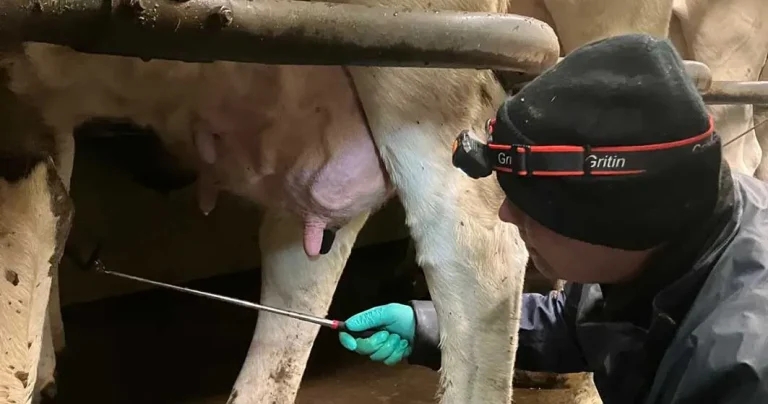
Using an extended mirror and head torch, the team scored the severity of any udder cleft dermatitis lesions on a 0 to 3 scale.
The true prevalence of udder cleft dermatitis (UCD) in the UK has finally been revealed in the largest study of its kind.
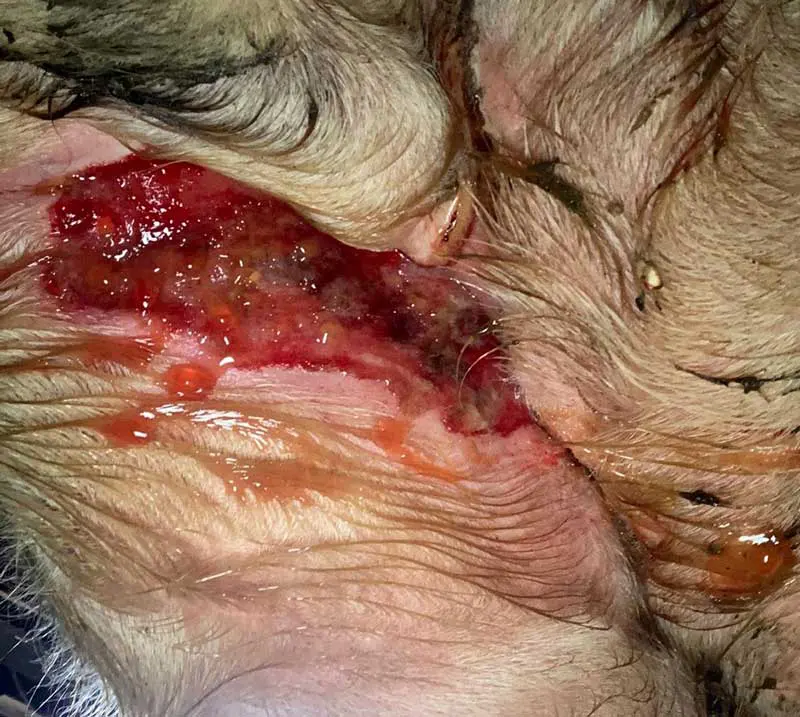
UCD is a common skin condition characterised by exudative dermatitis, which develops in the cleft at the fore udder attachment or between the two halves of the udder. It is accompanied by foul-smelling discharge. In some cases, it can lead to death due to haemorrhage following erosion into the milk vein, or as a result of pneumonia due to embolic spread of bacteria to the lungs.
While previous research had tentatively linked it to the treponemes that cause digital dermatitis (Stamm et al, 2009; Evans et al, 2010), more recent studies suggest it is caused by opportunistic anaerobic bacteria such as Trueperella pyogenes and Bacteroides pyogenes, following physical abrasion in the udder cleft (van Engelen et al, 2021).
Although the disease appears widespread in the UK, its actual prevalence has remained largely unknown until now.
Wanting to investigate the UK prevalence of UCD, the author and his colleague Nat Parker from LLM Farm Vets applied for a VetPartners research grant to carry out the project as part of a collaborative team of two vet techs and two students from Harper and Keele Veterinary School.
With clinical research support from Jenny Stavisky and Natalie Robinson at VetPartners, the project evolved from a clinical idea to a publishable study. The teams visited 28 randomly selected farms within a one-hour radius of LLM Whitchurch and examined a total of 8,302 cows for UCD lesions.
All lesions were assessed for severity and location. Other potential factors associated with both individual cows, and overall farm management, were recorded.
Between 14 March and 5 May 2023, the vet techs visited the farms with the students and inspected the cows once, either in the parlour during milking or in locking head yokes on automatic milking system farms. Springtime was selected because the end of winter housing was anticipated to be a peak period for identifying lesions.
The average herd size in the sample was 247 cows, higher than the current industry average of 183 (Defra, 2026). The most common breeds were Holstein and Holstein Friesian, although smaller numbers of herds were also using Scandinavian and Jersey genetics. Cows were mostly milked twice daily, although 14.8% of farms milked three times per day, using a variety of systems including automatic milking systems alongside rotary and herringbone parlours.
Fore udder attachment and udder depth were recorded, as these were highlighted as key risk factors in previous studies (Vermeersch et al, 2025). Deep udders were characterised as being below the hock, normal were level with the hock and tight were above the hock.
Loose fore udder attachment was recorded if there was less than a 90° angle in front of the udder, intermediate was noted if the udder angle was 90° to 160°, and tight angles were given to udders greater than 160°.
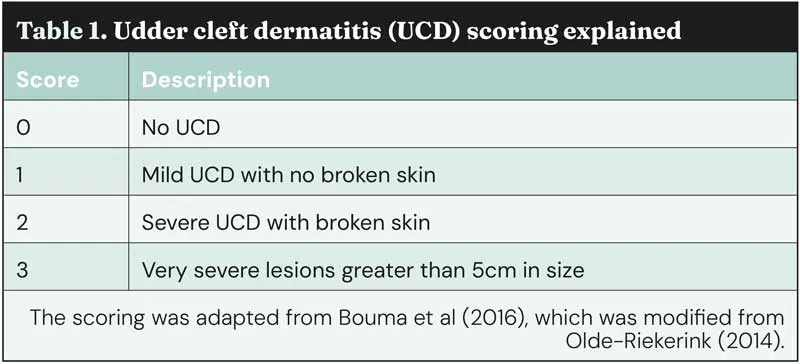
Using an extended mirror and head torch, the team also scored the severity of any UCD lesions on a 0 to 3 scale (Table 1) and recorded their locations.
At the same time, the body condition score of the animals, along with hock lesions and cleanliness, were recorded using the AHDB scorecards, with score 0 indicating no dirt and score 2 very dirty. A questionnaire was also completed to assess various management practices and herd factors, including annual milk production, foot bathing procedures, milking routines and bedding type.
The project, funded by VetPartners, was first published in the Journal of Dairy Science in April 2026.
UCD lesions were identified on all 28 participating farms. Within-herd prevalence averaged 9.9%, although it ranged widely within herds from 0.7% to 27.4%. Many farmers underestimated how common the condition was within their herds.
Anecdotally, farmers only appear to notice the condition when it starts to smell, but that smell is only the tip of the iceberg, as it generally only occurs once the lesions are severe.
Most affected cows had active lesions in the cleft at the fore udder attachment or in the cleft down the centre of the udder, and the lesions were largely severe (33.5%) or very severe (39.6%), indicating that lesions persist for a long time and are not being detected early enough.
Previous research highlights that healing is slow and recurrence is common (Bouma et al, 2016), and early detection is likely to be beneficial, given recovery rates are poor in severe cases (Ekman et al, 2021).
Consistent with previous studies (Olde Riekerink et al, 2014; Persson Waller et al, 2014; Puentes Garrido et al, 2025), the findings demonstrated that udder conformation was a risk factor. Cows with deep udders and loose fore udder attachment were four times more likely to have UCD lesions compared to cows with a strong fore udder attachment and tight udder.
Although not significant in the final statistical model, the data suggested that the environment also played a role. Preliminary analysis suggested sand bedding may play a role in the development of lesions, because sand enters the udder cleft, causing abrasions that become infected. However, this potential relationship was not borne out in the final analysis.
Furthermore, herds using automatic rope scrapers were 2.3 times more likely to have lesions, possibly due to contamination of the feet caused by the wave of slurry from the scraper. This can then create a wet, dirty environment around the udder cleft when cows lie down.
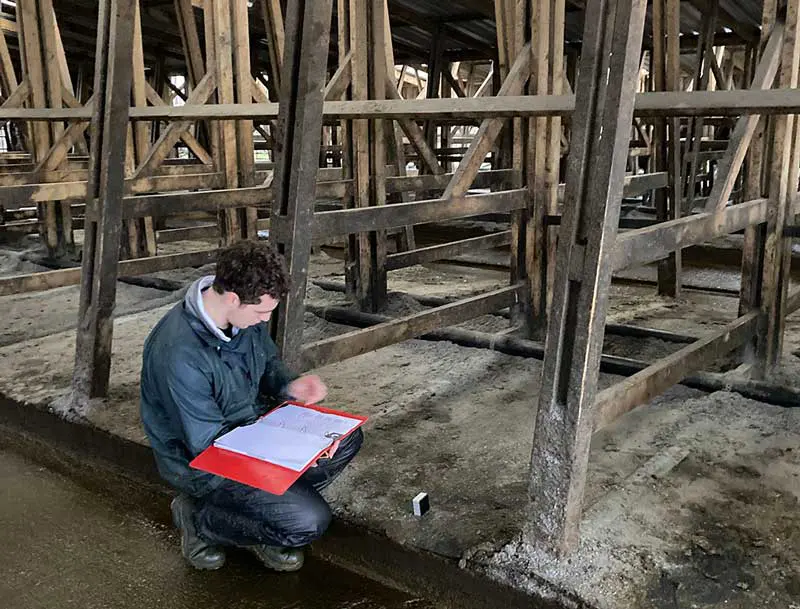
As next steps, it would be useful to take a deeper dive into the risk factors that lead to UCD.
Within the study, 39.6% of lesions were very severe (more than 5cm in length). Although the impact of UCD on production and welfare has not been assessed, it is highly likely that it is painful for cows. As with other chronic inflammatory conditions, such as mastitis and lameness, it is likely to have an impact on factors such as milk production, fertility and the risk of death or culling.
Further work is now required to understand how lesions could be most effectively treated to improve welfare.
As part of a subsequent project, led by vet tech development coordinator Natalie Parker from LLM, vet techs have been visiting affected farms to understand how to detect and treat UCD at an early stage. They have been screening cows during routine mobility scoring, so the farmer faces no additional cost.
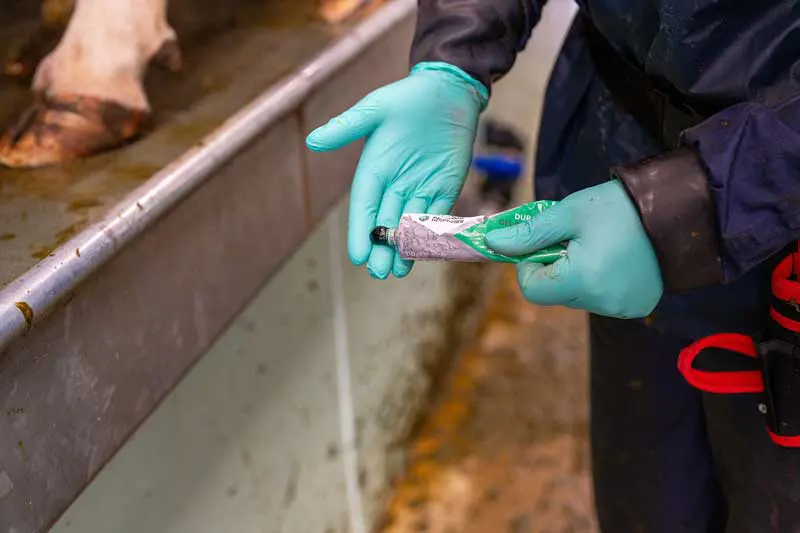
Animals with early-stage lesions have been successfully treated with a zinc-based gel bandage product, Ambugreen (NoBacz Healthcare). They were typically treated with the gel daily for seven days, then twice weekly for three further weeks, depending on the severity of lesions.
Severe lesions are proving more difficult to cure, although improvements in odour and discharge have been observed. Application of the product in the parlour has proven surprisingly easy and well-tolerated by the cows. This has aided compliance by the farmer with regular follow up treatments of the cows identified by the vet techs during herd screening. This supports previous studies showing that early detection is vital in reducing the prevalence of the condition (Ekman et al, 2021).
In addition to shedding light on prevalence in UK herds, the paper and ongoing farm research reinforce two key messages: early detection is critical to success, and udder conformation is a key risk factor.
Vets should be encouraged to have conversations with clients to emphasise that breeding for a strong fore udder attachment and tight udders (above the hock) can prevent UCD in the long term. Farmers should consider these traits when choosing bulls and selectively cull cows with poor udder conformation, as both will reduce the long-term risk of UCD within herds.
Sand should still be encouraged, as it is an optimal bedding material for preventing lameness and mastitis; however, good drainage and ventilation are critical to ensure sand does not stick to damp skin. Meanwhile, robotic scrapers can help keep the environment cleaner and reduce slurry contamination.
Better monitoring of the condition is needed on UK farms, as many farmers are unaware of its severity within their herds. Veterinary surgeons and vet techs have an important role to play in raising awareness of these lesions among farmers and in collaborating to implement routine checks, potentially in the milking parlour, where the lesions may be easier to identify.
In the short term, vets should build in detection and surveillance with farm clients to ensure the condition is treated at an early stage, when recovery is greater. In instances where the lesions are considered severe, vets should discuss use of NSAIDs with the farmer.
Will Gratwick grew up in Cheshire and graduated from the University of Liverpool in 2009. He started his career in rural mixed practice in north Wales, where he developed a keen interest in dairy herd health. To further this interest while having an adventure, Will moved to South Africa to complete a three-year residency programme and masters degree in cattle herd health at the University of Pretoria. Despite enjoying the climate and lifestyle of South Africa, in 2017 Will decided it was time to move back to the UK. After working in North Yorkshire he has returned home to the north-west to focus on dairy work at LLM Farm Vets.