
24 Mar 2026
Cara Hatfield BVetMed, AFHEA, DBR, MRCVS provides help on how preventive measures, including vaccinations and reduced antibiotics, can be conveyed to livestock keepers to help tackle calf mortality

Cara Hatfield
Job Title
Image: ahavelaar / Adobe Stock
Calf diarrhoea, or “scour”, remains one of the common causes of disease in neonatal and pre-weaned calves, with up to 80% of UK dairy farms experiencing issues and 50% having calf losses (MSD, 2020).
The mortality rate of calves that are inflicted with scour can be low in well-managed farms, but can be as high as 20% in severe cases (Uetake, 2012). Calves that suffered from scour have also been shown to reach the age at first calving later and give a lower first lactation yield (Tilling, 2018). Calf scour costs the UK cattle industry an estimated £11 million per year, as extensive gut damage leads to reduced lifetime performance (ADAS, 2013), highlighting the importance of prevention of the disease.
The causes of calf scour can be multifactorial, from non-infectious (such as nutritional scour) or infectious causes; viral (rotaviruses and coronaviruses), bacterial, such as enterotoxic Escherichia coli and Salmonella species, and protozoal (Cryptosporidium species and coccidiosis). Infections can be by a single agent or combined infections. It is important to note the infectious causes can also be isolated on farm, without being isolated as a causal agent within the animal. Therefore, the role of the environment, calf management and early detection of disease is vital to aid with prevention on farm.
Evidence suggests antibiotics have a therapeutic role in calf scours, with an overgrowth of E coli often occurring within the small intestine, irrespective of the inciting cause (Constable, 2004). However, blanket antimicrobial therapy for calf scours, without identification of the bacteria, can lead to selection for antimicrobial resistance (Maier et al, 2022).
The RUMA Task Force 3, in an aim to reduce mortality within the cattle sector, has set a new target to reduce oral antibiotics in calves by 10% this year (RUMA, 2025). This is a method of antibiotic use traditionally used by farmers to treat calf scours.
The VMD states that the 2024 sales of calf oral antibiotics sat at 4.03 (DDDVet), the highest measurement in the past eight years, indicating that farmer education around treatment of calf scour is needed (VMD, 2024).
The sources farmers may use for information on youngstock health are varied, may not include the involvement of a veterinary surgeon nor reach the responsible individual(s) for calf care (Baxter-Smith and Simpson, 2020).
Veterinary communication directly with farmers is needed to ensure correct and up-to-date guidance is used; however, this level of engagement can be challenging, with farmers often failing to be motivated to act on veterinary advice (Palczynski et al, 2022).
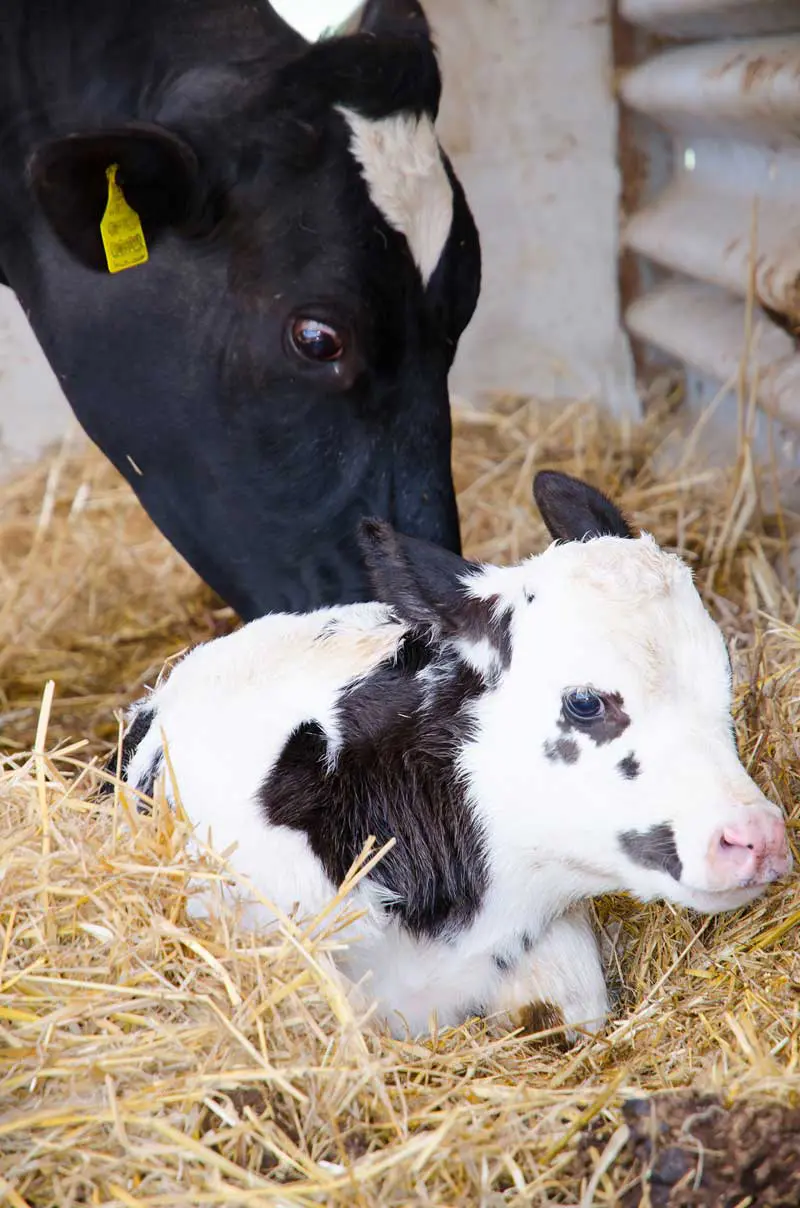
The key to prevention of calf scour is to ensure that the calf gets the best start to life; this includes reducing dystocia and subsequent faecal contamination at birth, as well as ensuring the calf is well fed and has a suitable, clean environment to grow in.
Calves are born with a naive immune system and are classed as agammaglobulinaemic (Sherwin and Down, 2018) and require passive transfer of immunity from their dam’s colostrum.
Maximising calves’ immunity through proper colostrum management is vital to offer them protection against the organisms that cause scour. How calves respond to the environment depends on their immune systems’ response (Puppel et al, 2019). Calves that fail to get passive transfer from colostrum are 1.5 times more likely to get scour, which can cost around £55 for dairy calves and £75 for beef calves (Raboisson et al, 2016). By focusing on the recommended 5 Qs (MSD, 2023), colostrum management can be focused on farm.
Quality. Ensuring only good quality colostrum is fed, by utilising either a Brix refractometer or colostrometer. Vaccination can boost the protective quality of a dam’s colostrum.
Quantity. Give at least 10% of a calf’s bodyweight within the first four hours of birth, and a remaining 5% within six hours. This usually equates to 6L within 12 hours of birth for dairy calves (Mainau et al, 2025). This can be tube fed, if needed. Ensure clients give sufficiently by establishing protocols with clear amounts to be given and timings.
Quickly. A dam’s colostrum quality declines rapidly after a calf’s birth, as does the absorption capability of the calf’s gastrointestinal tract for the immunoglobulins present in the colostrum. Ensuring the calf has had the right amount of colostrum within six to 12 hours of birth is vital. Maintaining colostrum/transition milk feeding for the first five to seven days is also beneficial and a factor for some scour vaccination protocols.
SQueaky clean. Contamination of colostrum and the feeding equipment used can lead to a failure of passive transfer (FPT), and can enable infection to develop – particularly if an outbreak occurs on farm. Good hygiene is needed when handling and feeding colostrum/milk to calves. If you have children, think how particular we are with their bottles and teats; the same should apply to calves.
Quantify. Monitoring the occurrence of FPT on farm can help prevent scour infections through identification of those animals at a greater risk of disease. As a vet, monitoring IgG concentrations in the first week of life, through serum or whole blood, is a key tool in identifying if FPT is impacting the disease incidence on farm and helps with prevention of disease in young calves.
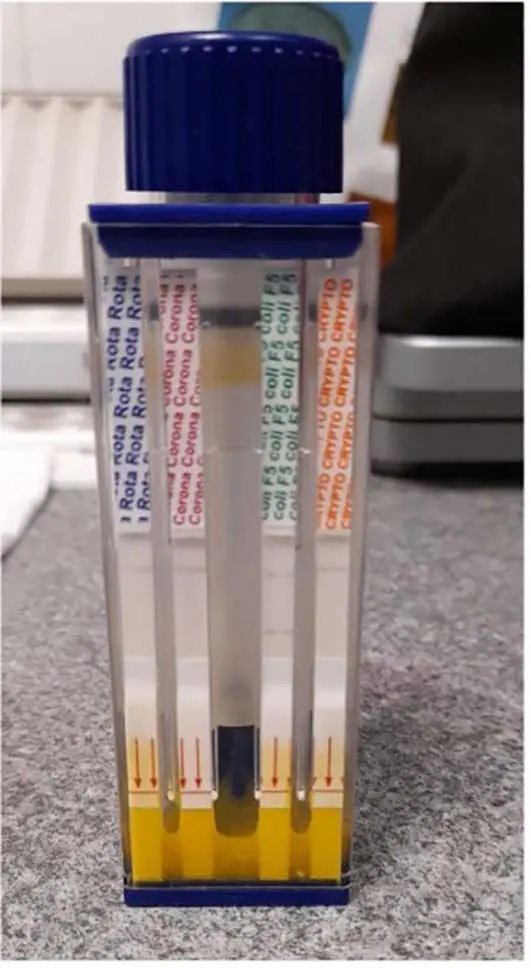
Diagnosis of the scour pathogens present on farm is needed to target which preventive/treatment options are the most suitable. Calf scour cannot be diagnosed from the scour consistency alone (Tilling, 2018). Quick on-farm assessment, using scour check kits (Figure 1), can identify if viral (rotavirus or coronavirus), bacterial (E coli) or protozoal (Cryptosporidium) pathogens are present.
Samples should be taken directly from the rectum to prevent environmental contamination. Samples can also be submitted to a veterinary laboratory for investigation (especially if Salmonella or coccidiosis is suspected), as can fresh cadavers (died within 24 hours).
The advantage of a laboratory submission, over on-farm investigation, is it allows for further testing to take place, if required. Once a pathogen or combination of pathogens have been identified, a standard operating procedure should be put in place on farm to tackle and, ultimately, prevent further issues.
As calf scour has a number of causes, good biosecurity on farm and maintenance of a clean environment are important to help prevent and reduce the spread of disease. Calving pens should be kept clean and not overstocked.
Calves affected with scour should be isolated to minimise spread. Calf housing, whether individual pens or group yards, should be mucked out regularly, steam cleaned, disinfected and left to dry. Removing faecal contamination from any feeding equipment – especially if it is shared – will not only prevent spread, but allows full penetration of the disinfection and maximum efficacy. This also applies to calf housing.
Ensuring that faecal contamination from adult or older cattle does not come into contact with young calves is also important, and disinfecting areas before entry to calf housing should be implemented. A summary of commonly used disinfectants, active against the main calf scour causal agents, can be found on Defra’s website (Defra, 2024).
As well as biosecurity, the environment a calf is raised in will affect not only its exposure to pathogens, but its ability to fight disease. Mixing of age groups and high stocking densities should be avoided – especially with regards to Cryptosporidium – as older calves can continue to shed a large number of oocysts, even after immunity has developed (MSD, 2023). Calves should be kept warm and dry, as having to generate heat will take anergy away from the immune system. Good drainage is also needed, as a damp environment encourages pathogen proliferation and keeps the area cold. Adequate ventilation (without draughts) will also aid with reducing pathogen survival (Cox, 1987).
Vaccination against neonatal calf scour is common practice within the UK (Sherwin and Down, 2018), although it still remains underutilised (Baxter-Smith and Simpson, 2020). It often relies on the transfer of immunoglobulins from vaccinated dams through the colostrum.
Vaccination of the dam, over the neonatal calf, is more beneficial due to calves’ underdeveloped immune systems at this stage and the presence of maternally derived antibodies, which interfere with the vaccine antibodies (Sherwin and Down, 2018). This does mean, however, that vaccine success is dependent on good colostrum management and adequate passive transfer (Sherwin and Down, 2018). Calves that have received colostrum from vaccinated dams have been shown to have a higher level of immunoglobulins, a reduction in clinical disease from scour and less shedding of pathogens (Reijnders et al, 2025; Sherwin and Down, 2018).
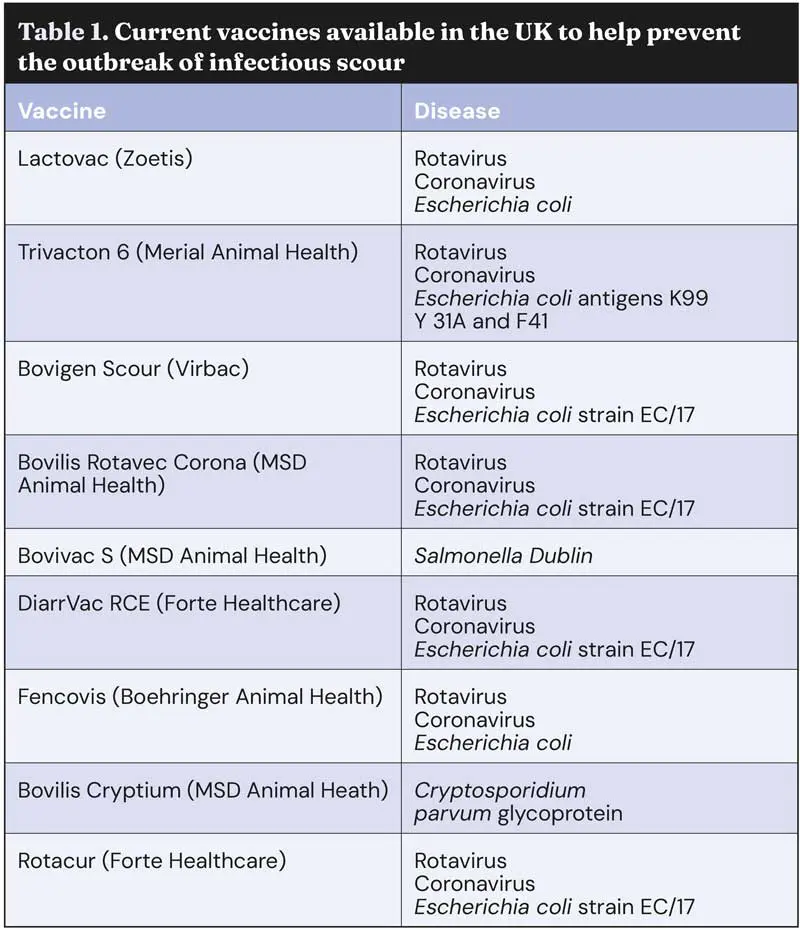
A summary of current available vaccines in the UK for calf scour is shown in Table 1. Products are also licensed for the prevention and treatment of infectious protozoal causes, which include halofuginone for Cryptosporidium and anti-coccidiostats for coccidiosis. Both types of treatments can be used prophylactically, although a diagnosis of the diseases should be confirmed beforehand – especially as halofuginone is toxic at twice the therapeutic dose rate (NOAH, 2025).
Probiotics have become more popular within the farming community – especially following the recommendation not to blanket treat with antibiotics, plus the requirement to reduce antibiotic use as a whole.
In human medicine, the efficacy of such products has come into question, but some evidence shows specific probiotics have been beneficial when treating acute infectious diarrhoea (Domingo, 2017). The author has noted positive results when these products have been used on farm, but without further knowledge and research on the products available, it would be prudent to still use them with caution.
It is likely probiotics would have a role in calf scour prevention, but when used alongside the already existing management and preventive strategies.
The vet-farmer relationship is one that takes time to establish and can offer specific challenges whenever vets are advising on a change in management protocols – especially if a disease outbreak has occurred. It is often the case farms have a low-level of engagement with vets on the day-to-day management of calves (Mahendran et al, 2022), a solution to which can be implementing standard operating procedures, which allow for vet involvement and guide farmers on best practices.
Record keeping on farm for calf health and diseases can be poor (Ellingsen et al, 2012) and farms do not always value calf management as a high enough priority (Mills et al, 2020). Using scoring charts (AHDB, 2025) can not only assist with recording of calf scour, but also help with the implementation of prompt treatment and aid with appropriate preventive strategies.
Giving farmers tools to help identify disease will ultimately lead to better welfare on farm and farmer education, and help bridge any gaps in communication barriers.