
11 Nov 2025
Graham Duncanson FRCVS recalls some of what he learned – and remembered – during his time in Kenya.

Graham Duncanson
Job Title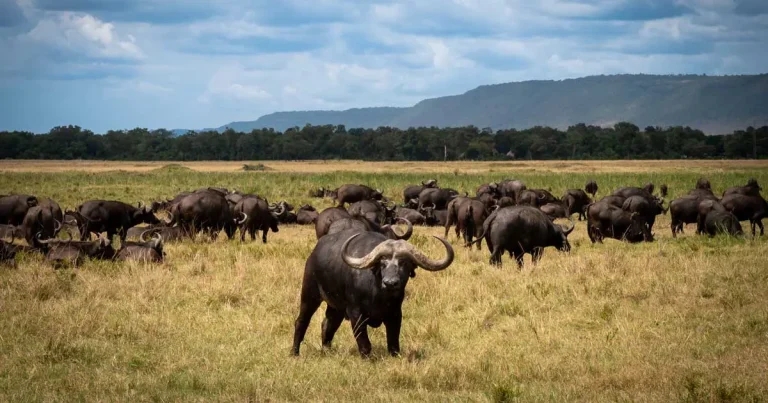
I never did test one of these cape buffalos for BTV. Image: chrissie / Adobe Stock
It was Saturday morning on the 31 December 1966. It was 8am and I had just arrived at my rather smelly office at Changanwe. It was smelly because it was beside the Mombasa public tip and it overlooked the Kenya meat commission Mombasa abattoir and the Mombasa town dairies.
I was also smelly as I had just been to the town dairies to deliver a calf on the veterinary bicycle. The reason that I was on a bicycle was that I had only been in the country three weeks and my government loan to buy a car had yet to be approved. You might rightly wonder how a large animal practising vet could carry his equipment on a bicycle. It belonged to the veterinary department and was normally ridden by Jacob Messenger and had a large basket on the front in which was a hessian bag containing my stethoscope, a thermometer, some microscope slides, some universal blood bottles, some scalpel blades, some syringes and needles, a bottle of penicillin, a bottle of oxytetracycline, a bottle of water for injection, a few sachets of Berenil, three calving ropes and three foot-long lengths of broomstick.
Jacob came in with a cup of African tea made by boiling water, milk and tea leaves together in a saucepan. It was different from tea that my mother brewed, but it was safe from the danger of brucellosis. Interestingly, Kenya was free of bovine TB at that time. Jacob informed me that the provincial veterinary officer Geoffry Smith, my immediate boss, demanded my presence in his air-conditioned office – mine only had a rather noisy overhead fan.
My orders were to go up to Wundanyi in the Taita Hills and “fly the veterinary flag” with other civil servants to welcome president Jomo Kenyatta. I had to get a move on as this was a journey of 150 miles. The first 50 miles was on tarmac, but the rest was on “red murram”. I would be driven by the cheerful Chaiko, a veterinary driver, who would help me to learn Swahili. The president would be speaking in Swahili, but everyone knew that his English was fluent. Chaiko was a fast but competent driver, and we arrived an hour before the president was due to arrive and open Wundanyi Agricultural Show. There was no vet in Wundanyi. The district was run by a livestock officer named Michael Gituru he asked me to come with him to look at some sheep and goats, which were dribbling from their mouths and nostrils. I was extremely alarmed as I imagined the drama if I had to put the whole district in quarantine for foot and mouth disease (FMD).
Although I had only been qualified six months, I had used my time wisely. I had spent five months doing two locum placements, one totally farm animal and the other a mixed practice. I had also spent three weeks at the School of Tropical Veterinary Medicine at Easter Bush. I had been showed several films of tropical virus diseases. I was confident that I would recognise FMD in sheep or cattle. I examined the animals carefully. They were a mixture of approximately 30 hair sheep and goats. I was confident that they did not have FMD. I was at a loss to know what disease they were suffering from. They were very ill, but were not suffering from diarrhoea, so I was pretty certain that they did not have peste des petits ruminants or even Nairobi sheep disease. My first guess was malignant catarrhal fever (MCF), but then I remembered the guys in Edinburgh saying in Kenya the normal host was the wildebeest whose Swahili name was gnu. I asked Michael if there were any gnu in the Taita Hills. He laughed and said: “We are nearly 6,000ft here. It is too cold for gnu. You get them in Masailand.”
Michael talking about cold triggered my memory. I said, “Michael, you have been very helpful. These animals have got a virus disease spread by midges called bluetongue. We will take some samples from these sores in their mouths together with some blood samples both from the sick animals as well as the animals that were sick sometime ago. I will get you to send one of your veterinary scouts with them in a thermos and take them to the diagnosis department at Kabete. He can probably get a ride in a police car returning to Nairobi with the president.”
So that is what happened. I stood in line to shake hands with the president after he had made his speech. Chaiko then drove me back to Mombasa. I still had enough energy to take a girl called Annie who was down on holiday from Nairobi to a New Year’s Eve party at the Mombasa Sports Club that night. She worked for the Wildlife Society. I nicknamed her Wildlife Annie as she insisted on me bicycling her back to the Manor Hotel in Mombasa sitting in the basket of Jacob’s bicycle. I then went to my lodgings, which was the very grotty hotel called The Hotel Splendeed. Mercifully, I moved out in a few days when I had been allocated a government house.
It was 10 days later that I got the good news that the sheep had indeed been suffering from bluetongue. I then got a bollocking from Geoff Smith for not putting Taita District in quarantine for bluetongue. However, I was lucky because Michael said that there had been no other cases reported to him and as the Taita Hills was a very isolated area surrounded to some extent by the vast area of Tsavo West National Park there were no other cases reported in the whole Coast Province.
I did not see another case of bluetongue for six years. I had risen to the exulted heights of acting assistant director of veterinary services (ADVS) in Rift Valley Province when I met up with a very good Norwegian vet, Asbjorn Rodum, in Molo district who was at a loss to know what was making some of the wool sheep in his area die. We went out for an enjoyable lunch at The Highlands Hotel, after he had shown some of the dying sheep. As we got into our respective Land Rovers I reminded him to put Molo district in quarantine for bluetongue.
I will always be grateful for my eight years in Kenya. I learned a lot. What is so annoying is my memories of that time are crystal clear and yet I can’t remember the name of the treasurer of the Equine Veterinary Dental Association. If he reads this, can he send me an invoice for my annual subscription.