25 Nov 2025
Paul Doran MA, VetMB, MRCVS summarises the discussions and findings from the recent Break the Pain vet conference and roundtable meeting.

Paul Doran
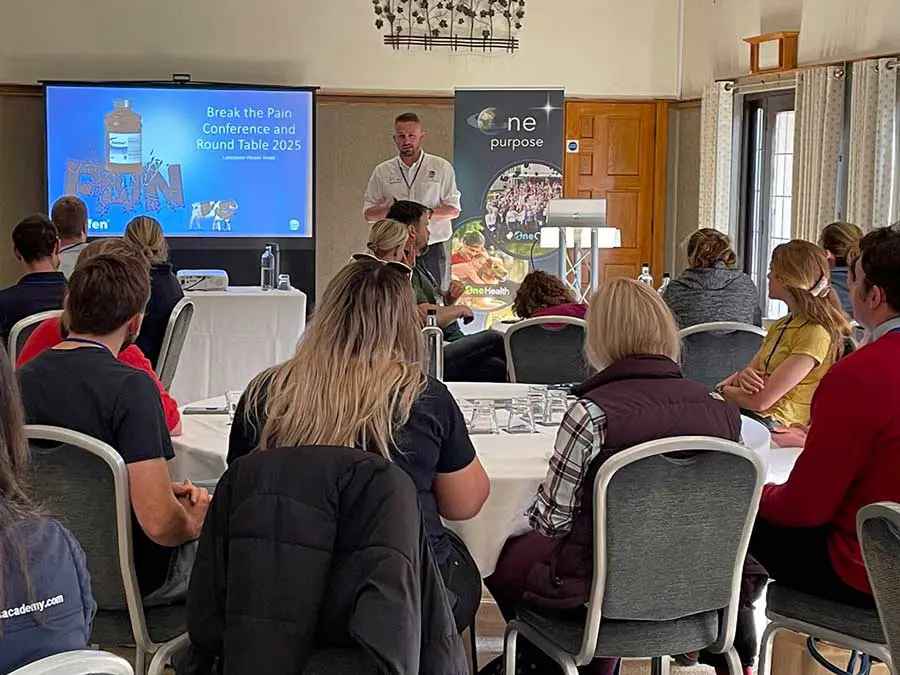
Job TitleCeva Animal Health hosted its second Break the Pain vet conference and round table meeting earlier this year, which brought together 40 farm vets from around the country to learn more about the most-current thinking on NSAID use in the dairy cow and to challenge barriers to pain management.
Taking place at the Lancaster House Hotel in Lancaster, the conference featured presentations on the extensive role of NSAIDs in pain relief at calving1, for the treatment of pain and lameness associated with digital dermatitis2 and for managing mobility on farm3.
The speakers included Nicola Gladden, farm animal clinical assistant professor at the University of Nottingham; James Wilson, foot health consultant at Herd Health Consultancy; Bethany Griffiths, veterinary surgeon at Farm Gate Vets in Cumbria; Emily Craven, PhD student at the University of Nottingham; and veterinary epidemiologist Natalie Robinson.
Nick Bell, director of Herd Health Consultancy, facilitated the round table discussion.
A key finding from the conference was that vets and farmers frequently under-used pain relief for dairy cows4.
A discrepancy was also found between vets’ perceptions of farmers’ willingness to pay and farmers’ actual readiness to provide pain relief, with cost of NSAIDs not being a significant concern for farmers.
Concerns pertaining to cost may be further ameliorated by the proven productivity gains of using NSAIDs strategically, with a substantial return on investment of £1.66 for every £1 invested3.
Vets should not make assumptions when it comes to pain relief and spend time with clients to investigate their thoughts on NSAIDs.
It was also suggested during the conference that perhaps the term “anti-inflammatories” would get more buy-in from farmers than pain relief, due to this terminology being commonly used in human health.
The disparity in the perception of pain among the on-farm mobility team – which includes vets, vet technicians, hoof trimmers and farmers – was also discussed, with research demonstrating that farmers consistently scored pain lower than vets, and usually lower than foot trimmers and vet technicians4. It is, therefore, advisable to spend time with the whole mobility team to help identify any disparity in mobility scoring and offer training, as appropriate, to try to ensure consistency.
Another key finding highlighted was that only 50% of farmers were found to be using NSAIDs for conditions such as active digital dermatitis4, a painful condition that is one of the most frequently recorded diseases associated with lameness in dairy cows2.
During the conference, the speakers revealed the extensive role of NSAIDs in three key areas: calving; for the treatment of pain and lameness associated with digital dermatitis; and for managing mobility on farm.
A snapshot of the research presented includes the following.
We, as a profession, are missing opportunities when it comes to discussing pain relief in cows. It is important to question ourselves, our protocols and how we communicate with farmers. Adapting to each farmer’s unique communication style is essential for effective interaction.
It is also advisable to keep communication practical and non-judgemental, in a bid to improve both welfare and production.