
20 Jul 2026
Nicola Lakeman MSc, BSc(Hons), CertSAN CertVNECC, VTS(Nutrition), RVN discusses the risks and strategies to treat the older animal.

Nicola Lakeman
Job Title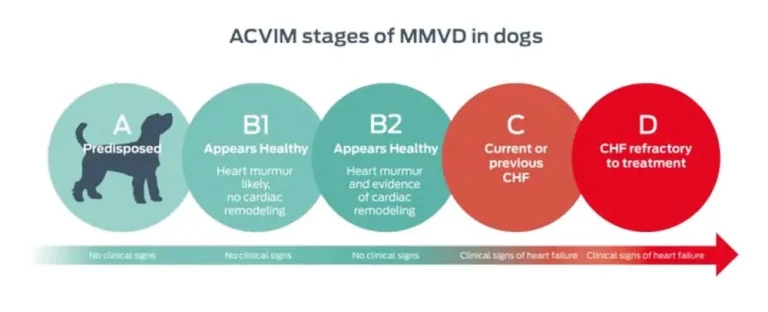
Figure 1: ACVIM stages of MMVD in dogs3.
Lifespan is the total number of years an individual lives, while healthspan is the period of life spent in good health, free from chronic disease and serious disability. The goal of modern veterinary medicine and lifestyle management is to close the gap between these two, aiming for a long life that is also healthy.
Globally in humans, a nine to 10-year difference exists between lifespan and healthspan, meaning people often spend their final decade in poor health. In the US, this gap was 12.4 years in 20241.
The goal of longevity medicine is to “compress morbidity”, pushing illness into a tiny window at the very end of life – closing the gap. Research in human medicine highlights lifestyle pillars:
The correct diet is a vital aspect in maintaining health and in the management of disease. Understanding nutrition and its role in both health and disease is an important skill for all veterinary professionals, and your advice will frequently be sought by your clients. Understanding the principal components of healthy nutrition allows you to recommend a balanced diet that avoids both nutritional excess and deficiency. It is important before any nutritional recommendation that a full diet history is taken and a nutritional assessment of the animal made.
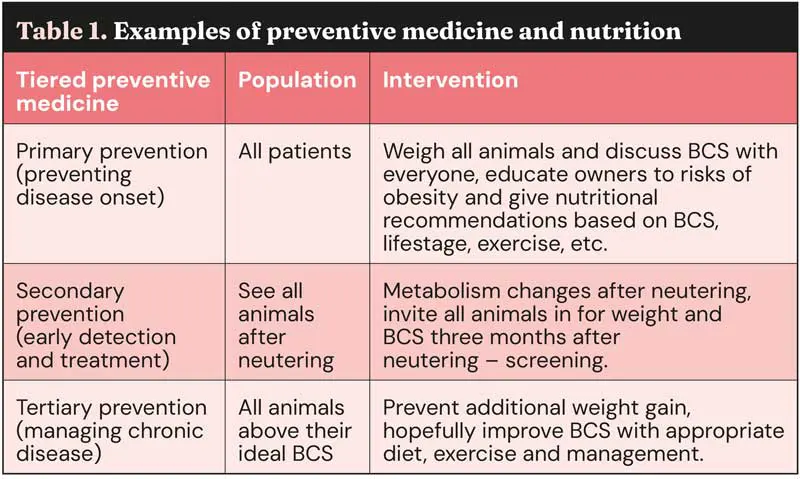
The role of nutrition in increasing healthspans is through preventive medicine, which has three tiers.
Primary prevention (preventing disease onset). Targets healthy individuals to stop disease before it starts by reducing risk factors. Examples in veterinary medicine include vaccinations, parasite control, and healthy lifestyle education.
Secondary prevention (early detection and treatment). Focuses on detecting disease in its early, often asymptomatic, stages to halt its progression. Examples include senior health care tests, regular weight checks and blood pressure checks.
Tertiary prevention (managing chronic disease). Aims to reduce the impact of an established, long-term disease by preventing complications and comorbidities and thereby maximising quality of life and healthspan. Examples include cardiac, diabetes, renal management programmes, and chronic pain management.
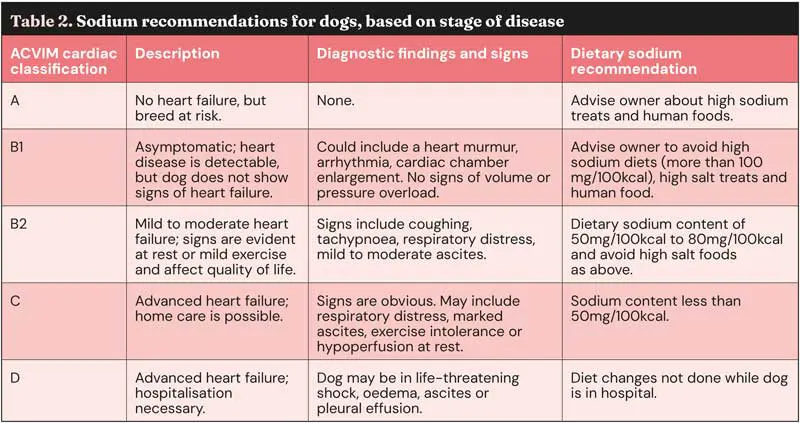
Where we know there is risk – for example, breeds predisposed to specific disease processes, like a cavalier King Charles spaniel with myxomatous mitral valve disease (MMVD) – we can improve healthspan and lifespan with nutrition. Obtaining and maintaining an ideal BCS is one element; use of the ACVIM consensus statement for stage A (predisposed breeds) recommends education surrounding low salt diets, alongside use of essential fatty acids (EFAs)3. Defined nutritional recommendations have been made for MMVD dogs (Table 2) based on the ACVIM classification (Figure 1)3,4. Reducing risk ultimately helps to increase the healthspan and lifespan of an individual. Understanding the risks of populations, breeds and species can help with the personalisation of recommendations for that individual. Every animal needs to be assessed as an individual in all aspects, not just nutrition.
The nutrition of older cats can be complex and very dependent on the individual, and there is an argument that there is no one singular diet that could be recommended for all senior cats. A nutritional assessment should be performed on all patients at every appropriate point of contact. A nutritional assessment comprises of weight, BCS, muscle condition score and nutrition history (what, where, how they eat; including behavioural aspects as these are especially important in cats).
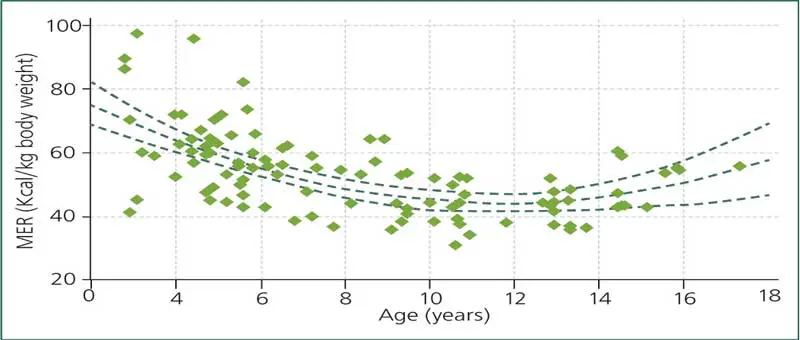
The proposed nutritional requirements for senior cats were traditionally fewer calories (as they are more inactive), lower protein levels, softer kibbles and a reduction in sodium and phosphorus in the diet. Studies on ageing factors in senior cats concluded that the energy requirements do alter and can increase once geriatric stages are reached5. Different stages of senior life will require different energy requirements alongside different disease processes, and a possible reduction in activity if osteoarthritis is present will also influence energy requirements. Recommendations are made that the nutritional assessment be undertaken to make the assessment of these energy requirements.
A reduction in renal function should be considered in all senior animals, and a reduction in protein quantities within the diet could be beneficial if renal damage has occurred6. The quality (the biological value) of the protein should be increased as skeletal muscle mass reduces, which also reduces any protein or amino acid reserves. Some life stage diets do not have a decrease in protein levels, as some consider that restricted protein levels are not required until there is direct evidence of renal impairment6.
Protein restriction in feline senior diets should be avoided. Cats are especially sensitive to decreases in protein levels within the diet. This is due to the inability to downgrade protein metabolism pathways. Reduced fat digestibility is also experienced in geriatric cats7. In healthy adult cats, protein digestibility is typically 85% to 90%. In geriatric cats this digestibility can be reduced to less than 77%8. Diets with a severely restricted protein level or proteins of a low quality/biological value can predispose cats above 12 years to negative nitrogen balance, and loss of lean body mass7.
The restriction of phosphorus in the diet does play a significant role in the prevention of renal impairment8. A decrease in kidney function can also lead to an increased loss of the water-soluble vitamins, due to the kidneys’ decreased ability to concentrate the urine. This can also lead to a reduction in the hydration levels of the animal. Senior animals have a reduced sensitivity to thirst, and thus there is a greater risk of dehydration in these animals.
Increasing water consumption can be achieved in a number of different ways, such as feeding a moist diet rather than a dry diet and increasing the availability of water. Increasing the number of bowls (including types) around the house and allowing water to stand for a period of time prior to being offered to some animals can be beneficial. This allows the chlorine in the water to evaporate off, which some animals do prefer. Use of water fountains can also help to increase water intake.
Ideally, phosphate-free hydration broths can aid in increasing calorific intake alongside hydration without an increase in phosphate. As part of the nursing clinic, it is important to discuss with the client how to monitor hydration levels. Demonstrating monitoring of clinical signs can help the client in the care of their pet. This can include testing for skin tenting, tacky mucous membranes and the colour of membranes. If pet owners know what is normal, when the animal becomes unwell – or the renal disease progresses – they can flag this to the practice more quickly. Ultimately, this increases the welfare of the animal.
As the animal ages, smell is the first sense to decline. As the animal’s sense of smell deteriorates, the animal may eat less. The aroma of the diet is particularly important in diets aimed at senior animals to encourage consumption. Wet diets do smell more than dry, although it should be remembered that a cat’s dietary preference is also based on the texture of the diet9.
Diets supplemented with antioxidants, prebiotics and fatty acids had significantly higher average serum vitamin E levels, and significantly better maintained bodyweight and lean body mass, skin thickness and haematocrit values in comparison to cats on the control diet, as well as a more beneficial faecal microbiota balance. Overall quality of life did appear better, but not measured10.
Many senior feline diets now have medium-chain triglycerides (MCTs) supplemented within them. MCTs are a subgroup of fats converted to ketone bodies in the liver and are used as the preferential source of energy by cerebral cells. Long-chain triglycerides (the fats usually found in the diet) are utilised differently within the body. Supplementation with MCTs has demonstrated improved cognitive function in older dogs11, although no effects have been demonstrated in cats. A diet supplemented with a blend of 5.5% MCTs showed improvements in the trainability of dogs (with the ability to learn new tasks more quickly). Increased interactivity with others and interest in play, plus improvements in alertness, when compared to a control group were also noted7. These MCTs were obtained from the addition of coconut oils to the diet. This is thought to be due to the ketone bodies improving mitochondrial function, increasing polyunsaturated fatty acids content in the brain and decreasing amyloid precursor protein12,13.
Osteoarthritis is a common radiographic finding in older cats, with a prevalence of up to 90% in appendicular joints14. A randomised, controlled, double-blinded prospective clinical study examined a diet high in fish oil, green-lipped mussel extract and glucosamine/chondroitin in client-owned osteoarthritic cats. The authors found that osteoarthritic cats receiving the diet, as compared with a control group, were more active as measured objectively with a collar-mounted accelerometer across a nine-week period15. Although this is not direct evidence of improvement, it was theorised that increased activity reflected decreased pain associated with OA.
Many manufacturers of senior diets don’t emphasise the importance of dietary fibre for cats. The animal itself cannot digest soluble fibre in the diet, but the microbes within the intestine can. Soluble fibre is fermented into short-chain fatty acids or volatile fatty acids. These products are an important energy source for the intestinal cells and can increase blood flow to the intestine.
Nitrogenous waste products in the blood are presented to the intestinal lumen, where urease, an enzyme produced by intestinal bacteria, hydrolyses the urea into ammonia and carbon dioxide. The ammonia is then utilised by the intestinal bacteria.
This process means that nitrogenous waste products are excreted in faecal matter, rather than in urine by the kidneys. Dietary fibre may also be beneficial for improving gastrointestinal motility and colonic transit times in cats. This is debated due to a decrease in overall mobility of the cat, a potential decrease in water intake or through nutritional changes.
Nicola Lakeman works as the nutrition manager for IVC Evidensia. Nicola graduated from Hartpury College with an honours degree in equine science and subsequently qualified as a veterinary nurse in 2002. Nicola has written for many veterinary publications, is the editor of Aspinall’s Complete Textbook of Veterinary Nursing and one of the consultant editors for The Veterinary Nurse. She has won the BVNA/Blue Cross award for animal welfare, the SQP Veterinary Nurse of the Year, the SQP Nutritional Advisor of the Year and, in 2024, the BSAVA Bruce Vivash Jones Award, which is presented annually by the BSAVA. Nicola has recently gained her Master’s degree in advanced veterinary nursing from the University of Glasgow.