
17 Nov 2026
Kit Sturgess MA, VetMB, PhD, CertVR, DSAM, CertVC, FRCVS advises how practitioners can approach these cases, including responsible use of antibiotics.

Kit Sturgess
Job Title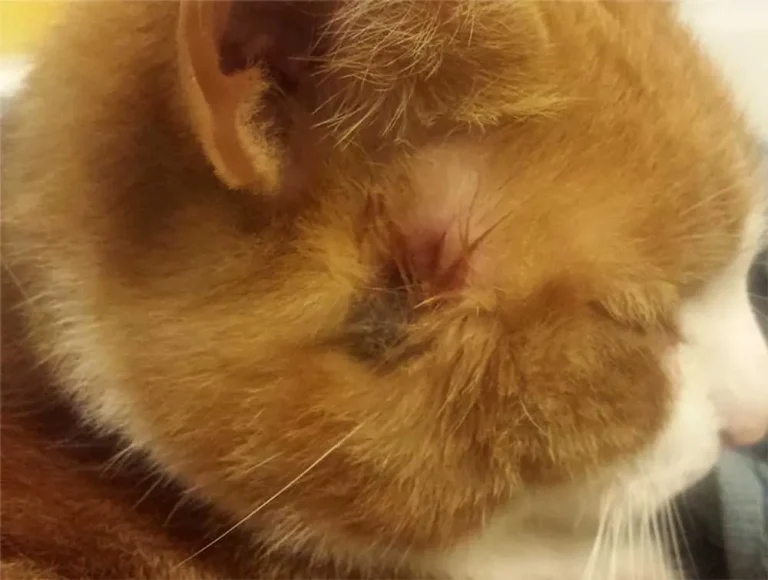
Figure 1. Draining cat bite abscess. Image: Courtesy of Fergus Allerton and Willows Veterinary Centre and Referral Service
Most cat bite abscesses heal with drainage, flushing and pain relief alone. Systemic antibiotics are needed only for a minority of cases.
In one UK first opinion audit, 86% of 22 fit, afebrile cats with a discrete abscess recovered without the need for antibiosis (White Lodge Veterinary Surgery, 2023). In the re-audit, 86.6% (of 52 cats) did not require antimicrobial treatment.
Even so, fight wounds and abscesses remain a common reason cats receive antibiotics. Surveys suggest:
Amoxicillin-clavulanate is the most commonly prescribed antimicrobial (60%) with cefovecin second (25%). Skin infections accounted for 48% of cefovecin use in UK cats (Burke et al, 2017). Cefovecin is a third-generation cephalosporin and a highest-priority critically important antimicrobial (HPCIA).
Cat bites and cat scratches are different, both in terms of the trauma they create and the bacteria involved. Several studies have been conducted on the flora of cat claws, with staphylococci being most frequently isolated (Portilho et al, 2024).
Enterobacteria (Salmonella species and Escherichia coli) and streptococci were also present along with yeasts. Around 20% of isolates are multidrug resistant, with outdoor cats tending to have a greater variety of species. Using nested PCR, Kim et al (2009) found Bartonella henselae (cat scratch fever) in 42.7% of feral cats and 29.5% of pet cats in Korea. In some areas of the world, Sporothrix species can be transferred by cat scratches.
The majority of cat scratch wounds in cats are relatively superficial and self limiting, unless the claw happens to puncture a sensitive area, such as through the cornea.
The narrow canines of cats mean that cat bites tend to push oral bacteria deep into the subcutis through a tiny puncture which seals over within hours. Soft tissue damage deep to the puncture wound can be more extensive due to the mobility of the skin over the subcutis, but this tends to be less than dog bites. The trapped bacteria multiply in the dead space and cause cellulitis. Within two to four days, this usually becomes a walled-off abscess.
The infection reflects normal feline oral flora and is almost always mixed. Typical organisms are Pasteurella multocida and obligate anaerobes such as Bacteroides, Fusobacterium, Porphyromonas and Prevotella species.
Dobbinson and Tannock (1985) found anaerobes in 10 of 11 feline subcutaneous abscesses, usually mixed with facultative species. These organisms are generally susceptible to penicillins; in a pooled series of 482 cases of Pasteurella multocida infection in people, of which 54% were cat associated, only 18 cases were beta-lactam resistant (Wei et al, 2025). Staphylococcus and other skin commensals are less common.
Common sites are:
Diagnosis is usually clinical, from the history and examination, but a cat’s coat will hide much of the damage, and if they groom the area any dried blood will be removed, so the impact of a fight will not be evident until cellulitis occurs and/or an abscess forms.
Fight and bite wounds typically affect outdoor or indoor cats – especially entire male cats. Fights can escalate when a new cat (especially an unneutered male) enters a neighbourhood and territory disputes occur.
Signs vary from localised pain, swelling, a discharging sinus, lameness, inability to raise the tail, and mild inappetence. More rarely, systemic signs associated with marked lethargy or inappetence are present.
For the vast majority of cat scratches and cat bites, further investigation is not necessary. Culture of an uncomplicated wound/abscess is unhelpful, as antibiotics are unnecessary.
Investigate when:
Tests to consider:
For the vast majority of superficial cat scratches, topical antiseptic is sufficient (Figure 2).
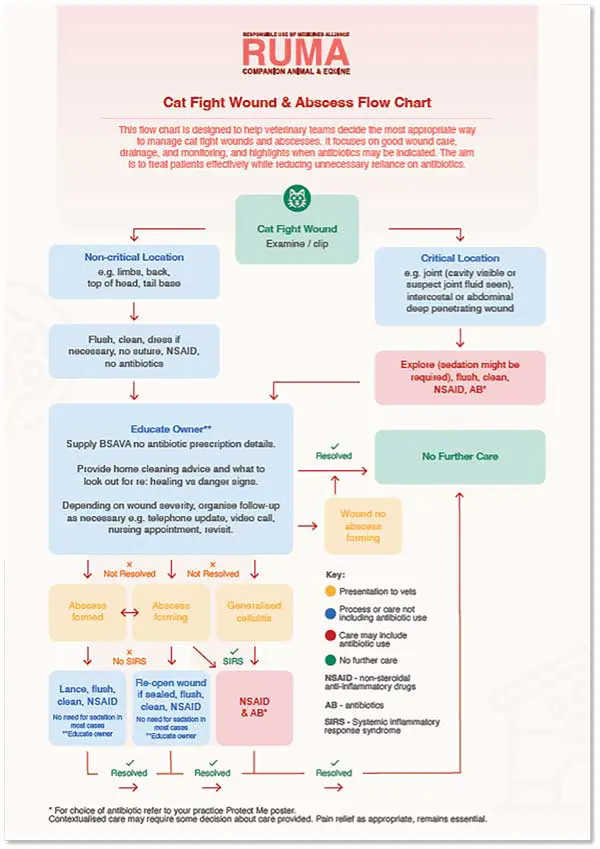
For most abscesses (85% of uncomplicated afebrile cases) that are appropriately mature, lancing, drainage and flushing with pain relief (NSAIDs unless contraindicated) are sufficient.
If appropriate, debride any dead tissue. Flush with sterile saline or Hartmann’s solution; no evidence exists to suggest an advantage in using antiseptics such as chlorhexidine or povidone-iodine instilling antibiotics.
Hydrogen peroxide is tissue toxic and has weak antimicrobial activity; it should not be used, and a low but potentially very serious risk of gas embolism exists.
Use about 7psi to 8psi (jet goes 30cm to 60cm before arcing), achieved with a 30ml to 35ml syringe and an 18G to 19G needle or catheter; this removes bacteria without driving them deeper.
If antiseptics are considered, use 0.05% chlorhexidine or dilute povidone-iodine (0.1% to 1%, the colour of weak tea).
Antibiotics should not be instilled after flushing.
Leave the wound open to drain. At-home care is not generally necessary; the benefit of keeping the abscess open and draining by bathing in warm salt water is unknown.
Antibiotics are only usually required if any of the following is present:
Even in these cases, if an abscess is formed, this should be lanced, drained and flushed.
Many cats tolerate lancing conscious or with light sedation. General anaesthesia is rarely necessary unless extensive intervention is required or the risk of damage to the structure or adjacent structures is high.
Often, an area of dead skin which has turned purple/black and hard will be present, and there is no skin sensation in this area, so lancing is painless. Little benefit exists in introducing local anaesthetic, as the pain associated with this is at a similar level to lancing and sufficient time needs to be given with the cat held or confined for the local anaesthetic to work (lidocaine takes two to five minutes, mepivacaine five minutes, bupivacaine 10 to 20 minutes, and topical local anaesthetic creams such as Emla take 30 to 60 minutes under an occlusive dressing). Inflamed, infected or abscessed tissue slows onset and reduces effectiveness, because less drug is in the un-ionised form that crosses nerve membranes.
For the majority of cats, NSAIDs are the treatment of choice. If the cat is experiencing significant pain, buprenorphine on the day of drainage can be given. Analgesia improves welfare and appetite, and is what owners notice most.
Despite cat scratch wounds and abscess having bacteria present, antibiotics are unnecessary (most scratch wounds) or largely ineffective (abscesses). Abscesses are surrounded by a thick-walled fibrous capsule through which antibiotics will not penetrate (Figure 3). The cat is usually feeling mildly unwell associated with the inflammation around the scratch or abscess and the pain of the swollen abscess. These can be relieved with adequate pain relief and reducing the pressure in the abscess by lancing.
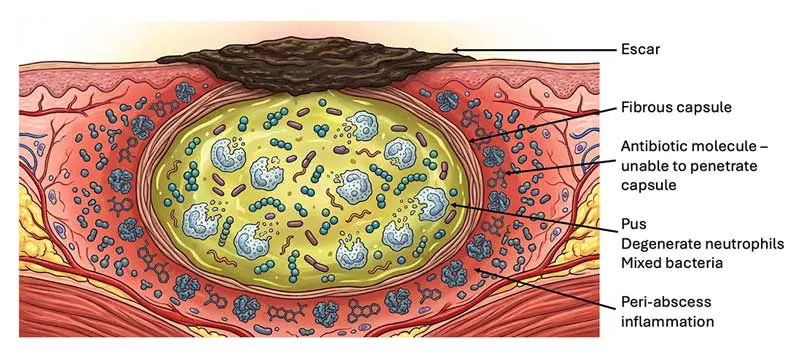
Flushing removes most of the residual bacteria to reduce the risk of recurrence.
Cats presenting with systemic signs associated with cellulitis or systemic inflammatory response syndrome will require treatment before culture and an antibiogram is back. Infection is likely to be mixed and anaerobes to be present.
Where practice guidelines already exist (for example, BSAVA/SAMSoc PROTECT ME poster), these should be followed. Good principles suggest the following:
Evidence suggests only one in seven afebrile cats with bite abscesses require antibiotics. O’Neill et al (2023) estimated the one-year prevalence of cat abscesses (mostly from cat bites) to be 3.1% in the UK. The most recent CATS report estimated the UK cat population at 11.5 million, meaning that around 340,000 cat bite abscesses occur in the UK annually. If we can only use antibiotics in the cats that need it, and only use three to five days of treatment, that will significantly reduce antibiotic use.
Although this article has focused on an individual case, developing a practice-wide policy is likely to lead to a more effective and sustained reduction in antibiotic use. Various sources are available to help develop practice-wide engagement (for example, tinyurl.com/4zc8hd6m)
It is also important to be clear that antibiotics have side effects which are surprisingly common, such as gastrointestinal issues including vomiting, diarrhoea and loss of appetite. It is well established that antibiotic use will also disrupt the gut microbiota (dysbiosis), reducing microbial diversity and altering normal gut function; these changes may persist beyond the treatment period and can be associated with longer-term effects on gut health.
Preventing fights is the most effective way to reduce the occurrence of abscess and wounds. Practical steps include:
Most cat scratch wounds can be managed with topical antiseptics. Cat bite abscesses are a common, high-volume opportunity for antimicrobial stewardship.
Lance, flush, give analgesia and re-check: most uncomplicated cases need nothing more. Keep antibiotics, preferably narrow-spectrum amoxicillin, for systemically unwell cats, undrainable cellulitis, deep or penetrating wounds, and immunocompromised cats. Keep HPCIAs for culture-guided exceptions.
Practices that combine a written protocol, owner support, free re-checks and regular audits have cut antibiotic and cefovecin use substantially without harming outcomes. Help owners reduce the likelihood of fights occurring with neutering and night-time confinement.
Kit Sturgess graduated from the University of Cambridge in 1986, then spent six years in general veterinary practice. He has further professional qualifications in imaging, cardiology and internal medicine, as well as a PhD for looking at the effects of FIV on mucosal immune function. Kit is a fellow of the RCVS, a specialist in small animal medicine and an advanced practitioner in veterinary cardiology. He has been seeing referral small animal medicine cases for the past 25 years – both at university-based and private specialist practices. Kit’s love of teaching and learning led him to develop a new, more flexible, role combining lecturing, writing and clinic time. The majority of his clinical time is spent providing an internal medicine service at Optivet Referrals in Havant, Hampshire. Kit maintains a keen interest in many areas of internal medicine and has authored numerous articles and two textbooks, and presented lectures and research abstracts at conferences worldwide.