
17 February 2026
Sophie Duguid BVMS, MRCVS and Adam Coomber BA(Hons), ACIM discuss how AI can empower vets and build client trust.

Adam Coomber, Sophie Duguid
Job Title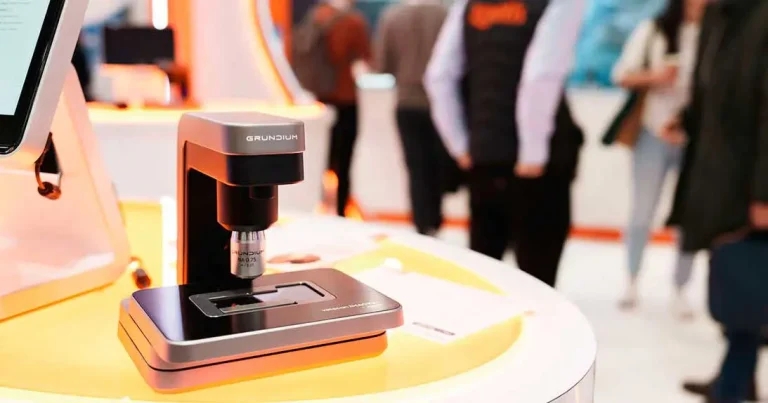
Vetscan Imagyst at London Vet Show.
Every vet knows the moment: a patient presents with a new lump, bump or swelling, and decisions need to be made quickly. Is this benign or something more sinister? Should we monitor or biopsy? How fast do we need to move?
For pet owners, the anxiety and uncertainty while awaiting a diagnosis can be unsettling, often matching the worry about what the actual diagnosis may turn out to be.
The clinical assessment begins in a familiar way: a thorough physical examination to evaluate the size, location and “feel” of the mass. But examination alone can only take you so far. To further characterise the lump, the next step involves obtaining a sample – typically via fine needle-aspiration (FNA). Cytological evaluation of these cells then helps determine whether the mass is inflammatory, benign or potentially neoplastic.
Over the past few years, as the point-of-care laboratory has modernised, the arrival of digital cytology has enabled faster imaging and remote access to clinical pathologists in general practice. Now, deep‑learning artificial intelligence (AI) is accelerating this further, flagging whether a sample contains suspicious or neoplastic cells before it even reaches a human expert, and helping vets swiftly triage cases and make more informed decisions at the point of care.
Two years ago, at the London Vet Show, the veterinary community was introduced to the Zoetis Virtual Laboratory, an online platform integrating diagnostic products and services that can reduce wait times from days to hours.
That step forward proved something profound: speed and precision can coexist.
The Virtual Laboratory marked a turning point. By streamlining the turnaround from days to hours, vets could deliver answers faster, helping to ease the burden on anxious owners and enabling more timely action. For health care teams, it brought 24/7 access to specialist‑level insights into the clinic, offering the ability to provide individualised patient care.
With the recent introduction of Vetscan Imagyst AI Masses (Zoetis), the next major advance has arrived, offering cytology results in minutes1,2 in the clinic – often achieved during the consult.
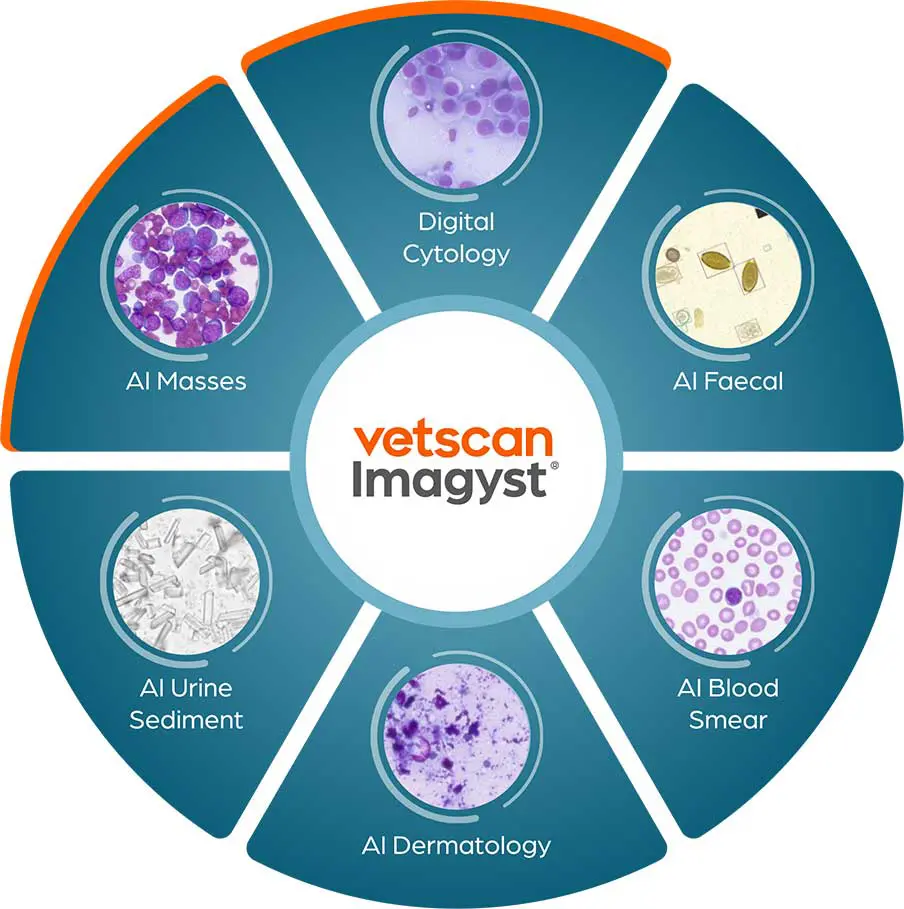
Building on the Vetscan Imagyst platform – which has grown from AI Faecal analysis to include AI Dermatology, AI Urine Sediment, AI Equine Faecal testing, AI Blood Smear and Digital Cytology – AI Masses now adds in‑clinic screening of skin and subcutaneous masses and lymph nodes. Samples are prepared exactly as they would be for standard cytology, (providing familiarity to the user) then scanned by the analyser to produce high‑quality digital images. These images are assessed by deep‑learning technology trained on large, validated cytology datasets prepared and interpreted by clinical pathologists.
By recognising patterns in cell shape, size, clustering and other key features, the AI provides an immediate first‑pass indication of whether cells may warrant attention, such as those associated with mast cell tumours, lymphoma or plasma cell tumours.
Where additional context or clarification is needed, clinicians can submit the case for an add-on expert review*, enabling a board-certified clinical pathologist to examine the slide remotely. This layered approach ensures that AI functions act as a decision-support tool, augmenting the vet’s clinical assessment. It can help vets triage cases more efficiently, prioritise which patients need an urgent follow up, and communicate cytology findings to owners in a clear, visual format.
That accelerated timeline changes the tone of the consult from tentative, provisional conversations to confident, evidence-based guidance, supported by both AI and optional remote human expertise*.
From a workflow perspective, the process can fit into the pace of general practice. Conducting the initial screening in the clinic gives teams the flexibility to decide when engagement with external reference laboratories is necessary and can sometimes provide immediate clarity during the same appointment. This can be particularly valuable in cases where early intervention may influence prognosis. The benefit goes beyond just saving time – it means less anxiety for pet owners, more decisive action for clinical teams and improved opportunities for prompt intervention and treatment for patients.
Missy, a two-and-a-half-year-old female Staffordshire bull terrier cross-breed, was adopted by a young couple. During her first wellness exam, the attending vet noticed a firm, raised mass on her chest. The couple had not seen it before and were understandably concerned.
The vet performed an FNA and used the Vetscan Imagyst platform to scan the sample. Within minutes, AI Masses flagged the presence of mast cells, suggesting a mast cell tumour. The vet requested an add-on expert review through the platform, which confirmed the preliminary AI findings. Additionally, the clinical pathologist provided further guidance within the report comments, offering valuable context for clinical decision-making.
Armed with a diagnosis, the vet discussed treatment options with Missy’s owners. Surgery was scheduled for the following week, and the mass was successfully removed.
Histopathology confirmed the tumour was low grade, and Missy recovered well, with no signs of recurrence.
For Missy’s vet, the ability to move from sample collection to diagnosis and treatment planning in a single visit was transformative. It reduced uncertainty, accelerated care and provided the pet owners with immediate clarity, turning a moment of fear into a proactive path forward.
Missy’s case also highlights the emotional impact of timely diagnostics. Her owners, new to pet ownership, were reassured by the clarity and speed of the process. They felt informed and involved, and their trust in the clinic deepened. For the veterinary team, it was a reminder of how technology can support, not replace, the human connection at the heart of animal care.
Early insight can meaningfully improve clinical outcomes. Masses identified and addressed promptly can often carry better prognoses, and AI Masses supports proactive care by flagging concerning features that warrant timely intervention. At the same time, the technology is designed to augment clinical judgement.
Many practices use the AI interpretation as an initial screen and then choose whether to seek additional clarification through an optional remote expert review*. This hybrid approach, combining AI-powered speed with human expertise, enables vets to balance efficiency with insight while delivering a collaborative, compassionate experience for every client.
Missy’s story illustrates the power of timely diagnostic insight, but the true strength of AI Masses is how consistently it elevates everyday clinical decision-making.
AI Masses can support vets in communicating with clients and making clinical decisions, bringing new levels of speed, clarity and confidence to the diagnostic process. One of its most valuable strengths lies in its ability to support compassionate, transparent conversations with pet owners at moments when clarity matters most.
When faced with the possibility of cancer, or any other serious condition, owners can struggle to understand complex information or cope with the uncertainty. The analyser’s visual outputs, highlighted cell images, annotated findings and concise summaries help vets explain cytology results in a straightforward and accessible way.
This transparency directly strengthens trust. When clients can see what the clinician sees and understand the rationale behind recommendations, they are more likely to consent to further investigations or treatment.
AI is now firmly embedded in the diagnostic landscape, supporting general practitioners in making faster, more confident assessments. As technology evolves, its capacity to enhance everyday workflows is expected to grow, always with veterinary judgement at the forefront.
The development of AI Masses reflects this wider trajectory: practical, clinic-friendly innovation designed to support efficiency, reliability and informed decision-making.
Whether used during routine wellness checks or in more complex clinical presentations, these tools can help teams deliver timely, compassionate care grounded in both human expertise and modern technology.
To learn more about Vetscan Imagyst and explore how AI Masses can support your practice, visit tinyurl.com/2rpce8s9
Sophie Duguid graduated from the University of Glasgow in 2007 and now serves as the national veterinary manager for Zoetis Diagnostics. With a background in companion animal practice, including primary care practice, referral hospitals and emergency care, her interests in internal medicine, immunology and diagnostics led her to Zoetis UK in 2014. Sophie now leads advancements in point-of-care diagnostic technology, supporting veterinary teams nationwide.
Adam Coomber is the diagnostics product manager at Zoetis, bringing more than two decades of marketing expertise to the UK diagnostics business and driving advancements across the company’s diagnostic platforms.