
29 Sept 2026
Marvin Firth BVSc(Hons), DipFMS, DipRCPath, DipACVP, AFHEA, MRSB, MRCVS discusses how this is changing the way common conditions and antimicrobial use is managed in small animal practice.

Marvin Firth
Job Title
Quantitative PCR (qPCR) is no longer confined to specialist laboratories, and technological advances allow in-clinic testing where rapid and reliable results can assist clinical decision making.
Compact, user‑friendly platforms now allow molecular testing to be performed at the point-of-care, within the time frame of a single consultation or day‑care admission within veterinary practice. For dogs and cats with common conditions such as diarrhoea, this shift has significant implications for patient welfare and antimicrobial stewardship.
This article outlines how in‑clinic qPCR has developed, what it can realistically offer in practice, and an example of how accurate identification of pathogens in diarrhoeic animals can support more targeted, responsible antimicrobial use.
Traditionally, PCR/qPCR has required centralised laboratories with trained molecular technologists, batch processing and multi‑day turnaround times. Advances in technology including microfluidics, integrated cartridges and instrument design have changed that landscape, with several veterinary‑focused systems now utilising the following technology:
Validation studies on compact veterinary PCR and RT‑qPCR platforms, including for agents such as feline and canine infectious disease pathogens, indicate that, when properly designed, these point‑of‑care systems can approach the analytical sensitivity and specificity of traditional laboratory assays. The underlying molecular principle is unchanged; what is transformed is proximity to the patient and speed of decision making with potentially improved economic returns.
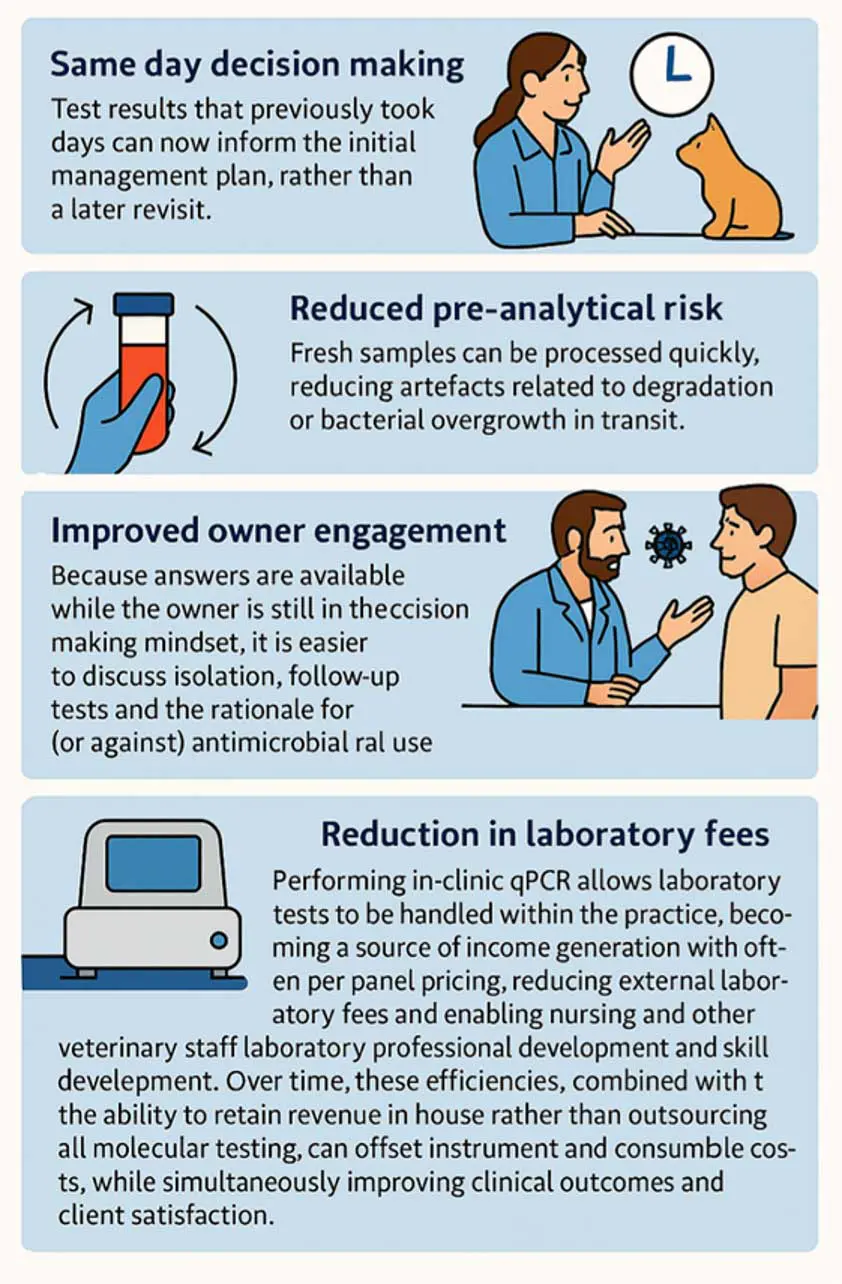
Bringing qPCR into the clinic affects not just turnaround time, but the entire clinical workflow. The infographic in Figure 1 highlights some of the noted benefits to this clinical workflow.
Over time, these efficiencies, combined with the ability to retain revenue in house rather than outsourcing all molecular testing, can offset instrument and consumable costs, while simultaneously improving clinical outcomes and client satisfaction. An example is in infectious diarrhoea, where accurate diagnosis often means the difference between empirical metronidazole “just in case” and a documented, pathogen‑directed plan, or a confident decision not to prescribe antibiotics at all: in essence, clinic-based, and evidence-based medicine.
Faecal PCR panels have reshaped our understanding of canine and feline diarrhoea. Studies using syndromic PCR‑based panels consistently show that the majority of diarrhoeic dogs and cats carry at least one targeted pathogen, and many have multiple agents detected.
Common targets include bacterial, viral and parasite pathogens, and commonly include Campylobacter species, Clostridium perfringens (toxin genes), Salmonella species, Giardia species, Cryptosporidium species, canine parvovirus, canine and feline coronaviruses, and other viral agents.
Co‑infections (for example, parvovirus with coronavirus, or viral plus bacterial combinations) are frequent and can influence disease severity and hospitalisation.
When these panels are run in external laboratories, results still add value, but they often arrive after the most critical treatment decisions have been made. In‑clinic qPCR brings that multi‑pathogen perspective to the initial assessment.
A positive result can generally be interpreted with confidence; however, if a negative result is obtained in the presence of strong clinical suspicion, the sample should be submitted to a reference laboratory for confirmatory testing. This initial screening can:
Highlight genuinely contagious cases that need barrier nursing or isolation.
Reveal zoonotic organisms such as Salmonella species or certain Escherichia coli strains in time to give meaningful hygiene advice.
Suggest when diarrhoea is likely to be primarily viral or parasitic and, therefore, not an indication for antibiotics.
A typical scenario is the young, systemically unwell dog with haemorrhagic diarrhoea. A same‑day qPCR panel identifying parvovirus, with or without other pathogens, can justify immediate isolation, targeted supportive care and appropriate public health messaging, rather than empiric broad‑spectrum antimicrobial use “while we wait to see”.
High analytical sensitivity is a defining strength of PCR/qPCR, but it also demands careful interpretation. Work on faecal PCR in dogs and cats shows that potentially pathogenic organisms are often detected in clinically normal animals.
It is also the case that many diarrhoeic animals carry multiple organisms, some of which may be commensals or secondary colonisers rather than primary drivers of disease; for example, Campylobacter and C perfringens toxin genes are frequently detected in both healthy and diarrhoeic dogs. This does not invalidate PCR; it simply reinforces that context is everything.
Quantitative or semi‑quantitative outputs (such as cycle threshold values; Ct), pathogen combinations and clinical details should all inform interpretation, including:
Framed in this way, in‑clinic qPCR is an extension of clinical reasoning, not a replacement for it. Instead of a binary “pathogen yes/no”, the team can discuss with owners what has been detected, how much might be present (for example, Ct value, if the platform provides this), and how likely it is to be driving the clinical signs, as well as follow-up testing to determine possible response to treatment and progression of the disease state, including determination of whether the patient has stopped shedding the pathogen into the environment.
Recent work on antimicrobial use in small animal practice has brought metronidazole into sharp focus. Surveys and prescribing analyses suggest that vets frequently prescribe metronidazole to dogs and cats in ways that fall outside antimicrobial guidance, including use for “gut modulation” and non‑antibacterial reasons.
Antimicrobials are still commonly prescribed for acute, self‑limiting diarrhoea, despite guidelines advising that they are rarely indicated in these cases.
Metronidazole and other broad‑spectrum agents can disrupt the intestinal microbiome, with some dysbiotic changes persisting for weeks after treatment. This pattern of empiricism has two consequences. Firstly, it may not improve outcomes for the individual patient – particularly in diarrhoea driven by diet, stress or self‑limiting viral infection. Secondly, it increases selection pressure for resistance in both commensal and pathogenic flora, undermining longer-term antimicrobial effectiveness.
Point‑of‑care qPCR can directly support antimicrobial stewardship in several ways. The first is avoiding unnecessary antibiotics. When in‑clinic qPCR identifies only viral and/or protozoal causes, with no bacterial pathogen where antibiotics would be indicated, clinicians may more confidently manage cases with diet, fluid therapy and symptomatic support, explaining to owners that antibacterial treatment is neither necessary nor beneficial.
The second is targeting treatment when genuinely warranted. In cases where a clearly pathogenic bacterial infection is detected, such as Salmonella in a systemically unwell dog, or high‑burden Campylobacter in a high‑risk context, targeted antimicrobial use can be justified and documented. Ideally, faecal culture and sensitivity can follow to refine choice, but the initial decision is now grounded in evidence.
A further reason would be to reducing “just in case” metronidazole. Demonstrating a negative qPCR result for likely bacterial pathogens, or findings consistent with colonisation rather than invasive disease, makes it easier for clinicians to decline owner requests for metronidazole or other antibiotics in line with BSAVA and other stewardship recommendations.
Finally, and no less important, would be supporting audit and practice‑level stewardship plans. Recording qPCR results alongside prescribing decisions allows practices to audit how often antibiotics are used in diarrhoea cases and how this correlates with documented pathogens. Over time, this can demonstrate progress towards reduced empirical use, helping meet national and professional stewardship goals. The same principles apply in other clinical syndromes aside from diarrhoea cases. For oculo-respiratory disease, vector‑borne infections or suspected leptospirosis, rapid molecular confirmation can differentiate bacterial from viral processes, supporting focused, time‑limited antimicrobial courses where indicated and avoiding unnecessary coverage when not.
Typically, companies that develop qPCR technology and analysers will have a range of pathogen panels and individual tests that can be selected by the clinician to help rule in or out their suspicions, making for satisfying clinical decision making.
For individual patients, the benefits of in‑clinic qPCR go beyond stewardship metrics. These include faster isolation and infection control. Rapid pathogen identification supports timely barrier nursing, cohorting, and cleaning protocols, reducing nosocomial spread and protecting vulnerable inpatients.
Further, sharper prognostic information can also be provided. An example would be knowing whether a diarrhoeic dog has, for example, parvovirus alone, parvovirus plus coronavirus, or neither, allows more accurate discussion about prognosis, potential referral and cost planning.
Reducing the diagnostic pathways may also be possible. Rather than multiple sequential tests over days, a single multiplex qPCR panel can clarify the infectious component early in the work‑up, allowing clinicians to move on promptly to diet trials, imaging or other diagnostics where appropriate.
It is also possible that as clinicians we can protect the patient’s microbiome and long‑term health by avoiding or shortening unnecessary antimicrobial courses. In doing so, we reduce collateral damage to the gut microbiota, with potential knock‑on benefits for immune function and overall health.
A further reported benefit of in-clinic molecular diagnosis can be improved owner communication. A printed or on‑screen report that names specific pathogens and explains their relevance often carries more weight than a vague “tummy bug” label, helping owners understand why an antibiotic is, or is not, being prescribed.
Before bringing qPCR into the consulting room, practices need to think through several practical points. What assay selection and validation do I need to see?
Platforms should be chosen with clear performance data (sensitivity, specificity, limits of detection) for the species and sample types you intend to test, and ensure panels target pathogens relevant to your caseload; for example, respiratory, diarrhoea, tick-borne if geographically relevant, infectious bacterial GI disease if raw fed, perhaps. Both training and quality control should be part of any in-house laboratory testing, and qPCR is no different.
Consider developing standard operating procedures for sample collection, cartridge loading, instrument maintenance and contamination control.
As with other analysers (haematology, biochemistry and others), try to assign clear responsibility for quality checks and result review with interested individuals in the practice.
Further considerations include integration with clinical guidelines and qPCR results to practice antimicrobial policies or national guidelines, so that team members know how to act on particular findings; for example, decide in advance when a positive result does and does not trigger antimicrobial treatment.
Finally, communication and costing of in-house testing. As with other forms of diagnostics, explain to clients that additional testing such as PCR can avoid unnecessary drugs, potential side effects and repeat visits.
Clear, consistent messaging from the whole team generally supports uptake by clients, and rapid results are always appreciated, improving the client:clinician bond.
When approached this way, in‑clinic qPCR becomes a routine part of a broader diagnostic toolkit, sitting alongside faecal flotation, SNAP‑style tests, imaging and serology, rather than an isolated “add‑on”.
The veterinary profession is increasingly conscious of its role in AMR and one health.
Small animal prescribing – particularly for gastrointestinal disease – has been highlighted as an area where more proportionate, evidence‑based antimicrobial use is both possible and necessary.
Infectious diarrhoea exemplifies this challenge: high background carriage of potential pathogens, entrenched habits of empirical antibiotic use, and zoonotic risks from organisms such as Salmonella species.
As technology continues to evolve, and as more syndromic panels become available for small animal practice, integrating point‑of‑care qPCR into everyday workflows offers a genuine opportunity to improve patient care while supporting antimicrobial stewardship and one health objectives.
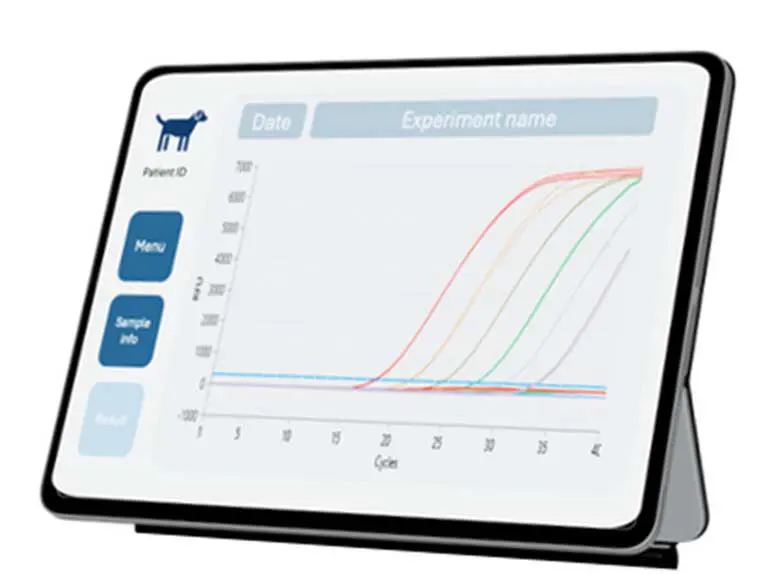
In‑clinic qPCR systems now bring lab‑level molecular diagnostics into first‑opinion practice, with turnaround times of 30 to 60 minutes for many assays.
Faecal qPCR panels reveal common, often multiple pathogens in diarrhoeic dogs and cats, but results need careful interpretation in the context of clinical signs and quantitative data.
Rapid identification (or exclusion) of bacterial pathogens enables more targeted antimicrobial use, reduces “just in case” antibiotic prescribing and supports practice‑level stewardship goals.
Point‑of‑care testing also improves infection control, prognostic discussions and owner communication, contributing to better patient welfare and one health outcomes.
Additional PCR/qPCR testing in-house allows further varied income generation for the practice, reduces external laboratory fees and turn around times and, ultimately, improves targeted patient care, sooner.