
11 Nov 2025
Ian Wright BVMS, BSc, MSc, MRCVS suggests this tapeworm is being overlooked in regular parasite control for dogs, and explains how it can be diagnosed, treated and prevented.

Ian Wright
Job Title
Hydatid disease is a zoonosis caused by the tapeworm Echinococcus granulosus. Canids (primarily domestic dogs) are the definitive host for the 5mm to 8mm long parasites, which live in the intestines.
Eggs passed in the faeces are immediately infective and may then be ingested by intermediate hosts. This, in turn, can lead to hydatid cyst formation in tissues which completes the life cycle when ingested by a canid.
A wide range of mammals, including ruminants and humans, can act as intermediate hosts, leading to offal condemnation in farm animals and significant pathology in man, with cysts forming in the bone, liver, lungs, central nervous system and heart.
Several distinct genotypes of E granulosus are recognised, with some having distinct intermediate host preferences, and not all genotypes are zoonotic. The genotype causing most infections in humans is principally maintained in a dog–sheep life cycle, although cattle can sometimes also be involved.
Despite the potential severity of hydatid disease in humans and its endemicity in the UK, it has been somewhat overlooked when considering routine parasite control for dogs. This is largely because it was considered historically to be limited to regional foci in Wales and the Western Isles of Scotland.
Growing evidence, however, suggests that it is present focally in other parts of the UK and, therefore, should be considered as part of an overall parasite risk assessment for dogs.
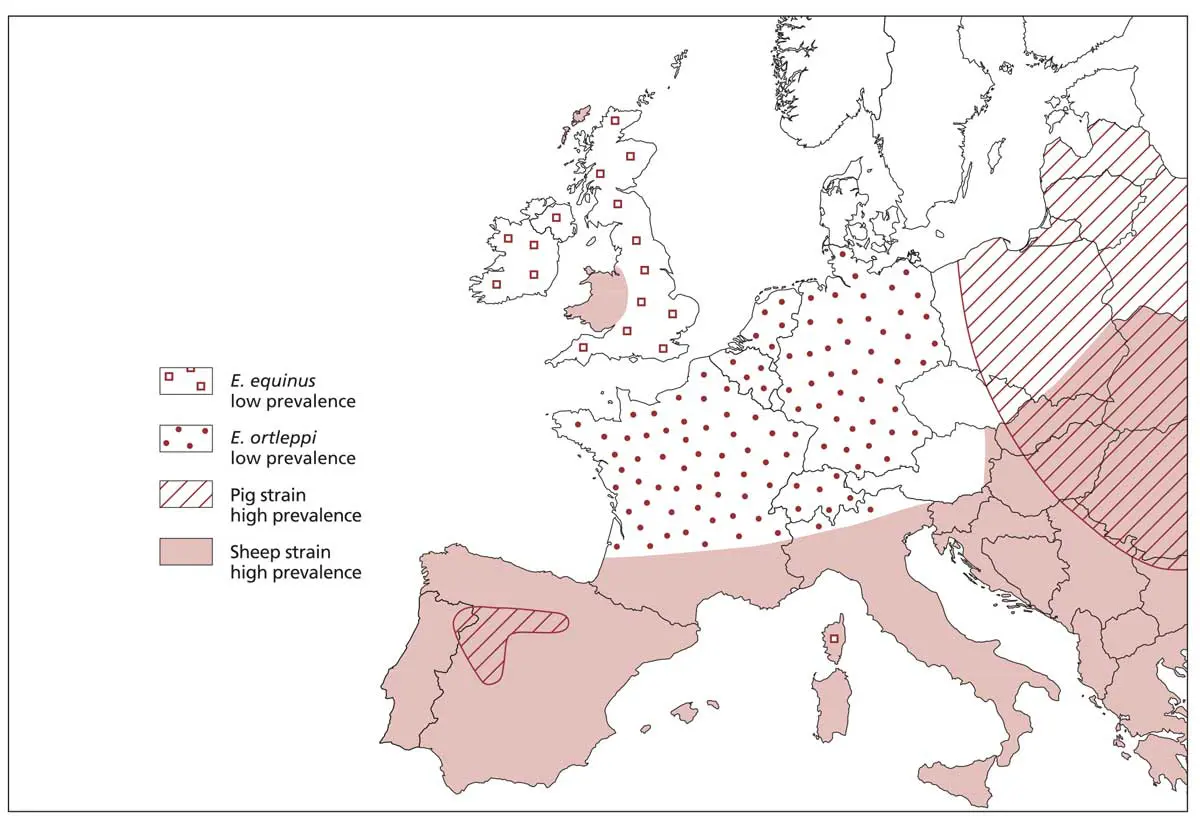
E granulosus is widespread in Europe (Figure 1). In the UK, it has long been established in Wales, the Welsh border, Herefordshire and the Western Isles of Scotland.
Between 1974 and 1983, two cases per million of human hydatid disease were reported in Wales compared to 0.2 cases per million in the rest of the UK.
A voluntary control programme of supervised praziquantel dosing of dogs in Wales reduced this incidence, and this was replaced by a health education programme in 1990. Subsequently, an increase in prevalence of E granulosus in Welsh dogs was seen, rising from 3.4% in 1993 to 8.1% in 2002 (Buishi et al, 2005).
Since then, numbers have been thought to be relatively stable, although no recent large-scale surveys of farm dogs for the parasite have taken place. The Welsh Parliament continues to raise public awareness of the disease and promotes praziquantel deworming programmes in high-risk dogs.
Evidence has been found in the UK, however, of foci of infection outside of Wales and the Scottish islands. Work carried out in abattoirs across Britain has produced positive cases that are not thought to have originated in Wales, suggesting that other endemic foci exist. Two hunt packs were also found to be positive in England by faecal testing in 2014 (Craig, 2014).
This has led to work at the University of Liverpool, demonstrating that the incidence of E granulosus is much more widespread in the UK than previously thought. Marisol Collins, speaking at the 2025 BSAVA Congress, presented data showing out of 46 sheep farms sampled, 17% of dogs were positive for Echinococcus species copro-antigen, and 11% had dogs positive for E granulosus copro-DNA. Positive cases were more likely to be found in Wales, but cases were also found in north-east England, Northern Ireland and eastern Scotland. Northern Ireland has previously been thought to be free of the parasite; the results raise the possibility that this might not be the case.
Out of 32 hunting packs, 9% of hunts tested positive for Echinococcus species copro-antigen, with cases found in the north-west and south-west of England and the Scottish Borders. Four cases identified in cattle carcases in abattoirs found in Gloucestershire, Herefordshire, Staffordshire and North Yorkshire had never entered Wales.
At BSAVA Congress, human cases were also discussed by Laura Nabarro of the Hospital for Tropical Diseases in London. She described five UK-acquired human cases that were treated in 2024, compared to just two UK-acquired cases between 2006–2016.
Although these numbers of cases are low, hydatid disease in humans typically has long incubation periods of years. This means increased incidence of disease being detected now could be an indication of historical increased exposure, with further increases likely to be seen in coming years. Information presented at the congress is due to be published in peer review papers over the next 12 months.
Dogs may act as intermediate hosts for E granulosus infection if eggs are ingested. As cysts develop, this can lead to subsequent pathology and should be considered as a differential for unexplained cystic masses – especially in young dogs. Such lesions, however, are uncommon even in endemic areas.
Adult tapeworms in the intestines are tolerated extremely well, with dogs acting as subclinical carriers of infection. The aim of treatment in dogs is, therefore, to prevent egg shedding with subsequent human exposure, and to reduce offal condemnation for farmers.
Once eggs are shed in faeces, humans may be exposed in a variety of ways. Eggs may stick to dog hair – especially around the anus, face and paws – before being mechanically transferred to human hands or faces (Torgerson et al, 2003). Eggs may also contaminate wild berries and produce grown for human domestic consumption.
Contamination of drinking water may also occur, leading to infection if people drink from untreated sources.
Infection in humans can lead to severe pathology, with hydatid cysts occurring in the liver, lungs and, less frequently, bones, kidneys, spleen, heart, muscles and central nervous system.
Subsequent disease is known as hydatidosis or cystic echinococcosis.
Echinococcus proglottids are rarely seen in faeces, as they are only millimetres long and frequently break up during intestinal passage. Diagnosis, therefore, depends on the detection of eggs, antigen or DNA in the faeces.
Faecal flotation for tapeworm eggs is generally an insensitive method (Wolfe et al, 2001) and, although improved methodologies and use of artificial intelligence have improved detection, it cannot be relied upon for E granulosus detection or for ruling out infection. All eggs of the family Taeniidae (including Echinococcus and Taenia species tapeworms) are also indistinguishable by morphology, making it uncertain which tapeworms are present even if eggs are detected.
Faecal PCR testing is now commercially available and carries a high sensitivity and specificity. It should be remembered, however, that shedding of infectious eggs will already be occurring when a positive result is obtained, with the potential for zoonotic exposure. This means that while testing is useful for screening and tracking geographical spread, testing and treating is not an appropriate means of Echinococcus species control in dogs.
Praziquantel at 5mg/kg is highly effective at eliminating infection in dogs. If infection is diagnosed, then contaminated fur should be clipped away and disposed of in clinical waste, and contacted surfaces disinfected. The coat should also be washed and personal protective equipment worn while carrying this out.
The pre-patent period for E granulosus is six weeks, so dogs at high risk of infection should be treated every six weeks with a licensed product. Monthly treatment is acceptable to allow use of combination products for monthly Toxocara species, and Angiostrongylus vasorum treatment where this is required on the basis of a risk assessment.
A combination of control measures is required to minimise zoonotic risk and economic impact for farmers.
Despite the highly zoonotic nature of E granulosus infection and its ongoing endemicity in the UK, control of this parasite has moved down the priority list of many vets, parasite control groups and policy makers.
Its unknown location and prevalence in many parts of the UK, however, and long incubation period in humans, means that we need to continue to be vigilant in keeping pet owners and the wider public safe.
Increased education, surveillance and monthly deworming of dogs at high risk of tapeworm infection is vital if the zoonotic and economic impact of E granulosus is to be mitigated in the coming years.