
3 Mar 2026
Deborah James RVN provides information on common issues pets present with – from acute gastroenteritis to chronic gastrointestinal disease

Deborah James
Job Title
Image: stepko / Adobe Stock
Gastrointestinal (GI) disorders are among the most common issues pets will present with in practice, with GI issues accounting for the second most amount of insurance claims in dogs and the number one reason in cats, with nearly 30% of claims being related to the GI tract (Garcia, 2018).
We will briefly go on a journey through the GI tract before examining diseases and nursing guidance for different conditions and diseases.
The GI tract is important for consuming food and water, salivation, swallowing, digesting and absorbing nutrients, maintaining fluid, acid-base and electrolyte balances within the body and ridding the body of waste products (Jones, 2024).
It consists of the mouth and associated structures, such as the lips, teeth, tongue and salivary glands, the oesophagus, the stomach, the small intestine comprising of the duodenum, jejunum and ileum, the large intestine consisting of the descending, transverse and ascending colon, the caecum and the rectum and anus.
While this article primarily is focusing on acute gastroenteritis and chronic GI disease and emergencies, it is important to be aware of common disorders that affect the different parts of the GI tract.
Motility disorders affect the oesophagus mainly, where the ability for food matter to pass through normally is impeded, leading to complications such as regurgitation and aspiration (Jones, 2024). Disorders such as megaoesophagus, foreign bodies and strictures are most common.
Nursing care primarily involved nutritional support using soft low-fat foods to minimise irritation and the consideration of feeding tubes where necessary, as well as administration of gastro-protectants and proton-pump inhibitors to reduce the acidity of the stomach (Cox, 2024).
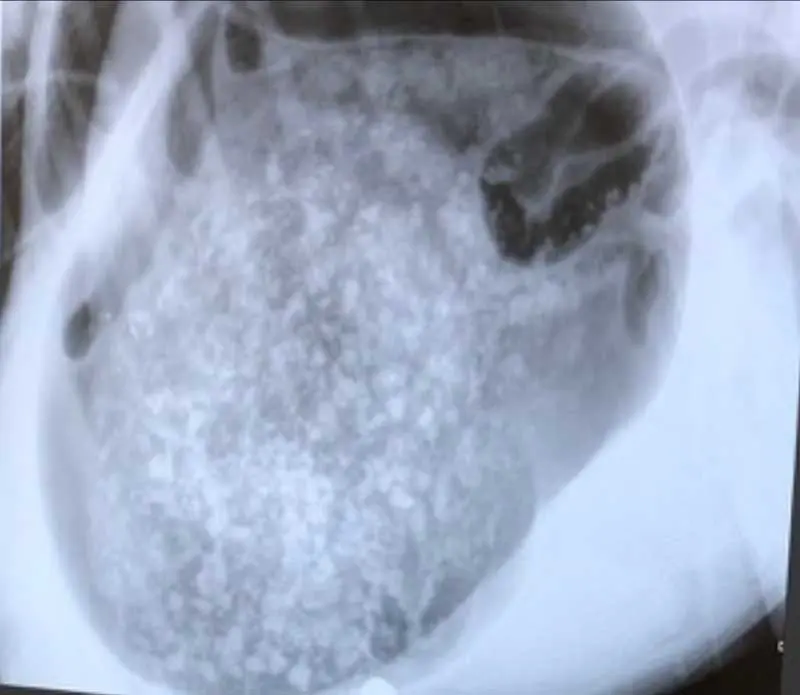
A variety of diseases can affect the stomach, from acute and chronic inflammation to ulcers, infections, foreign bodies, gastric dilation volvulus (GDV; Figure 1) and neoplasia (Jones, 2024). Reducing stomach acidity using proton-pump inhibitors and gastroprotectants to protect the ulcer are the key nursing considerations while ensuring the patient is nutritionally supported and providing additional aid such as fluid therapy, assisted nutrition such as feeding tubes and anti-emetics where required (Jones, 2024).
Now we move on to the small intestine followed by the large intestine. Simple diseases such as chronic inflammation or more complex diseases such as neoplasia can be a cause for concern here.
Once again, nutritional support and management is key here, namely offering small frequent meals to aid digestion and ensuring patients’ hydration status is maintained – with the option for fluid therapy if required (Takeuchi and Naba, 2013).
Acute gastroenteritis is probably the most common condition we will see. Patients often present with weight loss and abdominal pain, lethargy and a period of vomiting and diarrhoea (Woods-Lee, 2023). Depending on the severity, the patient could be bradycardic due to hypovolaemia, pyrexic and/or have haematemesis.
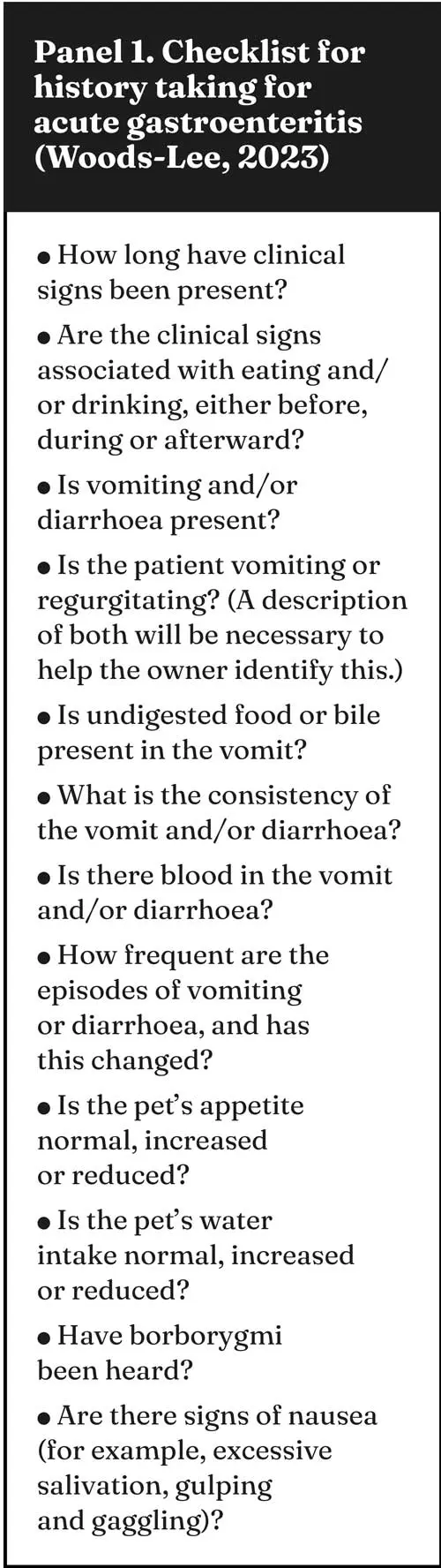
History taking is of vital importance. The WSAVA created a handy checklist (Panel 1) for ensuring the history we are collecting is accurate and relevant (Woods-Lee, 2023).
A number of common causes for acute gastroenteritis exist (Woods-Lee, 2023), including:
Nutritional support is the key nursing care we can provide. Calculating the nutritional energy requirements for each patient means we are in the best possible position to ensure our patients are going to receive complete and balanced nutritional support (Woods-Lee, 2023). Warming food up, adding a Lick-e-Lix or similar on the top of a pet’s food, trying different flavours if there are no allergens and hand feeding are all ways, we can enhance the feeding experience and give the best care to our patients.
Probiotics may be of benefit to the patient depending on the cause as they have been shown to shorten the duration of gastrointestinal upset and alongside dietary adaptation provides additional support (Woods-Lee, 2023).
These are generally available over the counter, so it is important to discuss with clients which one they should use for their pet.
Chronic GI disease is defined as a persistent, long-term period of around two to three weeks minimum of signs such as vomiting, diarrhoea and weight loss (Maunder, 2010). A few signalments may help with differential diagnoses and prioritising, such as age. For example, inflammatory bowel disease (IBD) is unlikely in dogs below a year where infections or dietary sensitivity may be more common. Blood tests and faecal tests are also useful (Maunder, 2010).
IBD is probably the most common chronic GI disease and dependent on the severity will depend on the nutritional support and treatment required. Mild cases generally will resolve with dietary changes such as feeding a single, novel protein and carbohydrate or exclusion diets (Maunder, 2010).
More severe cases may require vitamin B12 treatment that is given subcutaneously in consults and can be administered by nurses, which can help build a bond between the patient, client and nursing team. In addition, some patients may require antibiotics, feeding tubes, IV fluid therapy and pain relief.
Regular walks and toilet breaks will be required for these patients and while in referral practices a faecal Foley catheter may be placed, this won’t be the case for all patients. It is important to consider, therefore, their eliminations and skin and coat care, so think about applying a barrier cream such as Sudocrem to sore areas and placing an Elizabethan collar to prevent licking, bathing where soiled and applying tail bandages and even clipping fur (Jones, 2024).
It would be impossible to cover all GI emergencies here, but I have covered two that can be the most daunting.
Gut stasis is a common GI emergency in our small furries, and in particular rabbits. This is an acute and life-threatening condition and a lot of the monitoring and care falls on the nursing team as they can be high maintenance.
Generally, these patients will present with owners reporting that they haven’t been eating or defecating.
Conduct a full clinical exam and generally the best indicator is no gut sounds and a high blood glucose. Normal blood glucose range in rabbits is between 4.2mmol/L to 8.2mmol/L and anything exceeding this would indicate stasis (Morrison, 2024).
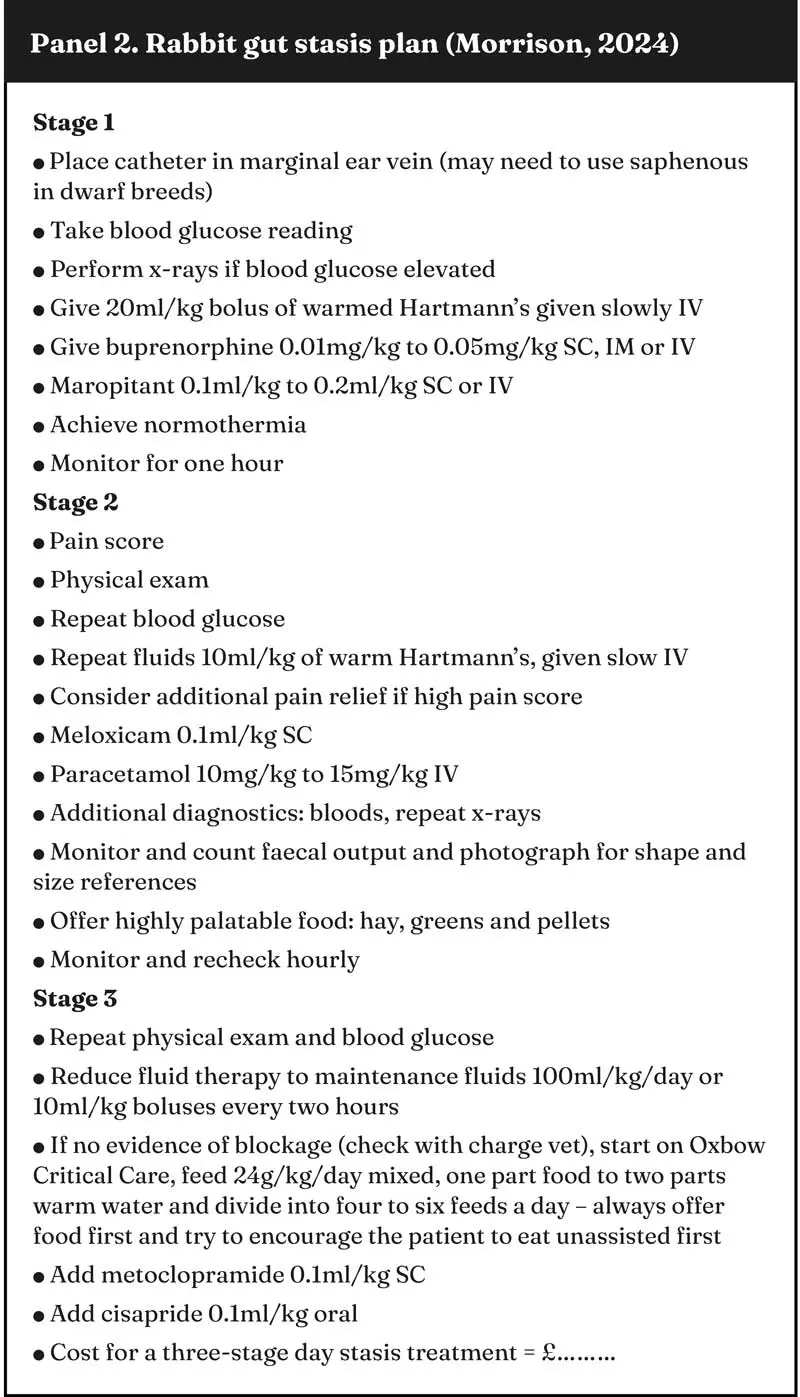
Rabbit stasis care plans, such as that created by Morrison (2024) and recreated in Panel 2, are a good way of creating a uniform plan for vets and nurses to follow as rabbits can be daunting. The system follows a traffic light system where red indicates the rabbit at the most serious stage of illness and generally upon admission and green where the signs are beginning to resolve. Morrison (2024) has found that since using this plan, most rabbits are frequently discharged after one day of hospitalisation.
GDV is an acute life-threatening condition that normally affects our deep-chested breeds such as great Danes, German shepherds, Dobermanns and even dachshunds. The stomach twists, which causes gas to accumulate and become trapped in the stomach, causing the dilation, and the stomach then decreases the blood supply to the heart, leading to shock, hypotension and hypovolaemia. This decreased blood supply can eventually lead to sepsis, arrythmias and disseminated intravascular coagulation (DIC) and death if not treated (Jones, 2024).
Generally, these patients present very poorly with non-productive vomiting, gagging, retching, pacing, lethargy and abdominal distension, which are all clinical signs (Jones, 2024). As nurses, we need to stabilise our patients prior to surgery.
Getting bloods, analgesia and fluid therapy on board is the priority. Placing a stomach tube to try to decompress the stomach prior to theatre is ideal, but, depending on the patient, this may not be possible (Jones, 2024).
Other factors to consider when stabilising these patients include monitoring their electrocardiogram, as up to 40% of dogs with a GDV have arrhythmias, oxygen supplementation, dextrose if the patient is in septic shock and plasma products in case the patient has complicating factors such as DIC (Jones, 2024).
Postoperatively, patients are generally kept on fluid therapy and analgesia as a minimum. Gastroprotectants can be considered to reduce the severity of gastric necrosis and ulceration, and antibiotics administered perioperatively are generally continued due to the risk of sepsis. Antiemetics and prokinetics are also considered, as ileus may occur postoperatively (Jones, 2024). These patients require a lot of monitoring – not just the basic temperature, pulse and respiration – with lactate, glucose, renal parameters, packed cell volume, ECG and urine output all considerations.
Nutritionally, a feeding tube ideally should be placed during surgery with the key to get nutritionally dense food in small quantities to be fed often to prevent stomach distension at an appropriate percentage of the patient’s energy requirements (Jones, 2024).
GI patients can be high maintenance and demanding and, in some cases, very daunting, particularly if you haven’t seen them before.
Nurses play a primary care role in not only communicating with clients and triaging these patients, but the continuing intensive and prompt stabilisation and ongoing care with lots of opportunities to use and enhance our skill sets and confidence.
Deborah James qualified from Hartpury College in 2017 with a BSc in Veterinary Nursing Science and works as team leader at Vets Klinic. She has completed an ISFM Certificate in Feline Nursing and is in her second year of her MSc in Veterinary Nursing at the University of Glasgow. She has two cats at home: Tipsy, a 10-year-old hand-reared cat, and six-year-old Frank. In her spare time, you can find Deborah snuggled with a book or teaching and participating in pole fitness and aerial arts.