
03 March 2026
Hill’s discusses its ActivBiome+ Technology, a proprietary blend of prebiotics, that starts working quickly to nourish each pet’s gastrointestinal microbiome.


The gastrointestinal tract is inhabited by communities of microorganisms essential to the health of the host.
These microorganisms are referred to as the microbiome and the exact population of microorganisms is unique to each host. These bacteria are functionally and compositionally diverse, allowing contribution to energy homeostasis, metabolism, gut epithelial cell health and immunologic activity; all of which are ultimately important for the overall health of the host.
Maintenance of this ecosystem is often desired even in healthy animals to optimise digestive benefits, similarly to how people are encouraged to eat their fruits and vegetables. This population is not static and can change due to medications, such as antibiotics, environmental factors, disease states and dietary influences. Additionally, it is common to see dysbiosis (imbalance in the gastrointestinal microbiome) in chronic GI disease in cats and dogs.
Over the past several years, Hill’s has focused heavily on studying the microbiome, characterising bacterial populations of the gastrointestinal tract of cats and dogs. Most critically, Hill’s has performed analyses to understand the functions of those bacteria in the gastrointestinal tract
Hill’s has found that ActivBiome+ Technology, a proprietary blend of prebiotics, starts working quickly to nourish each pet’s gastrointestinal microbiome.
Hill’s ActivBiome+ Technology is a blend of prebiotics shown to rapidly nourish the gut microbiome and release helpful postbiotics (metabolic products of microbial metabolism) to support digestive health and well-being.
By promoting activity of beneficial gut bacteria, it also helps to suppress the growth of potentially undesirable bacteria and their metabolites. The prebiotic sources in ActivBiome+ Technology were selected because they have multiple functions (such as water retention, stool bulking and gastrointestinal transit) and contain fibre-bound polyphenols.
The microbes ferment the prebiotics and produce gut-nourishing compounds, as well as release and nourish the aforementioned antioxidant and anti-inflammatory polyphenols. These and other postbiotics benefit the gut, as well as other organs and tissues.
A series of studies at Hill’s Pet Nutrition Center (PNC) were conducted demonstrating how ActivBiome+ Technology works and clinically showed improvements when this synergistic blend of prebiotics was added to certain foods. Both dogs and cats showed improvements in markers of gastrointestinal microbiome health1,2 Dogs and cats also showed improvements in stool quality2.
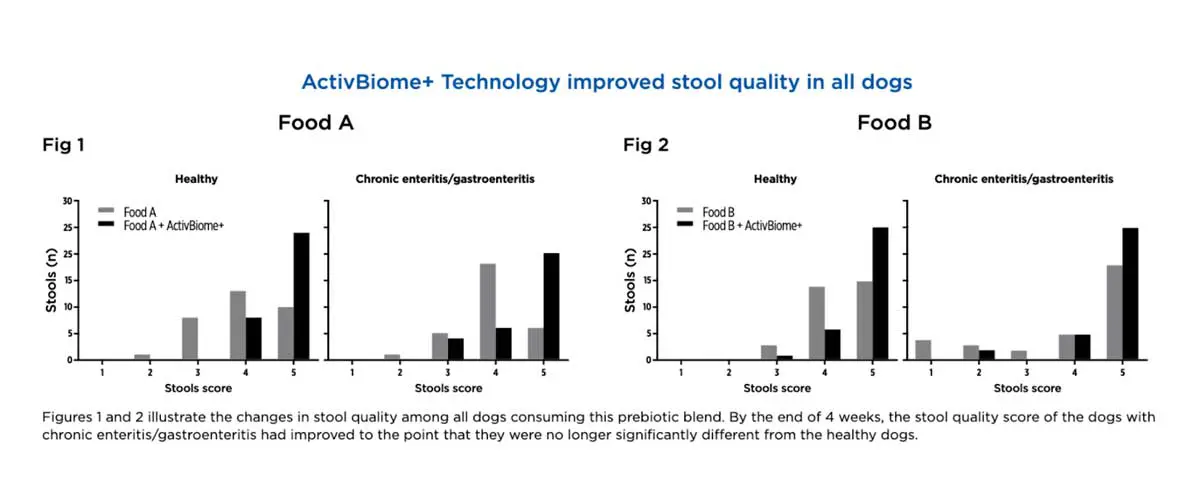
One canine feeding study evaluated the benefits of the ActivBiome+ Technology in healthy dogs (n = 16) and in dogs with chronic, recurrent enteritis or gastroenteritis (n=16) in a randomised, cross-over design study. ActivBiome+ Technology was added to either a hydrolysed meat food (Food A, Figure 1) or grain-rich food (Food B, Figure 2) and fed over a 56-day period. All dogs had significant improvements in stool quality, including those with chronic enteritis/gastroenteritis, when given food that included the ActivBiome+ Technology prebiotic blend2.
This positive change in the microbiome also leads to an increase in the production of helpful postbiotics. ActivBiome+ Technology also significantly increased faecal levels of numerous other helpful postbiotics, including certain polyphenols and -chain fatty acids (SCFA’s). The SCFA’s help reduce faecal pH, creating an environment that favours the growth of beneficial bacteria in the host.
Potentially harmful postbiotics (faecal polyamines, such as putrescine and spermidine) were also measured and were reduced by the addition of ActivBiome+ Technology2.