
27 Oct 2026
Lotfi El Bahri DVM, MSc, PhD discusses the options for pets after ingesting Ilex aquifolium.

Lotfi El Bahri
Job Title
Image: pixarno / Adobe Stock
Ilex aquifolium – commonly referred to as holly, English holly, Christmas holly, and winterberry – is a plant native to western Europe, north Africa and western and central Asia.
The genus Ilex belongs to the family Aquifoliaceae, which consists of 800 species, and is a large evergreen shrub or small tree, slow growing when young, with dark, glossy evergreen, usually strongly spiny leaves and small dull fragrant white colour flowers (four petals). Male and female are usually on separate plants. Bright red berries (fruits) appear on female plants from late autumn to mid-winter.
I aquifolium is an ornamental plant prized for its shiny green, spiny leaves and bright red berries, used for decoration in holiday wreaths, garlands and arrangements. Because of its attractive fruits and peculiar pricking leaves, it is one of the most used Christmas plants to decorate the house.
Pets that live indoors are at increased risk of exposure to these festive plants. The berries are attractive to pets and children due to their vibrant colour, making them more susceptible to ingestion. The dried berries will eventually fall off, which makes it easy for pets or children to reach them. Both dogs and cats have been known to chew on house plants, with the primary difference between these two species being the amount of plant material ingested: although cats often only nibble on a few leaves, many dogs will devour the entire plant.
Holly can be toxic to dogs and cats. The red berries are highly toxic, with only 20 berries being reported to kill a large dog weighing 20kg.
The berries are also toxic to children. Children have had symptoms after swallowing as few as two holly berries. Ingesting more than 20 berries can be lethal for a child. When a person consumes 10 to 15 berries, severe digestive distress can occur.
Holly berry extracts contain several potentially toxic components including saponins, polyphenols, benzofurans, methylxanthines and cyanogenic glycosides, identified by combined gas chromatography/retention indices and carbon-13 nuclear magnetic resonance analysis.
Holly exerts toxic effects through several mechanisms.
Ingestion of large amounts of spiny leaves results in oral ulcerations or lacerations. A very large number of leaves could lead also to GI obstruction. Choking on the stiff leaves is also a potential hazard.
The juice extracted from red berries is known to be purgative and emetic, with strong effects after they are swallowed.
Saponins, metabolites synthesised by the plant, are organic amphiphilic compounds, able to solubilise hydrophobic molecules in aqueous solution.
The structure of saponins contains a sugar moiety linked to a hydrophobic aglycone consisting of triterpenoid pentacyclics with a 30-carbon skeleton. High doses of a racemic mixture of oleanolic acid and ursolic acid (C30H48O3; same chemical formula but differing in spatial arrangements of their atoms), and also uvaol (C30H50O2) present in the aglycone result in nausea, abdominal pain, vomiting and diarrhoea.
Oleanolic acid can also reduce blood pressure, leading to hypotension, through several mechanisms related to a potent diuretic-natriuretic activity (inhibition of Na+ reabsorption) and modulation of the renin-angiotensin system.
Caffeic acid (C9 H8O4) present in the holly plant is the main representative of polyphenol derivatives; at high doses, it can irritate the lining of the stomach and intestines, leading to GI upset.
The amphiphilic properties of saponins give them the potential ability to interact with cell membrane. Saponins interact with membrane sterols in the cell membranes with which they form insoluble complexes leading to increase in membrane permeability, changing the permeability of small intestinal cells, allowing the passage of ions and macromolecules across the lipid bilayer.
Haemolysis occurs when the structure of erythrocyte cell membranes is damaged or disrupted, causing haemoglobin to be released.
Saponins have a strong lytic action on erythrocyte membranes, believed to be the result of the affinity of the aglycone moiety for membrane sterols leading to solubilisation of phospholipids. Isolated cell membranes from human erythrocytes treated with saponins developed membrane pores or defects in red blood cells, thereby inducing haemolysis.
Ingestion of theobromine – the predominant methylxanthine – and secondary caffeine present in the berries can result, at lower doses (16mg/kg) in dogs, in delayed symptoms (long elimination half-life of the theobromine is 17.5 hours due to enterohepatic recirculation) such as neurological (tremors, seizures, hyperthermia) and cardiac signs (tachycardia, arrhythmia).
Menisdaurilide and aquilegiolide (C8H8O3), the two racemic compounds (dextrorotatory and laevorotatory forms of a compound in equal proportion) of benzofuran class present in the holly, can result in a wide range of clinical effects, typically including sympathomimetic symptoms like tachycardia, hyperthermia, agitation, tremors and mydriasis.
Cyanogenic glycosides (2-β-d-glucopyranosyloxy-p-hydroxy-6,7-dihydromandelonitrile) has also been identified from the extract of berries. The toxicity of cyanogenic glycosides is dependent on the release of hydrogen cyanide by hydrolysis. Cyanide poisoning in pets is extremely uncommon.
Larger amounts of leaves and berries may cause symptoms beginning quickly, within 30 minutes of ingestion, or may be delayed for a few hours. They include the following.
GI signs:
CNS signs:
If very large amounts of the leaves or berries are ingested, CNS signs are delayed for several hours and include:
In human medicine, serious adverse neurological effects are reported including ataxia, muscle weakness and mydriasis. Death can occur in case of severe dehydration.

No specific antidote exists. Treatment is largely symptomatic and supportive.
An IV catheter should be placed. To control seizures, diazepam (0.5mg/kg to 2mg/kg IV bolus) should be administered and repeated if necessary within 20 minutes (serum half-life in dogs is 2.5 to 3.2 hours) up to three times in a 24-hour period, or 1mg/kg to 2mg/kg rectally.
Do not give diazepam by IM. This is contraindicated in patients with severe liver disease, however.
Alternatively, administer lorazepam (long-acting benzodiazepine, 0.2mg/kg IV bolus), because of its high affinity for benzodiazepine receptors in the CNS, or midazolam 0.2mg/kg to 0.4mg/kg IV may be repeated once. When IV access is not available, midazolam can be administered by IM because it is rapidly absorbed by this route.
Ketamine used alone causes muscle rigidity and could potentially exacerbate seizures and tachyarrhythmia. Valproic acid is not recommended (serum half‑life in dogs is between one and a half and two hours).
If seizures persist or recur, administer propofol (3mg/kg to 6mg/kg IV initial bolus) followed by 0.1/kg/min to 0.6 mg/kg/min CRI. Alternatively, 2 per cent to 2.5 per cent concentrations of isoflurane alone with oxygen can also be used. For maintenance, use 1.5 per cent to 1.8 per cent concentrations of isoflurane in oxygen.
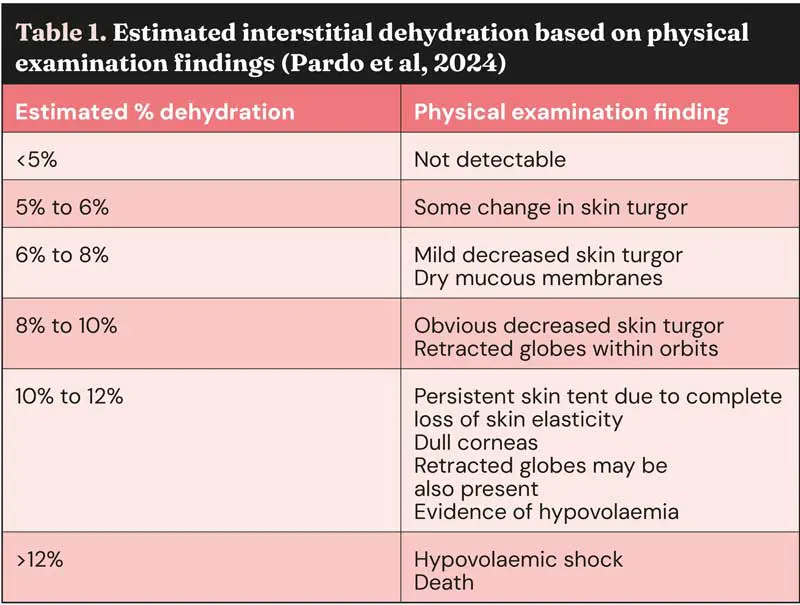
Excessive vomiting and diarrhoea can lead to severe dehydration. IV fluid therapy is indicated to rehydrate; restore intravascular volume using isotonic saline sodium chloride 0.9 percent at least 48 hours at twice the usual maintenance rate over 12 to 24 hours. The volume of fluid to be administered should be calculated based on the percentage dehydration and the animal’s body weight from the following formula:
Fluid deficit (L) = Bodyweight (kg) x % dehydration (as a decimal)
Percentage dehydration can be estimated by examining mucous membrane moisture, skin turgor, eye position and corneal moisture, as described in Table 1.
Administering an increased fluid volume may not increased toxin excretion and can result in fluid overload.
Cold compresses and ice packs are effective ways to relieve inflamed in dogs. Analgesics may be required if pain is significant. Administer gabapentin, a centrally acting GABA receptor agonist, 8mg/kg orally every six hours in cats and 10mg/kg in dogs every eight hours.
Sucralfate (salt of sucrose complexed to sulfated aluminium hydroxide) binds to ulcer sites of the GI tract, stimulates healing and protects them. Give an initial loading dose of 3g to 6g orally four times a day and then 0.5g to 1g on an empty stomach at least one hour before meals.
Proton pump inhibitors (PPIs) that inhibit gastric acid production and treat digestive irritation may be beneficial: omeprazole (0.7mg/kg IV every 24 hours), pantoprazole 1mg/kg IV or lansoprazole (0.6mg/kg to 1mg/kg IV every 24 hours). Sucralfate delays, but does not decrease the extent of the absorption of PPIs.
Severe vomiting should be treated. Administer antiemetic serotonin antagonists with powerful activity such as ondansetron 0.5mg/kg to 1mg/kg IV slow bolus (2 to 3 minutes) every 8 to 12 hours (use cautiously in dogs with the MDR1 mutation) or dolasetron 0.6mg/kg IV slow bolus every 24 hours. Do not use maropitant (neurokinin 1 antagonist) if the patient is at risk for a foreign body obstruction. Metoclopramide (dopamine antagonist) is contraindicated (excitatory effects can occur).
The first action should be to remove any berries still in the mouth. Follow that up by giving a small amount of water to clear any berry material from the mouth and oesophagus. The induction of emesis is contraindicated.
Administer a single dose of activated charcoal (AC; 1g/kg to 4g/kg) mixed with water to make a 20 per cent slurry (1g/5ml water) via a nasogastric tube as soon as possible post-ingestion, and after the airway is secured, and if the animal is asymptomatic. AC admitted orally is contraindicated in convulsing or comatose animals, and should be used with caution in the vomiting patient due to the risk of aspiration pneumonia.