
05 May 2026
London vet Rory Cowlam and veterinary cancer specialist Sue Ettinger reveal their experiences of using in-practice diagnostic platform Vetscan OptiCell.

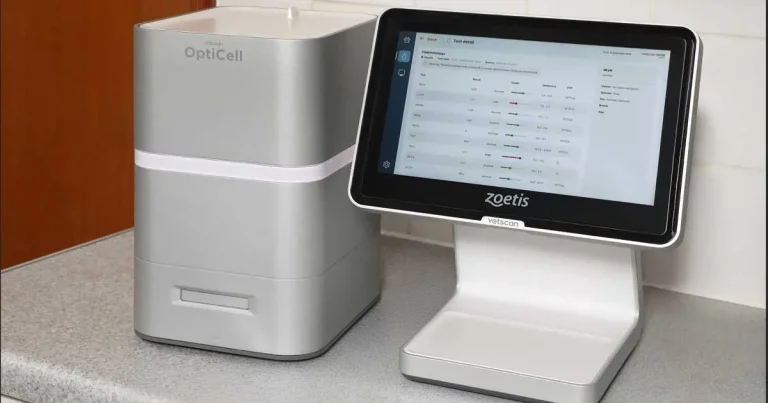
As veterinary practices operate at full capacity, quick access to reliable in-clinic diagnostics has become invaluable – giving teams precious time back and easing workflow pressure.
From the moment a patient arrives, clinicians move through a sequence of assessment, investigation, and decision‑making. The diagnostic stage is where uncertainty narrows, differentials are refined, and treatment plans take shape. Point‑of‑care tools can deliver results within hours, or even minutes, helping clinicians move to treatment plans with minimal waiting.
As a result, new diagnostic technologies are gaining traction, especially those integrated with artificial intelligence (AI) to support reliable and accurate decision-making in practice.
Complete blood count (CBC) analysis remains one of the most important diagnostic tools available to vets. Haematology results can provide valuable insights into a patient’s health, helping clinicians detect infection, inflammation, anemia and other systemic conditions.
Historically, however, point-of-care haematology analysers have not been prioritised in clinical practice. Concerns about accuracy and reliability led many vets to continue relying heavily on external laboratory testing.
The shift we’re seeing in veterinary diagnostic technology towards AI-enabled platforms makes a lot of sense when you consider the benefits it provides in terms of performance, usability and clinical insight over time.
Rather than replacing equipment when capabilities improve, many modern AI-enabled diagnostic systems are designed to evolve through software-driven updates and algorithm enhancements. This approach allows practices to benefit from ongoing innovation without disrupting day-to-day workflows.
Rory Cowlam, clinical director at Pickles and Co in London and a member of the Veterinary Diagnostics Innovation Council, believes it is essential for practices to adopt this kind of technology to keep pace with demand and operate efficiently.
At Pickles and Co, the team integrates AI where it can make a meaningful difference, and when it comes to point-of-care diagnostics, Dr Cowlam says confidence in technology has been a key factor shaping its adoption.
“So, there’s always been a slight mistrust in haematology analyzers at point of care, and what OptiCell addresses is that confidence for me,” he remarks.
“We’ve brought it into our clinic in the UK, and our vets have more confidence, we have quicker and better parameters on all of our cases, and that just increases our offerings to our clients on a day-to-day basis,” Dr Cowlam adds.
Beyond convenience, this model also reflects a broader shift in how diagnostic tools are designed: moving from static instruments to connected platforms that can continually evolve alongside clinical needs.
“I think the benefits of this type of technology are the fact that you don’t have to replace it,” says Dr Cowlam. “We don’t have time for people to be coming and installing new things every few years. We’ve got this piece of tech, it can be developed live, remotely, and it can continue to get better and better and better.”
Vet teams are also seeking diagnostic tools that integrate easily into everyday practice and support clearer communication with pet owners.
Michelle Larsen, head of medical platforms, clinical studies, and medical education, global diagnostic platforms at Zoetis, says improving workflow and reliability has been a central focus in the development of newer in-clinic technologies1.
“Feedback on Vetscan OptiCell has been overwhelmingly positive with respect to workflow and performance,” she explains.
Results vets can rely on when dealing with complex or critical cases is where clinicians are experiencing OptiCell’s benefits. “The other area where we’re really hearing positive feedback is the performance and reliability for those sick patients results,” Dr Larsen says.
“Vetscan OptiCell has kind of created another level of reliability when it comes to providing reliable haematology results for sick patients that can easily be coupled with Vetscan Imagyst AI Blood Smear and Digital Cytology for the most comprehensive haematologic case support at the point of care.”
Systems that are easier for the wider clinical team to operate help streamline workflows, freeing up time for vets to focus on patient care and clinical decision making?
“It eliminates the major pain points of earlier in-clinic haematology: bulky, messy reagent packs, extensive training for pack changes and analyzer maintenance; and routine quality controls. Now, with minimal training, anyone can use the equipment.”
When clinicians can trust the results generated in-clinic, it reduces time spent troubleshooting unexpected findings or repeating tests, freeing up valuable time for patient care.

Veterinary cancer specialist Sue Ettinger says in-clinic CBC analysis plays an important role in both patient monitoring and client communication at Guardian Veterinary Specialists in Brewster, New York. “I love OptiCell,” she says. “It’s effective, and it’s cost-efficient for my clients.”
Dr Ettinger also highlights the impact of fast turnaround times on consultations and more meaningful conversations – which can lead to better medical outcomes for the patient. “Quicker turnaround time means you can go in the room and talk to the owners about any abnormalities right away,” she explains. “That allows you to make timely decisions with the owners in the room, and there’s so much value with that.”
As veterinary diagnostics continue to evolve, AI-enabled platforms are helping practices move towards a model where in-clinic testing is not only faster and more accessible, but also continuously improving over time (and without disruption)!

All trademarks are the property of Zoetis Services LLC or a related company or a licensor unless otherwise noted. ©2026 Zoetis Services LLC. All rights reserved.