
22 May 2026
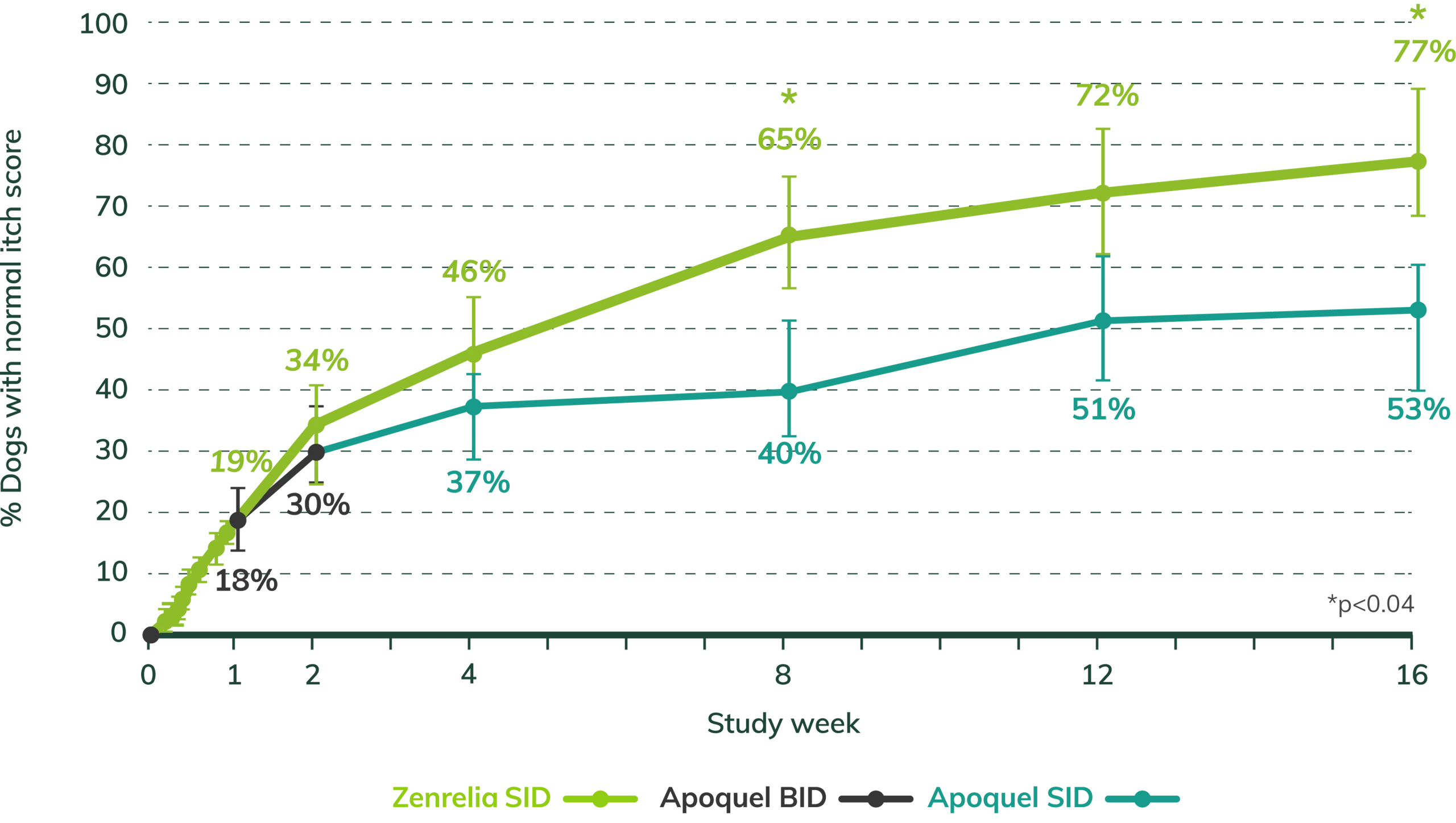
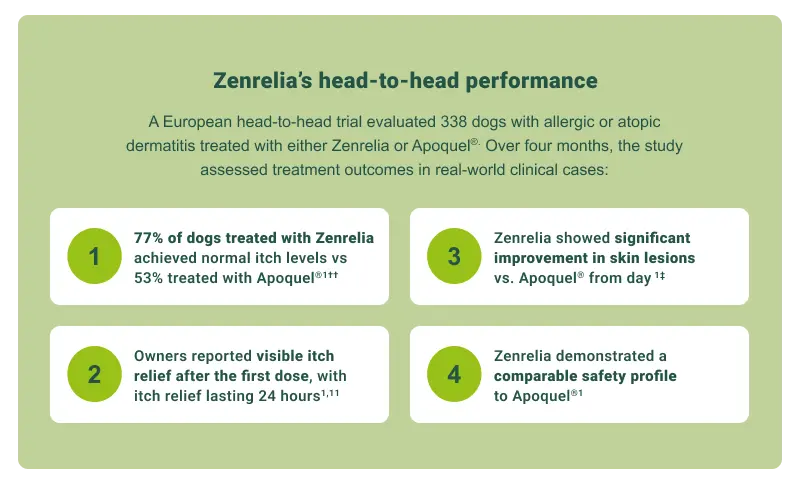
Zenrelia gets 45% more itchy dogs back to normal than Apoquel(1††); now more than 2 million dogs treated worldwide(2).


Managing itch in canine atopic dermatitis can be one of the most frustrating clinical challenges, with quality-of-life implications for owners and dogs3-5. As well as a key clinical goal, adequate itch reduction is also an important factor in meeting owner expectations. In fact, research shows that 79% of owners expect treatment to return their dog’s itch to normal levels6¥.
This article explores how Zenrelia is being successfully integrated into treatment plans, over 18 months on from its global launch.
Zenrelia™ (ilunocitinib) is a JAK inhibitor indicated for the treatment of allergic and atopic dermatitis, which gets 45% more dogs back to normal itch levels vs Apoquel® (oclacitinib)1††.
Zenrelia helps to simplify itch management, with once-daily dosing from the start and no treatment breaks required for vaccination7,10Δ.
“Zenrelia is a really useful addition for managing atopic patients and I’ve seen good clinical results in cases that haven’t responded to anything else. Weekly I have referral clients tell me they’re considering euthanasia because of the impact of their dog’s skin disease, so the more options we have to get dogs back to normal, the better.”
— Natalie Barnard BVetMed, CertVD, DipECVD, MRCVS, an RCVS-recognised and European specialist in veterinary dermatology.
Hear dermatology experts Dr Natalie Barnard and Dr Victoria Robinson describe their experience with Zenrelia and how they benchmark treatment success. Watch the Zenrelia Expert Symposium here.
Alongside advances in treatment, expectations of what constitutes successful itch control are also evolving.
“We know that clients want their dogs back to normal when they treat their itch. Human dermatologists now aim for as close to “itch free” as possible, and we should aim for similar outcomes for the pets in our care.”
— Victoria Robinson, BVM&S, BSc, CertAVP(VD), DipECVD, MRCVS, an RCVS and European specialist in veterinary dermatology.
Normal’ has a precise definition when it comes to treating pruritus6. In clinical practice, itch severity can be assessed using the Pruritus Visual Analogue Scale (PVAS; Figure 2)6. This validated scale asks owners to rate their dog’s itching on a continuous scale from 0 (no itch) to 10 (extreme itch).
Historically, improvement in canine allergic and atopic dermatitis was often defined as a two-point reduction in itch score or a 50% reduction in pruritus8. However, these targets are no longer seen as adequate by veterinary dermatologists and may still leave dogs experiencing significant levels of itch8.
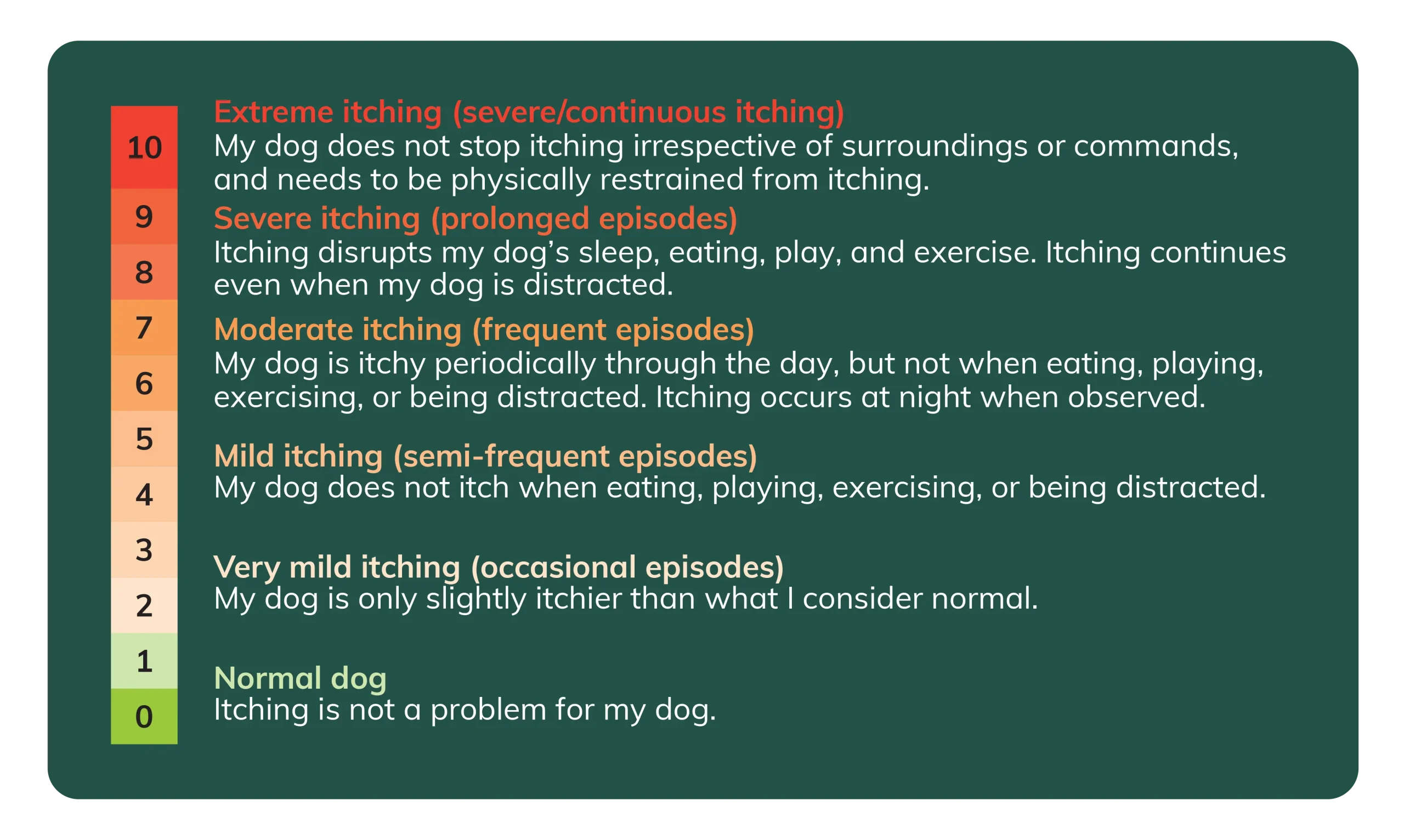
Increasingly, international guidelines recommend assessing treatment success by achievement of specific pruritus scores, for example, ‘normal’ (PVAS <2) which matches the itch levels seen in non-allergic dogs6,8.
Aiming for ‘normal’ itch levels enables vets to meet owner treatment expectations6¥ rather than settling for potentially inadequate levels of itch reduction. In a large, peer-reviewed study, 77% of dogs treated with Zenrelia achieved a normal itch level1††.
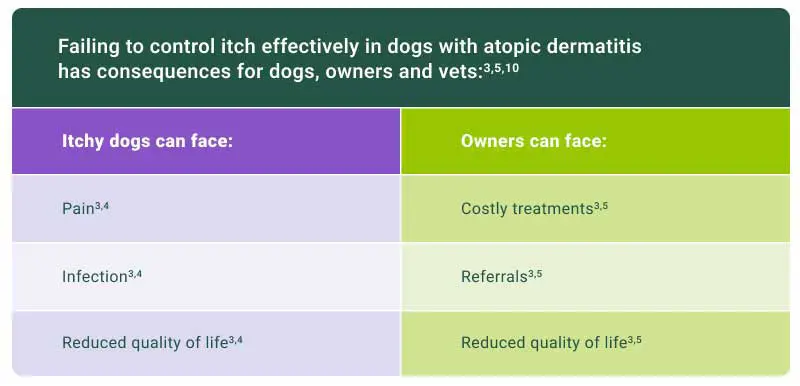
As well as a return to normal, owners also expect their dog’s itch to be resolved quickly and affordably.5,9 In fact, 80% of owners will leave a vet practice if their vet can’t figure out how to treat their itchy dog5. One study defined the tipping point as three visits or after spending the equivalent of around £6809. Treatment convenience also plays an important role, with owners more likely to adhere to once-daily treatment vs. twice-daily treatment1,10,12 .
As the most cost-effective JAK-inhibitor available for itchy dogsα, Zenrelia gives vets the chance to reevaluate treatment goals with owners and improve the quality of life for their dogs.
Vets have experienced success using Zenrelia in both newly itchy dogs and their existing troublesome cases.13
“I would consider using Zenrelia in dogs with mild or acute pruritus, and we’ve seen that it also seems to be useful in patients with chronic inflammation, ear disease and pododermatitis. I initially used it in my more challenging cases which perhaps wasn’t a fair test but it has performed really well.”
— Dr Barnard
1. Forster S et al (2025). Veterinary Dermatology 36: 165-176.
2. Elanco Global Sales data. March 2026.
3. Fernandes B et al (2023). Veterinary Science 10(11): 659.
4. Linek M et al (2010). Veterinary Dermatology 21(5): 456-462.
5. Elanco Itchy Dogs Report 2025 (v1.0) (p4), available at ElancoItchyDogsReportFINAL.pdf (accessed March 2026).
6. Rybnícek J et al (2009). Veterinary Dermatology 20(2): 115-122.
7. Zenrelia Summary of Product Characteristics
8. Olivry T et al (2018). BMC Veterinary Research 14: 238.
9. Hanna B (2022). DVM360 53: 42, available from https://www.dvm360. com/view/earlier-dermatology-referral-rewards-primary-care-practicepart-1-easing-client-expenses-and-enhancing-patientcare (accessed September 2025).
10. Spitznagel MB (2021). Veterinary Dermatology 32(2): 192-e50.
11. Unpublished data: Owner Pruritus Assessment (PVAS) Form.
12. Boda C et al (2011). International Journal of Applied Research in Veterinary Medicine 9(2): 157-165.
13. Zenrelia Success Stories. Zenrelia | Success stories of Zenrelia-treated itchy dogs
†† 77% of dogs treated with Zenrelia achieved PVAS <2 by Day 112 compared to 53% of dogs treated with Apoquel. A ‘normal’ itch score is considered to be comparable to that of a healthy, non-allergic dog (PVAS <2)1
¥ 79% of owners expect a PVAS of 0-1.96
Δ Refer to the Zenrelia Summary of Product Characteristics Section 3.8 for more information7
**Based on PVAS scores over first 14d of treatment1
‡ Improvement based on mean CADESI-04 scores from day 28. A CADESI-04 score of <10 is comparable to that of a healthy, non-allergic dog1
α Based on the list price of Zenrelia (vs. other licensed JAKi’s for dogs)
ZenreliaTM film coated tablets contain ilunocitinib. Legal category POM-V in UK, POM in IE. For further information call Elanco Animal Health on +44(0)1256 353131 or write to: Elanco UK AH Limited,Form 2, Bartley Way, Bartley Wood Business Park, Hook, RG27 9XA, United Kingdom. For further information, consult the product SPC.
Zenrelia, Elanco and the diagonal bar logo are trademarks of Elanco or its affiliates. Apoquel® is a trademark of Zoetis UK Limited & Zoetis Belgium (IE). ©2026 Elanco or its affiliates. PM-IE-26-0093. Date of preparation 03/26. Advice should be sought from the medicine prescriber prior to use. Prescription decisions are for the person issuing the prescription alone.
Use medicines responsibly www.noah.co.uk/responsible www.apha.ie