
2 Jun 2026
Ian Wright BVMS, BSc, MSc, MRCVS discusses the issues with imported dogs increasing this risk and explains the work of a parasite surveillance project.

Ian Wright
Job Title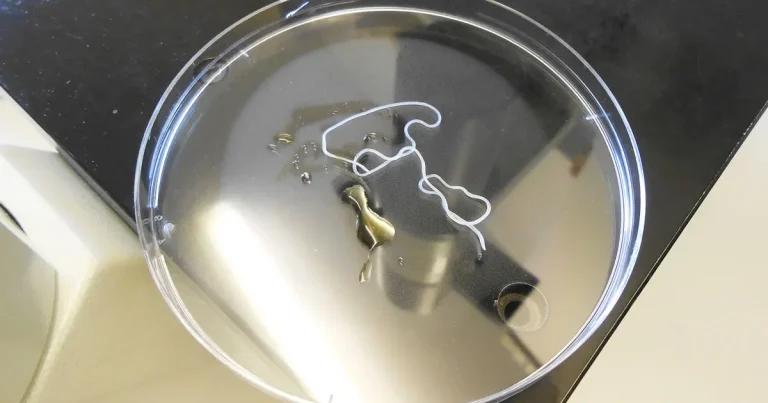
Figure 1. Dirofilaria repens adult.
Legal and illegal importation of dogs alongside climate change are increasing the risk of exotic worms entering the UK and forming endemic foci.
These parasites are being seen in travelled UK cats and dogs with increasing regularity, and veterinary professionals need to be aware of these foreign travellers for both individual pet health and national biosecurity.
Four worm or worm-like parasites are commonly seen in imported dogs and occasionally cats: Dirofilaria immitis (heartworm), Dirofilaria repens, Thelazia callipaeda (eye worm) and Linguatula serrata (a nasal pentastomid).
D immitis can be screened for using patient side antigen tests, but no similar test is available for the other three. For these parasites, morphological identification of adult parasites is the primary method of diagnosis. Screening of imported pets and rapid diagnosis in clinically affected animals is crucial for good prognostic outcomes and to reduce the risk of endemic establishment. This is particularly important, as all four parasites have zoonotic potential.
D repens is a closely related parasite to D immitis, but is less pathogenic to cats and dogs, with adult worms living subcutaneously. It is mosquito transmitted, but can complete its life cycle at lower temperatures than D immitis (Morgan, 2016) and, as a result, has a far wider distribution across Europe.
Many infections are well tolerated by canine and feline hosts, but disease can occur. Dermatitis is the most common clinical presentation as multifocal nodular or papular dermatitis. Ocular presentations and aberrant migration have also been recorded (Agapito et al, 2017). These signs can recur seasonally for years after infection, resulting in pruritus, erythema, papules and focal or multifocal alopecia. Less commonly, hyperkeratosis, crusting, distinct nodules, acanthosis and secondary pyoderma can occur. It has zoonotic potential, and can cause creeping eruptions and conjunctivitis in people.
Zoonotic exposure occurs through bites from infected mosquitoes, so although infected dogs pose no direct risk to pet owners, endemic establishment in UK mosquito populations is a public health concern. Cases in travelled dogs in the UK have already been reported in peer-review literature, and these cases are likely a significant underestimate of total numbers entering the UK (Wright, 2017; Agapito et al, 2017; Panarese et al, 2023). If infected dogs continue to enter the UK and are not treated quickly, there is the possibility for UK mosquito populations to be exposed and for the parasite to become endemic.
No commercial serology or PCR tests specifically for D repens are currently available in the UK. Diagnosis relies on a Knott’s test looking for microfilaria in the blood, biopsy and histology of skin nodules of gross identification of aberrant adult worms (Figure 1). These are long and thin, with males 5cm to 7cm and females 10cm to 17cm in length.
Treatment of clinical cases carries an excellent prognosis in most cases and consists of using a licensed moxidectin/imidacloprid spot-on treatment monthly until resolution of clinical signs and a negative Knott’s test. Discrete subcutaneous nodules containing adult worms can be removed surgically if necessary. It is crucial that imported dogs be checked for ocular and skin lesions, and a Knott’s test is performed.
If imported dogs test negative for D immitis by antigen and Knott’s, then it is worth considering treating with a single dose of moxidectin/imidacloprid to eliminate any D repens infection that may be present. A monthly licensed product should also be advised for pets travelling in endemic countries.
T callipaeda is a vector-borne nematode that resides in the conjunctival sac, lacrimal duct and glands of suitable hosts, which include dogs, cats, wildlife (foxes, rabbits, hares) and humans.
The worm has been spreading through Europe in recent years, following its fruit fly vector, Phortica variegata. The fly transmits the parasite when feeding on lacrimal secretions. Although often non-pathogenic, infection left undetected can lead to conjunctivitis, keratitis, ephiphora, eyelid oedema, corneal ulceration and, in serious cases, blindness.
Cases in UK-travelled dogs have been recorded in dogs imported from Romania, Italy, France (Graham-Brown et al, 2017) and more recently from the Balkans (Veterinary Vision, no date). These cases are likely to be an underestimate of the true total entering the UK.
P variegata has also been recorded in the UK, with climatic modelling suggesting conditions favourable for spread, and if exposed to infected dogs, could lead to endemic establishment. Zoonotic risk comes from infected fruit flies rather than directly from infected animals, so to minimise zoonotic risk it is important that endemic establishment is prevented.
Diagnosis can currently only be achieved in practice by visualisation of the worms in and around the conjunctiva and conjunctival sac. Sedation may be required to fully visualise the worms.
Treatment is a combination of eye flushing, physical removal of worms and treatment with a licensed macrocyclic lactone (Imidacloprid/moxidectin spot-on treatment, or two milbemycin oxime oral treatments given two weeks apart). It is important infections are detected rapidly in infected dogs and treated promptly, both for individual case outcomes and to prevent fruit flies being exposed to infected dogs.
For dogs travelling in infected countries, no licensed product exists for T callipaeda prevention, but it is likely that monthly use of a licensed macrocyclic lactone will minimise the risk of infection.
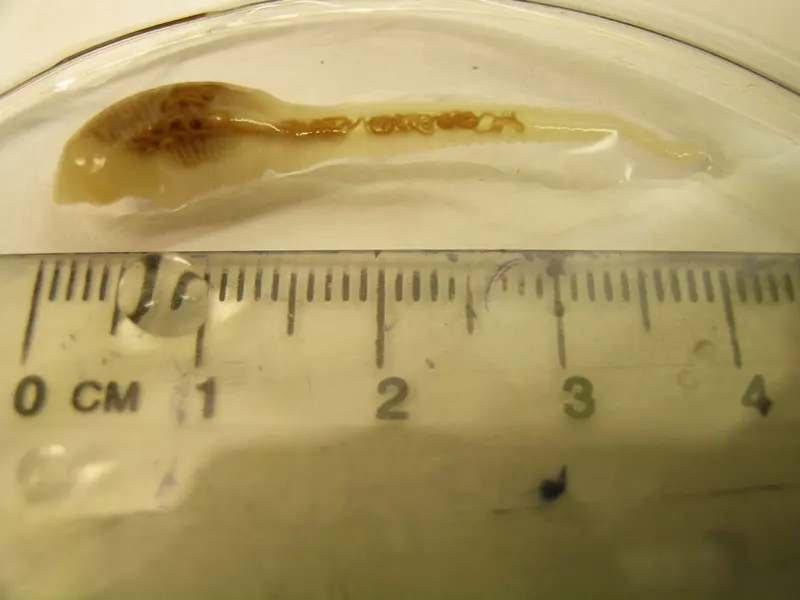
The nasal pentastomid L serrata (also known as “tongue worm”; Figure 2) is an arthropod living in the nasopharynx of a definitive host. These are most commonly canids, although a range of other carnivore hosts may also be infected with adult parasites, including humans.
Eggs are shed primarily in nasal secretions, but may also be swallowed and passed in faeces. A wide range of animals may act as intermediate hosts, including humans if eggs are ingested, with encysted nymphs developing in a variety of tissues such as lymph nodes, liver and lungs.
Most cases of infection in dogs and cats are subclinical. However, large burdens can lead to rhinitis and nasopharingitis with associated chronic sneezing and/or coughing, purulent nasal discharge, and epistaxis.
It is vital that these signs are detected early in affected dogs to limit zoonotic exposure to owners and others in contact, who may ingest infective eggs in nasal discharge or from faecal contamination.
A number of nasal pentastomid L serrata (tongue worm) cases have been seen in the UK in recent years from dogs imported from eastern Europe and the Middle East, where the parasite is endemic (Villedieu et al, 2017; Macrelli and Macintosh, 2022).
A recent untravelled UK case and historic reports of L serrata in UK wildlife has led to the suggestion the parasite may have endemic foci in the UK (Campbell and Jones, 2023).
This case, however, had been fed imported food and, therefore, the source of infection may not have originated in the UK. Surveillance is vital to limit spread of infection, but also to establish if the parasite is already present in UK wildlife and domestic reservoirs.
Dogs with relevant clinical signs – especially those with travel history – should be examined for the parasite. Nasal secretions or faecal samples can be examined using flotation techniques for eggs, but are relatively insensitive.
Diagnosis is most commonly made by gross identification adult parasites expulsed or discovered by rhinoscopy. No large efficacy studies regarding medical treatment exist, but published case reports suggest that milbemycin has some efficacy. Some suggestion exists that other macrocyclic lactones may also be effective. Adult parasites may also be physically removed.
The exotic worm and worm-like parasite surveillance project – which can be found at bit.ly/4f8tCIQ – has been developed by APHA in collaboration with the European Scientific Counsel Companion Animal Parasites UK and Ireland.
Veterinary practices can submit suspected D repens, T callipaeda and L serrata samples to the scheme free of charge for morphological identification. This allows diagnosis to be confirmed for further treatment and zoonotic exposure advice, but also allows data to be captured for nationwide surveillance.
This will help to identify developing endemic foci and geographic areas with larger numbers of imported cases. More information on the scheme can be found on the exotic worm and worm-like parasite surveillance project site on the GOV.UK website.
Increased movement of pets and fluid vector and parasite distributions in Europe make establishment of exotic parasitic worms establishing in the UK more likely.
Exotic parasitic worms and worm-like parasites should be considered as possible infections in imported pets, and those with travel history and relevant clinical signs. Prevention through early detection and treatment is crucial for good prognostic outcomes, to limit zoonotic spread and minimise the risk for endemic establishment.
Surveillance is vital to monitor where high-risk areas for transmission are and for early detection of endemic foci.
Contributing to the exotic worm and worm-like parasite surveillance project when positive cases are suspected is a valuable way to contribute to this strategy.
Ian Wright is a practising vet and co-owner of The Mount Veterinary Practice in Fleetwood, Lancashire. He has a master’s degree in veterinary parasitology and is chairman and director of the European Scientific Counsel Companion Animal Parasites (ESCCAP), as well as guidelines director for ESCCAP Europe.