
8 Sept 2026
Matt Gurney BVSc, CertVA, PgCertVBM, DiplECVAA, FRCVS reviews some of the literature on these drugs and how they affect perioperative pain.

Matt Gurney
Job Title
Image: Kate / Adobe Stock
The concept of pre-emptive, multimodal analgesia is well established. In this review, we will discuss the value of NSAIDs as an essential component of analgesia for acute pain management.
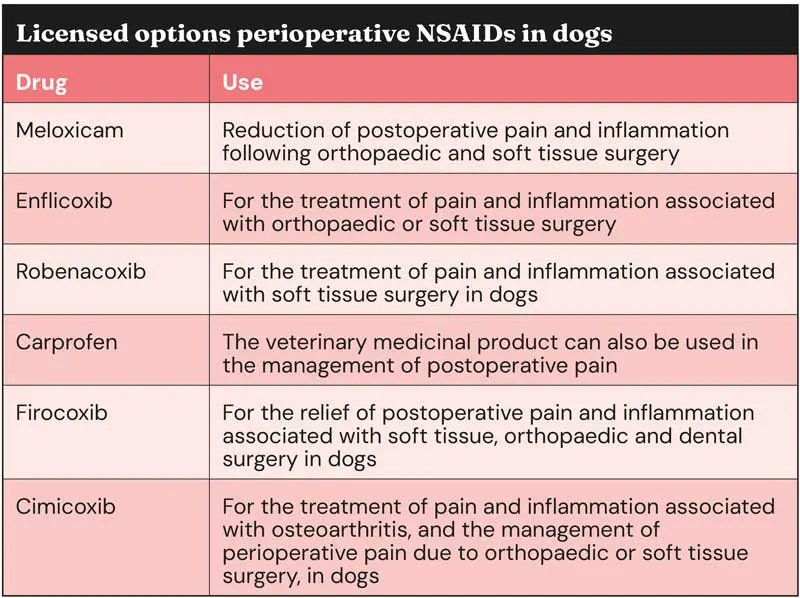
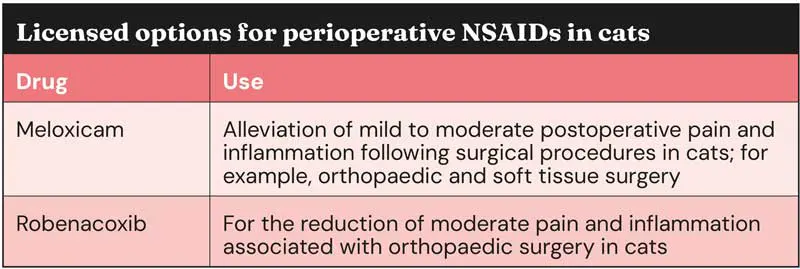
When we look at the various NSAIDs with a perioperative licence in dogs and cats, we see a variation in those licence indications. To delve into some of those indications is difficult, because the papers are not in the public domain.
For more recently licensed NSAIDs such as robenacoxib and enflicoxib, the reader can scrutinise the studies. Understanding the types of procedure involved in those studies is useful, and this is where the relevance to our day-to-day practice comes in.
Of note, firocoxib is the only NSAID in the UK that has a perioperative licence specifically for dental surgery; however, the supporting studies are not readily available. In the US, deracoxib has a licence for dental surgery based on a study in dogs undergoing one or more dental extraction, without nerve blocks and using butorphanol as the opioid (Bienhoff et al, 2012). Dogs in one group (n = 31) received deracoxib 1mg/kg to 2mg/kg by mouth and the other group (n = 31) received no analgesia. Dogs were pain scored with a modified Glasgow pain scale and assessed across three days. Rescue analgesia was required in 15% of dogs in the NSAID group and 66% in the placebo group. Three of the four NSAID dogs were rescued the day of surgery, whereas the remaining dog was rescued the day after surgery. Of the placebo dogs, 16 were rescued the day of surgery, three were rescued the day after surgery and the remaining dog was rescued two days after surgery.
This work highlights clear differences in pain scores when not using an NSAID and also highlights the limitations of pain scoring in assessing pain – given that 44% of dogs in the placebo group received no analgesia and did not exceed the threshold for intervention with pain scoring. The authors concluded that perioperative deracoxib significantly improved postoperative analgesia after canine dental surgery. Now, clearly, in a clinical setting, we would incorporate opioids and local anaesthetics in our dental cases; however, that does raise another question.
Work by Watanabe et al (2019) assessed postoperative pain in cats and stratified the pain assessment according to disease severity. The cats enrolled in this study were undergoing routine dental work and received multimodal analgesia (opioids, NSAID, local anaesthesia with bupivacaine).
Pain behaviours were recorded before and after dental work, and during the dental procedure the disease was graded as mild or severe.
Pain scores were significantly increased in cats with severe disease when compared with the baseline (up to day four) compared to cats with minimal disease. Requirement for rescue analgesia was significantly higher in severe (91.7%) than minimal disease (0%). Pain scores significantly correlated with the number of tooth extractions, gingival and calculus index. Significant differences in food intake was noted between groups. Despite the multimodal approach, cats with severe disease required a greater level of analgesia. No studies exist that document the benefit of NSAIDs over placebo in cats – and we can see the ethical challenges of that work when it is well established in clinical practice to use NSAIDs.
The Watanabe study highlights that routine analgesia is not always enough in severe disease, and the author recommends the inclusion of options such as a perioperative ketamine infusion in such cases. This represents an area of future research.
A further area of research is to examine whether the use of NSAIDs in the days preceding dental surgery would improve perioperative pain scores.
Given the level of periodontal disease in the UK pet population, it is clear that NSAIDs play a valuable role in acute pain management.
Expanding on the feline perspective, a recent publication reported the results of a global survey on feline pain management (Steagall et al, 2026). Meloxicam (76.4%) and buprenorphine (48.1%) were the most frequently used analgesics in acute pain. Meloxicam was typically given postoperatively, and buprenorphine was mainly administered preoperatively. Regarding NSAID use, the authors of this work documented that NSAIDs are underused for ocular pain and enucleation surgeries. A clear need exists for greater use of NSAIDs in all cases of acute pain as part of a multimodal approach. Of note from this work is the tendency to administer NSAIDs in the postoperative period rather than preoperatively. The evidence around when to administer NSAIDs warrants further consideration.
In a study, titled “Efficacy and safety of 3 versus 5 days of meloxicam as an analgesic for feline onychectomy and sterilization”, the effect of different NSAID duration was assessed in cats (Ingwersen et al, 2012). The study suggested that for the level of pain associated with onychectomy plus sterilisation, a three-day course of meloxicam was as effective and as safe as a five-day course, and that timing of administration (preoperative versus postoperative) had a greater effect on outcome than duration of treatment.
In this prospective clinical trial involving 50 client-owned cats undergoing onychectomy and sterilisation (ovariohysterectomy or castration), cats received meloxicam 0.2mg/kg subcutaneously on day one (either preoperatively or postoperatively), followed by 0.05mg/kg by mouth once daily thereafter.
Treatment duration was either three or five days. Outcomes assessed were pain scores, lameness scores, haematology, biochemistry and the requirement for rescue analgesia. No significant differences in analgesic efficacy were reported between the three-day and five-day protocols. No significant differences in safety parameters between treatment groups were documented, and no cat required rescue analgesia. Cats that received meloxicam before surgery had significantly better gait/lameness scores than those receiving it postoperatively, supporting the concept of pre-emptive analgesia.
This study helps to answer the question: “how long should I provide NSAIDs after ovariohysterectomy (OVH) in cats?” To note is the fact that numbers in the study were low (total 50 cats) and the procedures were OVH, onychectomy and castration, so one could argue that further work is required to definitively answer this question.
Lending support to that work is a useful paper by Carroll et al (2005), which demonstrated that preoperative meloxicam provided superior analgesia and reduced rescue analgesic requirements compared with butorphanol alone in cats undergoing onychectomy with or without neutering, further supporting pre-emptive NSAID use in feline surgery.
Enflicoxib is an NSAID with a duration of action of seven days. Enflicoxib was compared to meloxicam in dogs undergoing orthopaedic surgery. Twenty-eight dogs were randomised to receive 8mg/kg enflicoxib (n = 14) orally the day before surgery, or 0.2mg/kg meloxicam (n = 14) subcutaneously at induction and orally at 0.1mg/kg daily every 24 hours for seven days. The main outcome measure was pain assessed using the short form of the Glasgow Composite Pain Scale. Visual analogue scales were also used to assess pain at rest, pain at palpation and inflammation. According to pain scores, enflicoxib was shown to be non-inferior to meloxicam for seven days post-surgery. The advantage here is that analgesia can be achieved with a single oral tablet.
The concept of pre-emptive analgesia refers to the timing of analgesic administration either before or after the incision. This classic pre versus post approach assumes that intraoperative factors contribute most to generation of a sensitised state. This concept has been broadened in light of increasing knowledge to consider the influence of multiple factors on the generation of central sensitisation, with the aim of attenuating the impact of noxious preoperative, intraoperative and postoperative stimuli, and is termed preventive analgesia.
Of the three broad perioperative periods (pre, intra, post), as yet it is unclear the extent to which each period contributes to central sensitisation and postoperative pain, although some studies have documented beneficial effects of postoperative versus intraoperative nociceptive blockade in people (Gordon et al, 2002). Other studies have demonstrated more effective relief of postoperative pain by targeting preoperative pain (Klasen et al, 2005).
Recent pain management guidelines recommend that pre-emptive NSAIDs are particularly valuable when administered before surgical trauma – provided no contraindications such as renal compromise or hypovolaemia are present.
An essential aspect in practising preventive analgesia is that the analgesic intervention should be continued for as long as the sensitising pain stimulus lasts (Dahl and Møiniche, 2004), highlighting the need to accurately assess pain – as illustrated in the studies described.
NSAIDs form a valuable and well-accepted component of multimodal analgesia. This review has touched on only some of the extensive literature.
The question to ask when faced with acute pain is, “can I find a reason not to give an NSAID?”
Matt Gurney is a specialist in anaesthesia and pain management. Matt sees chronic pain cases at Eastcott Referrals in Swindon and at Pawra, a canine wellness centre in London. Matt is co-founder of Zero Pain Philosophy, an educational resource for vet professionals.