
1 Nov 2026
Nicola Lakeman MSc, BSc(Hons), CertSAN CertVNECC, VTS(Nutrition), RVN outlines how RVNs can provide structured, practical support for owners of patients with this illness.

Nicola Lakeman
Job Title
Image: Milan / Adobe Stock
A diagnosis of diabetes mellitus can be overwhelming for clients because successful management requires sustained time, financial commitment and practical effort.
Diabetes is an incurable, complex condition, and some animals can be difficult to stabilise or may not tolerate every treatment option. Clear, staged support from the veterinary team can help owners develop the knowledge and confidence needed to manage their pet safely at home.
RVNs are often responsible for teaching owners the skills required for home monitoring and medication administration. Nurse-led clinics should therefore function as a structured education programme rather than a single information-heavy appointment. Covering the essential topics over several planned sessions allows owners to learn, practise and ask questions without becoming overwhelmed. This should be tailored to the needs of the owner.
A nurse-led diabetes support programme can be organised around four stages: initial education and treatment technique; early follow-up to check confidence and identify practical problems; clinical monitoring and treatment review; and long-term support for nutrition, weight management and adherence. Urgent clinical concerns should be directed promptly to the veterinary surgeon responsible for the case. RVNs are acting as advocates for the pet and owner.
Owners differ in how they absorb and retain information, so education should be offered in several formats. Useful resources include printed and digital handouts, videos demonstrating practical techniques, face-to-face instruction and supervised opportunities to practise.
Ask each owner the formats they find most helpful, check their understanding and provide clear contact details for non-emergency questions.
After demonstrating each practical skill, ask the owner to explain and demonstrate it in their own words. This teach-back approach confirms understanding, reveals errors before the owner returns home and allows the nurse to tailor further support.
Insulin storage and preparation requirements vary by product licence and may differ between countries. Before advising an owner, check the current summary of product characteristics (SPC) for the prescribed product and reinforce its specific instructions. Explain how to store the insulin safely in a refrigerator and whether it may be kept below 25°C once loaded into a dosing pen, as some products still require refrigeration.
The United Kingdom SPC for Caninsulin gives specific instructions for mixing the suspension before administration. It also states that the product should not be used if visible agglomerates persist after thorough shaking.
Owners should therefore be taught to follow the product-specific mixing instructions and to inspect the suspension before each dose rather than relying on general assumptions about insulin handling. This can be quite different from what is taught in practice and reference to the SPCs should be undertaken.
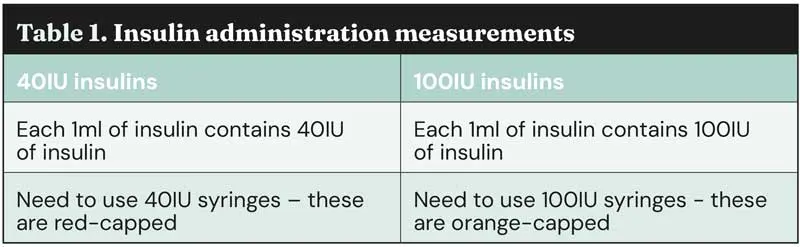
Insulin concentration is measured in international units per millilitre (IU/ml; Table 1). Many licensed veterinary insulins are supplied at 40IU/ml and must be administered with a matching U40 syringe, which commonly has a red cap.
Some insulins, including certain neutral or soluble preparations, are supplied at 100IU/ml and require a U100 syringe, which commonly has an orange cap.
During the nurse consultation, owners should be shown how to verify both the insulin concentration and the syringe type before every purchase and use, particularly if they obtain supplies from an online pharmacy.
Reusable insulin delivery devices are increasingly used because they can make accurate dosing easier.
To administer a dose, the owner should press and hold the administration button while the dose selector returns to zero, then keep the pen in place for at least five seconds. Removing it sooner may allow small drops of insulin to leak from the needle tip and result in incomplete delivery.
RVNs beginning to run diabetes clinics should first gain practical experience with the insulin delivery devices used in their practice. They should be able to demonstrate each technique accurately, identify common errors and supervise owners while they practise before administering medication independently at home.
Sodium-glucose cotransporter 2 (SGLT2) inhibitors are orally administered medicines that reduce renal glucose reabsorption, increasing urinary glucose excretion and lowering blood glucose. They do not replace the need for sufficient endogenous insulin activity.
If insulin activity is inadequate, cells increasingly use fat as an alternative energy source and ketone production rises; ketone monitoring is therefore essential because diabetic ketoacidosis can develop even when blood glucose is not markedly elevated.
Owners may need to be taught how to collect a suitable urine sample, perform the recommended ketone test, record the result and follow the practice’s agreed protocol instructions if ketones are detected or the cat becomes unwell. Owners should be given appropriate contact details for these results.
Once owners can store and administer medication safely, the consultation should address the daily factors that influence glycaemic stability. These include diet, feeding pattern, body condition, concurrent disease and the owner’s ability to follow a consistent routine.
At diagnosis, every diabetic cat requires a full nutritional assessment that considers current diet, energy intake, bodyweight, body condition, muscle condition, concurrent disease and feeding behaviour.
Diets high in simple carbohydrates, including some semi-moist products that use humectants such as glycerine, may contribute to postprandial hyperglycaemia and should be assessed critically. The chosen plan must also be affordable and palatable enough for the cat to eat reliably.
Underweight cats require a strategy for safe weight gain alongside diabetic management, whereas overweight cats require a monitored weight-loss programme.
In cats, administration of exogenous insulin does not always need to coincide precisely with meal times. Owners should nevertheless disclose all snacks, treats and additional foods to the veterinary staff constructing the feeding care plan for the case because unaccounted energy intake can interfere; milk, broths and soups should also be included when calculating intake. Where appropriate, the cat’s established feeding pattern may be continued. Free-choice feeding means offering a measured total daily ration that the cat may eat at different times, whereas ad libitum feeding provides unrestricted access to food.
For both cats and dogs, the long-term nutritional goal is to achieve and maintain an appropriate body condition score.
Obesity increases the risk of diabetes mellitus in cats fourfold and can make weight management more difficult after diagnosis. Initial management should prioritise reducing and stabilising blood glucose; once the patient is clinically stable, a conservative weight-loss programme can be introduced and monitored by a veterinary professional.
Diet selection can be challenging, but the chosen food must be palatable, support the target body condition and contribute to stable blood glucose while meeting the animal’s wider clinical needs.
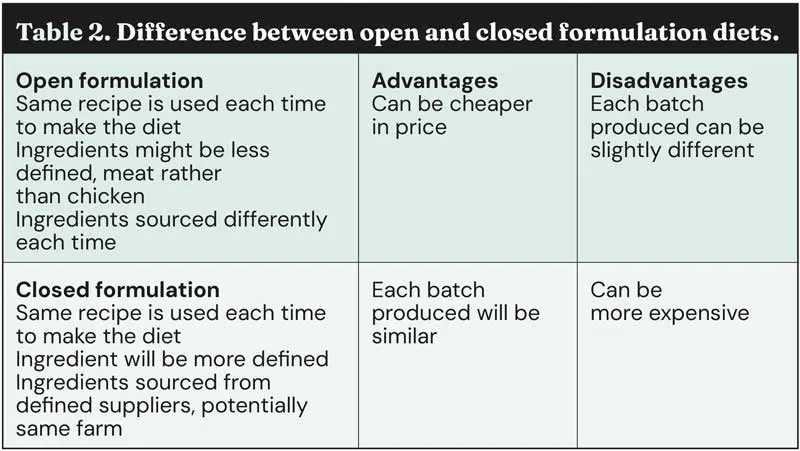
A closed-formulation diet may be preferable where batch-to-batch consistency is important; Table 2 explains the distinction between open and closed formulations.
Obese diabetic cats require a controlled, closely monitored weight-loss programme because rapid weight loss increases the risk of hepatic lipidosis.
Once an appropriate body condition score has been achieved and glycaemic control remains stable, regular clinical examinations should continue, including bodyweight assessment and fructosamine measurement where clinically indicated. A diet higher in protein, with an appropriate fat content and reduced carbohydrate content, may support gradual weight loss, but the plan should be individualised to the patient.
Diet selection must also account for concurrent disease. When renal dysfunction is present, phosphorus restriction may be beneficial, but some renal diets contain more carbohydrate because protein is restricted. Weight-management goals must therefore be balanced against renal status, body condition, muscle condition and the risk of progressive loss of lean tissue. In a patient with concurrent diabetes mellitus and renal disease, the recommendation should be individualised and reviewed as either condition changes.

As with feline nutrition for diabetic diets, the recommendation needs to be personalised for the individual – based on weight, body condition score, overall clinical health, previous history, feeding habits and owners’ requirements.
Dogs with diabetes are insulin dependent, so day-to-day consistency is central to management.
Owners should keep feeding times, portion sizes, dietary energy and nutrient composition, insulin administration and exercise as consistent as possible.
Nurse consultations should explain why a closed-formulation diet may support this consistency and how the type and amount of carbohydrate can influence the postprandial glucose response.
A therapeutic diet for a diabetic dog should have a consistent formulation and contain minimal simple sugars. Its carbohydrate and fibre profile should help moderate the postprandial rise in blood glucose while still meeting the dog’s energy, protein and wider nutritional requirements.
There is no definitive answer to the best forms of communication; it will vary depending on the situation, the client and the information that you are trying to impart.
A good communicator can adapt how they communicate depending on these factors. This is an important element of all nurse consultations, not just diabetes clinics.
As a clinic nurse, you will be discussing matters with the client, but having other forms of communication, such as leaflets, handouts, and website addresses, can be useful. Bullet-pointing key points (medications or feeding quantities) for the client can be helpful; these can be emailed to clients so that they can refer back to them if needed.
A newly diagnosed diabetic pet can be exceptionally overwhelming for its owner. Each client should therefore have a clear route for raising non-emergency concerns, discussing practical difficulties and obtaining reinforcement of previous teaching.
Where possible, a named nurse should provide continuity, coordinate follow-up and refer clinical concerns to the veterinary surgeon responsible for the case. This consistent point of contact can improve owner confidence and support safe, sustainable diabetes management at home.
Nicola Lakeman works as nutrition manager for IVC Evidensia. Nicola graduated from Hartpury College with an honours degree in equine science, and subsequently qualified as a VN in 2002. She has won the BVNA/Blue Cross Veterinary Nurse of the Year and was awarded the BSAVA outstanding contribution to veterinary nursing award. Nicola has gained her master’s degree in advanced veterinary nursing with the University of Glasgow and is a board-certified Veterinary Technician Specialist (VTS) in nutrition.