
28 Apr 2026
Mike Davies BVetMed, CertVR, CertSAO, FRCVS shares an update on pet foods, with advice for veterinarians on hot topics such as raw and vegan diets.

Mike Davies
Job Title
Image: NVB Stocker / Adobe Stock
Market research shows that pet owners, including those in the UK, US, Canada and Australia, are more likely to get advice about feeding their pet from the internet, social media and pet shops than from their veterinary practice.
Furthermore, studies have shown that even when clients want information on nutrition from their practice, this is not discussed during veterinary visits (Hunter and Murison, 2025; Laflamme et al, 2008; Morgan et al, 2017; Schleicher et al, 2019; Rajagopaul et al, 2016). These studies demonstrate that veterinarians should be discussing nutrition more with their clients.
Having said that, most practices that I know do give some nutritional advice during consultations – especially at the time of acquisition of a new pet and at vaccination time. I also know some that run nurse-led nutrition clinics. However, worryingly, the American Animal Hospital Association (AAHA) Reports (AAHA, 2003; 2009) found that just 21% of owners complied with veterinary advice for therapeutic diets.
I run a lot of courses for veterinarians and nurses, and I am often disappointed at their lack of knowledge and, even worse, belief in disinformation from various sectors that flies in the face of scientific evidence. Examples include recommending practices such as feeding raw meat-based diets, vegan foods for cats, grain-free foods, a belief that extruded kibble foods are harmful, and recommending homemade rations that are unlikely to be nutritionally adequate even when based on recipes compiled by experts.
In one study, no homemade recipes (n=114) for cat maintenance met nutritional requirements (Wilson et al, 2019). In another, 67 recipes intended for dogs or cats with chronic kidney disease did not meet requirements (Larsen et al, 2012). It has been shown to be impossible to re-create a homemade ration reliably from a recipe (Davies, 2014).
In this article, I am going to outline some of the basic considerations that veterinary staff should know before they give nutritional advice to clients.
The first thing that should be looked for on a pet food label is whether the food is complete or complementary. In my experience, most people do not know this.
In January 2026, I bought two pet foods that were next to each other on a pet store shelf (Figure 1). These foods are fine, but one is labelled “complete” and the other “complementary”. Do you think your clients would realise this when making a purchase?
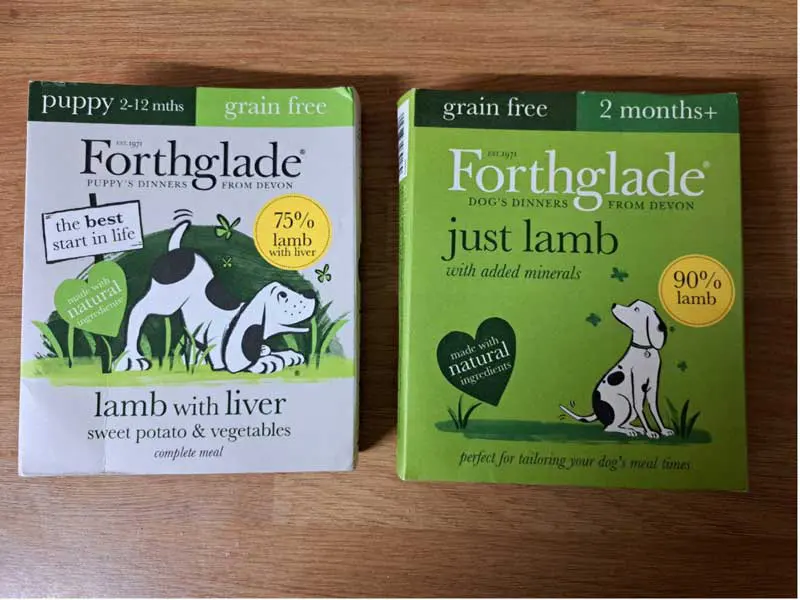
If feeding a complementary food, it is important to know what needs to be fed with it to achieve a complete and balanced daily ration. Unfortunately, few pet food manufacturers provide adequate information about this on their labels.
The profession should be able to rely on pet food labels to give accurate advice, but in recent years it has been shown that pet foods labelled as “complete” are usually not complete. In the UK, one study (Davies et al, 2017) showed that only 6% (six out of 97) of wet and 38% (30 out of 80) of dry food were fully compliant for minerals and trace elements, and many were so imbalanced that they presented a serious health risk to pets; for example, for copper, 20% of wet food failed to meet minimum requirements, while 29% of wet foods and 20% of dry foods had inappropriate Ca:P ratio.
In a study last year (Kępińska-Pacelik et al, 2025), all analysed dry cat foods (n=27) met the minimum recommended levels for protein and fat for adult cats, as established by the European Pet Food Industry Federation (FEDIAF) in 2024. However, 11% of the products did not meet the minimum recommended level for linoleic acid (C18:2 n-6), and 14% lacked arachidonic acid (C20:4).
In another study, insect-based foods were shown not to be compliant with minerals or fatty acids (Ryu et al, 2024), studies have shown that poorly constructed vegan foods failed to meet guidelines (Zafalon et al, 2020) and raw pet foods have also been found to not comply with guidelines (Freeman and Michel, 2001). In the study by Davies and others (2017), raw pet foods tested were the least compliant for minerals and trace elements.
The front cover of packaging often refers to a specific ingredient; for example, beef dinner or chicken casserole.
To pull out an ingredient in a pet food to highlight on labels, website, social media or other materials, the ingredient must constitute at least 4% of the content; for example, 4g per 100g of food. This means that a species claim on the front of a label (such as beef, lamb or chicken) may not be the main species protein in the product.
This was confirmed in a study (Maine et al, 2017) that examined the DNA in 17 leading UK dog and cat foods. In 14 out of 17 samples, bovine, porcine and chicken DNA were found in various proportions and combinations, but were not explicitly identified on the product labels. Of the seven products with prominent headline descriptions containing the term “with beef”, only two were found to contain more bovine DNA (more than 50%) than pig and chicken DNA combined.
This issue is important for pet owners from some religious backgrounds who might buy a food believing it is beef, but which in fact may contain mostly pork. It is also important for veterinarians trying to evaluate the underlying cause of a suspected dietary allergy causing skin or gastrointestinal signs.
There are pet foods that are marketed in different flavours (such as beef, lamb or chicken) with different coloured labels, but in fact the food inside the can is identical because the food contains 4% of each species protein. Is this fair on the consumer?
By law, the water (or moisture) content must be listed on a pet food label if it exceeds 14%, which means that dry foods do not have to declare this. Usually, the water content in dry foods is about 8% to 10%.
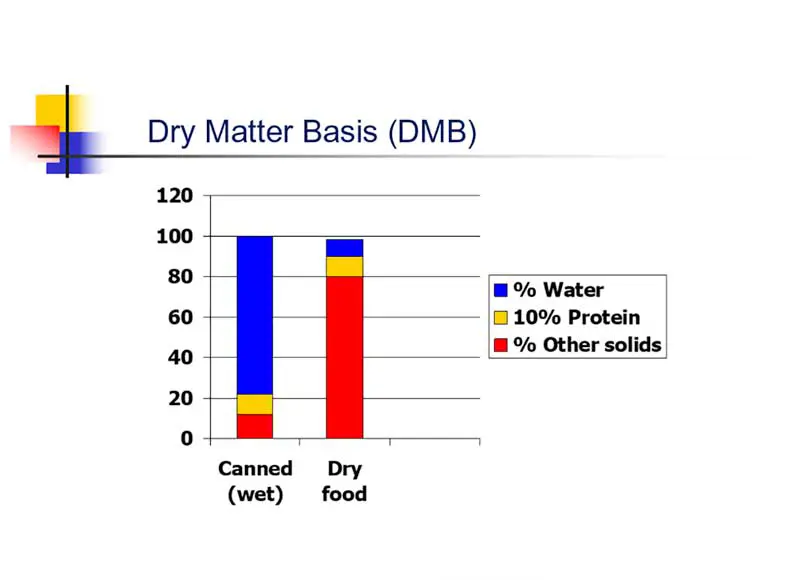
When comparing pet foods, it is important to calculate the ingredients on a dry matter (DM) basis – this is necessary, as wet foods can contain anything from 70% to more than 80% water. So, a declaration of 10% protein on label may be 33% to 50% for wet, to 11% DM for dry foods.
Owners often think they can read and compare the ingredients on a wet product with a dry product, but they cannot without converting to DM (Figure 2).
Carbohydrates do not have to be declared on a pet food label. Wet foods are usually very low in carbohydrates, but there are some that contain cereals that are higher.
Dry foods are usually high in carbohydrate content, but the only way to work out how much is to add up all the other declared ingredients, plus percentage of water, and take the total away from 100%. What is left is the carbohydrate (nitrogen-free extract).
Domesticated dogs have genetically evolved to be omnivores (Wayne and Vonholdt, 2012; Vonholdt et al, 2010) and can be fed vegetarian and vegan diets, and even wild wolves eat a large amount of plant material (Papageorgiou et al, 1994).
Cats remain obligate carnivores, and there are some questions about the origin and safety of some essential ingredients (for example, retinol, niacin, vitamin B12, vitamin D3) in cat food marketed as being vegetarian or vegan.
Some specific diseases are associated with the presence of some grains, including gluten sensitivity resulting in gastrointestinal or possibly multisystemic (skin and neurological) signs, but confirmed gluten-sensitivity is very rare and this condition resolves by removing exposure to gluten-containing foods, such as wheat (including all varieties such as durum, spelt and farro), barley and rye.
Dietary allergies due to cereal proteins causing gastrointestinal or dermatological signs do occur; however, the prevalence of cereal-based dietary allergies is low (probably less than 0.2% of all dermatoses) and much less frequent than allergies caused by animal proteins (beef, chicken) or dairy products.
In a systematic review (Davies, unpublished), there was insufficient scientific evidence to support a recommendation for widespread feeding of grain-free diets to dogs.
In December 2023, the US Food and Drug Administration (FDA) announced that it had discontinued its investigation into a suggested link between feeding grain-free foods and dilated cardiomyopathy in dogs as they could find no link between any pet foods and canine dilated cardiomyopathy.
At a RAW Veterinary Society meeting I spoke at a few years ago, the phrase “kibble kills” was a commonly quoted statement.
However, there is no credible scientific evidence that shows health issues are more prevalent in pets fed kibble-based products compared to others when the much higher market share of kibble-based foods compared to others is taken into consideration.
FEDIAF Nutritional Guidelines for Cats and Dogs are peer reviewed by independent veterinary nutritionists throughout Europe and the latest version 2025 is downloadable from tinyurl.com/y7b3bz46
The guidelines recommend significantly different minimum nutritional requirement for adult and young cats and dogs. Nevertheless, it is possible to formulate a ration that meets the higher needs of young puppies or kittens that will also meet the requirements for an adult; however, this does mean that adults will be fed a lot more than required for the whole of their lives.
FEDIAF recommends very different nutrient levels for cats and dogs; for example, the minimum amount of protein and other nutrients is much higher for cats than dogs.
Cats also require taurine, which dogs do not. So, foods intended for both species must meet all the higher and different requirements for cats, thereby providing much more than dogs require.
Whenever possible, recommend foods that are manufactured to a fixed formula, as this means there is little variation between batches.
This is particularly important for pets prone to gastrointestinal problems.
The veterinary professions are science based and should only recommend products that have been proven through scientific studies to be safe and efficacious. Indeed, it is unethical to recommend a product that does not have the scientific evidence to support its use (RCVS).
Unfortunately, many pet foods and supplements in the marketplace imply health benefits with little or no evidence to support their claim. One of the worst examples I have seen was a complementary cat food product that claimed to be able to prevent heart disease and hypertension in all cats. This complementary product claimed on the associated website that “these ingredients can help to prevent hypertension and heart disease in all cats”, which is not true, and in breach of the Veterinary Medicines Act (Amended) 2024 (www.applaws.com; last accessed 25 November 2025).
Having reviewed the literature, and in view of recent UK outbreaks of TB, and Shiga toxin-producing Escherichia coli in humans linked to contact with animals fed raw, as well as 290 reports of Salmonella isolated from raw meat pet food sampled in 2024 (APHA, 2025), my opinion is that UK veterinary professionals should dismiss the weak advice currently being given by the BVA and BSAVA, and should follow the recommendations made in the US by the following bodies.
Even if a practice discourages feeding raw foods, some clients will continue to do so. Provet Limited has issued advice (www.provet.co.uk) on this subject for practices to try to reduce the risks.

If you advise your clients not to feed raw meat foods, but they do not take your advice, advise them:
Veterinary staff should ensure that they are knowledgeable enough about the subject before offering professional opinion to their clients on nutritional matters.
Care needs to be taken when examining and interpreting pet food labels.
In the UK, pet foods labelled as complete should be assumed not to be complete, unless the manufacturer analyses its products after every batch is made to ensure compliance with FEDIAF guidelines.
Only products with scientific evidence to support safety and efficacy should be recommended for the management of clinical conditions.
Ask to see the scientific evidence to support health claims on labels or websites, as no organisations are proactively monitoring and policing this area of marketing.
Mike Davies qualified from the RVC, has RCVS postgraduate certificates in veterinary radiology and small animal orthopaedics, and holds a fellowship by examination in clinical nutrition in cats and dogs. He is an RCVS specialist in veterinary nutrition (small animal clinical nutrition). Mike has worked in academia and private practice, and for several pet food manufacturers and pharmaceutical companies. He speaks internationally on clinical nutrition and geriatrics, and founded the original City and Guilds certificate in small animal nutrition, and the BVNA certificates in small animal and exotic nutrition. He runs Provet’s certificate course in clinical nutrition.