
12 November 2026
Leading raw pet food manufacturer Bella+Duke, provide advice on how vets can advise owners.


Carolanne Cicero RVN
Job Title
Owners and veterinary teams share the same goal: protecting animal health and welfare through informed, evidence-based decisions. Open conversations about diet give vets the opportunity to assess nutritional adequacy, discuss recognised food safety risks, and help owners make informed choices without compromising their relationship with their veterinary practice.
As a leading raw pet food manufacturer whose complete recipes meet FEDIAF nutritional guidelines, Bella+Duke believes that working together is essential to animal welfare. This article explores the available evidence, the importance of manufacturing standards, and the practical steps veterinary professionals and manufacturers can take to support raw-feeding clients. Throughout, we aim to be clear about what the evidence shows and where it is still developing, and we share the view that further research is needed.
Vets now regularly encounter raw feeding in practice, as more owners are choosing raw pet food for their pets. The BVA Voice of the Profession 2024 survey found that 94% of companion animal vets have clients who feed raw1. UK Pet Food data also indicates that commercial raw pet food sales volumes grew by 12.5%2. Together, these figures demonstrate why raw feeding is a relevant consideration in everyday veterinary practice. For veterinary professionals, the practical challenge is not just whether to endorse raw feeding, but how best to support the clients who choose it.
However, some owners may be reluctant to discuss their feeding choices because they fear judgement or disagreement. This can leave veterinary professionals without a complete dietary history when investigating clinical signs or advising on preventative healthcare.
An open, non-judgemental approach allows vets to understand exactly what a pet eats and distinguish between professionally formulated commercial diets and home-prepared meals, which can present different nutritional and microbiological challenges.
The aim is not to persuade every vet to recommend raw feeding, but to help veterinary teams understand it better, respect owners’ decision to feed it, and support those clients with confidence.
Look for confirmation of independent auditing, validated pathogen controls, microbiological testing with positive release, and an unbroken cold chain from slaughter to the owner’s freezer.
At Bella+Duke, these controls include:
The table below sets out these controls and why each matters clinically. RawSAFE accreditation and UK Pet Food certification are relevant benchmarks when assessing a manufacturer’s approach to safety.
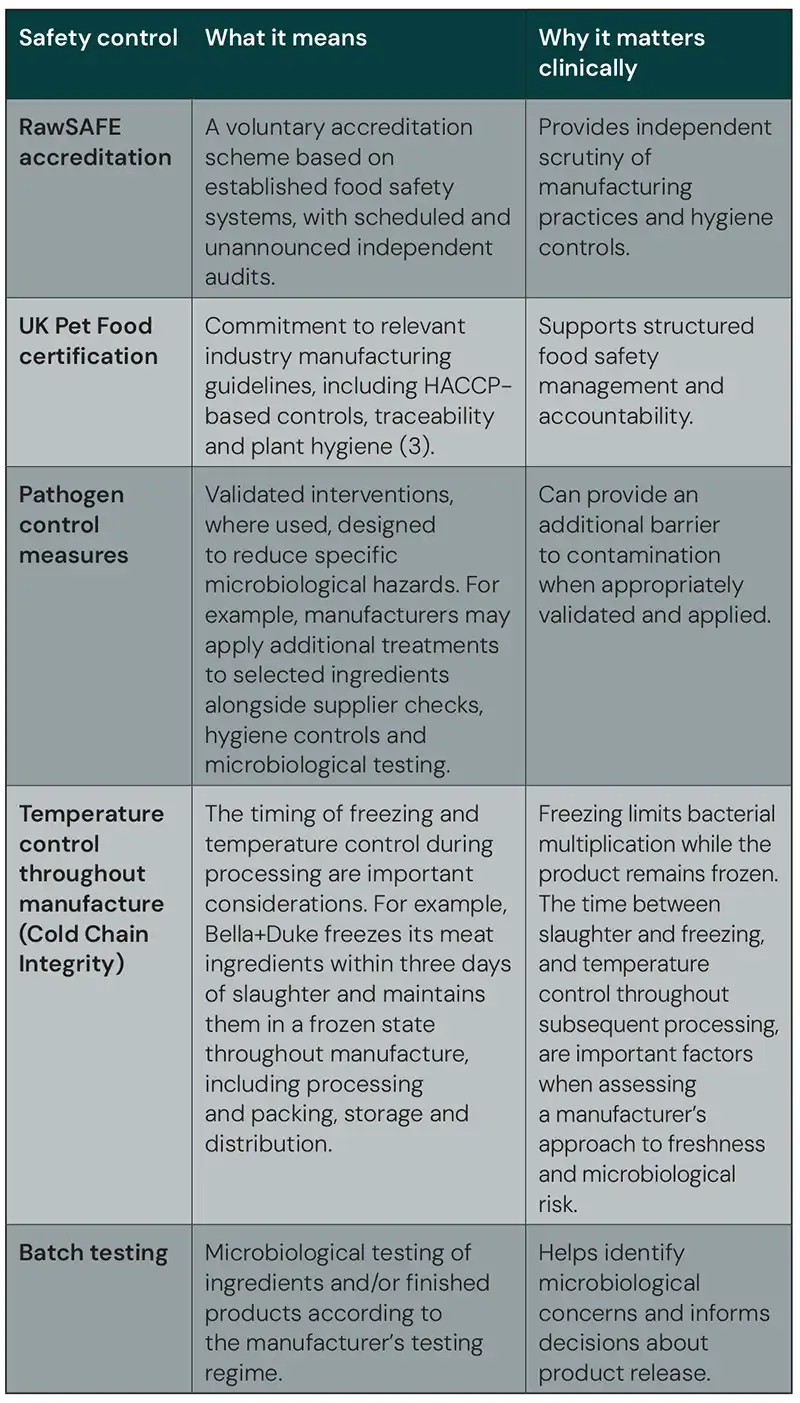
The important distinction is that “raw” describes a type of food; it does not, by itself, tell a veterinary professional how an individual product has been manufactured or what controls have been applied.
Microbiological contamination is not exclusive to raw pet food. Outbreak investigations have linked contaminated dry pet food to human illness, while research has examined potential Salmonella exposure associated with dry pet food and the importance of manufacturing controls to prevent contamination and recontamination4,5. This does not mean the risks are equivalent across food formats: manufacturing processes, pathogen-reduction steps and potential routes of exposure differ.
However, these findings reinforce the importance of robust manufacturing controls, hygiene, appropriate microbiological testing and clear food safety procedures across the pet food industry.
The FSA’s report highlights the importance of looking beyond raw pet food as a single category, recognising that manufacturing processes, testing and handling all play a role in determining food safety.
The Food Standards Agency (FSA) published findings on 10 February 2026 from testing 380 raw dog and cat food products sampled between March 2023 and February 20246. UK Health Security Agency (UKHSA) laboratory testing found that 35% contained harmful bacteria, including Salmonella, Campylobacter and E. coli, while 29% failed to meet legal microbiological standards.
The findings should not be dismissed or disputed. Instead, they highlight why raw pet food should not be treated as a uniform category. Manufacturing practices, ingredient sourcing, hygiene controls, microbiological testing and independent auditing all matter when assessing the processes used to manage food safety risks.
The FSA sampling period ended in February 2024, more than two years before publication of the report. These results therefore describe the products sampled during that period, rather than providing a direct measurement of current contamination levels across the entire market.
To understand the wider picture, it is also useful to consider longer-term surveillance data.
Surveillance data suggests the category is moving in the right direction. Animal and Plant Health Agency (APHA) surveillance data published in February 2026 indicated that Salmonella isolations in UK raw pet food manufacturing fell by approximately 29% between 2022 and 20247. UK Pet Food data indicates that commercial raw pet food sales volumes grew by 12.5% over the same period.
The decline in reported isolations should not be solely interpreted as proof that all raw pet food has become safer; however, it is encouraging, particularly alongside category growth. It underlines the importance of continued monitoring and robust manufacturing controls as the category develops.
Yes, when it is correctly formulated, tested and labelled as complete. A commercially prepared raw diet labelled as complete should provide all the nutrients required by the relevant animal when fed according to its directions. FEDIAF (the European Pet Food Industry Federation) publishes nutritional guidelines used by pet food manufacturers to formulate complete and balanced diets for cats and dogs8.
Nutritional adequacy depends on formulation, ingredient composition, and quality control. A mixture of meat and other ingredients should not automatically be assumed to provide complete nutrition simply because it contains a variety of animal products.
Bella+Duke works with nutritional expertise to formulate its complete recipes against FEDIAF guidelines. The company also regularly tests finished meals at a UK-accredited laboratory to assess their nutritional composition.
Caroline Blackmore DIP ION, BANT, CHNC, explains:
“We regularly test our finished meals at a UK-accredited laboratory to ensure their nutritional composition falls within FEDIAF’s recommended minimum and maximum guidelines. As the nutritional profile of raw ingredients can vary seasonally, we use small amounts of nutritional premix where needed to maintain consistency throughout the year. For example, the vitamin D content of beef can vary with seasonal grazing.
“Where possible, our premixes include chelated forms of selected minerals, bound to organic compounds such as amino acids, which may offer improved bioavailability compared with certain conventional mineral sources.”
“This approach helps us account for natural variations in raw ingredients while maintaining the nutritional balance of our recipes. Our nutritional testing shows that, for nutrients with defined minimum and maximum levels, our meals sit in the middle to upper part of the relevant FEDIAF guideline ranges. We publish the nutritional results for each recipe on our website so vets and owners can review them.”
For veterinary professionals, access to nutritional information and an opportunity to ask manufacturers questions can support more informed discussions about the suitability of a diet for an individual pet.
Antimicrobial resistance (AMR) is an important consideration when discussing raw pet food because raw animal products may carry antimicrobial-resistant bacteria9. Manufacturing controls and microbiological testing can help manage food safety hazards, but no single intervention can guarantee the absence of resistant organisms.
Because resistance is carried by bacteria, the most effective lever available to manufacturers is reducing overall bacterial contamination and preventing it from reaching the home. Bella+Duke’s controls include a positive-release system in which batches are held until Salmonella testing returns a negative result. The company also tests for Enterobacteriaceae in line with its APHA-agreed sampling plan at a UKAS-accredited laboratory.
Additional measures include on-site hygiene swabbing, laboratory testing of food-contact equipment and the collection of certificates of conformity and supporting microbiological documentation for ingredients, including oils, fruit and vegetables. Testing of fruit and vegetable ingredients covers hazards including E. coli, faecal streptococci, Listeria and Salmonella.
Together, these measures form part of a broader approach to ingredient assurance, hygiene management and microbiological risk control.
Whatever diet an owner chooses, safe handling remains important. Veterinary teams can reinforce the need for appropriate storage, thorough handwashing, cleaning of feeding bowls, and prevention of cross-contamination between pet food and food intended for human consumption.
In the Bella+Duke Health & Happiness Survey (September 2025), 86% of 1814 surveyed pet owners reported that they would not return to their previous feeding method after switching their pet to Bella+Duke. Owners also reported observations relating to stool consistency, energy levels, and coat condition.
These findings reflect owner experiences and preferences, rather than controlled clinical outcomes. Because the survey reflects the experiences of owners who have chosen raw feeding, selection bias is an important limitation when interpreting the results.
Among respondents whose pets had previously experienced a health concern, one in three said their vet had noticed an improvement since they began feeding Bella+Duke. In addition, 47% of respondents said their vet was supportive of their choice to feed raw.
These findings are not the result of clinical trials; however, they help illustrate why owners are committed to their chosen feeding approach, and why keeping communication open between owners and their veterinary teams matters.
For clinicians, constructive conversations about nutritional adequacy, product quality, microbiological safety, and handling practices can help keep raw-feeding clients engaged with veterinary care.
Bella+Duke’s approach is to provide practical support and accessible information to veterinary professionals, without expecting them to endorse raw feeding. The aim is to be a transparent resource for vets advising clients who choose to feed raw.
This commitment builds on an article by Allister Webb published in Vet Times on 4 November 2022, which outlined Bella+Duke’s intention to work collaboratively with the veterinary community as raw feeding became increasingly established.
Since then, Bella+Duke has continued to develop its professional engagement:
The company welcomes questions and constructive challenges from veterinary professionals. It also recognises the importance of continuing to develop the evidence base around raw feeding and of being transparent about both the available evidence and its limitations.
Ultimately, veterinary teams and responsible manufacturers share an interest in ensuring that pets receive appropriate nutrition and that recognised food safety risks are managed as effectively as possible. Maintaining a constructive relationship helps owners access reliable information and remain engaged with veterinary care.
A short, non-judgemental diet history can help veterinary professionals understand what an owner feeds, assess nutritional suitability and discuss safe handling practices. Starting with an open question, such as “Can you tell me what you feed your pet?”, can encourage owners to share information without feeling judged.
Useful follow-up questions include:
These questions help veterinary professionals understand the individual pet’s diet and household circumstances, enabling relevant, practical advice.
The shared objective is not to eliminate differences of opinion about feeding approaches, but to ensure that every owner can have an informed conversation about their pet’s nutrition and welfare.
Veterinary professionals and pet food manufacturers have the same fundamental goal: healthy pets and informed owners. Building trust through open dialogue, transparent manufacturing practices, and evidence-led advice offers a constructive way forward.