
10 Feb 2026
Lotfi El Bahri DVM, MSc, PhD looks at the risks these popular garden plants pose to small animals, and how to treat the issues.

Lotfi El Bahri
Job Title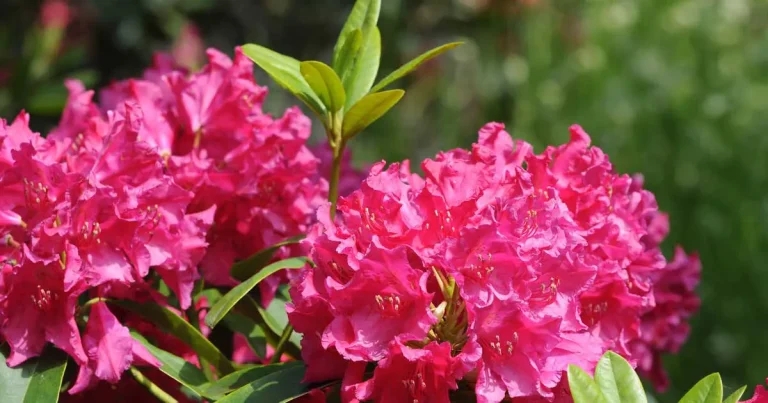
Rhododendron bush. Image: cilicia / Adobe Stock
The genus Rhododendron (from the Greek rhodos, “rose”, and dendron, “tree”) and its subgenus, azalea, are ornamental plants growing indoors and outdoors that are popular in many households. It belongs to the family Ericaceae, which includes related species (for example, Pieris japonica, Kalmia latifolia and Agauria salicifolia).
Rhododendron/azalea consists of more than 1,000 species that grow worldwide in Europe, North America, Turkey, Nepal (as its national flower), Brazil, Japan and India.
Rhododendron is a large, strictly evergreen woody shrub and tree. The leaves are dark green, elliptical, alternate, simple, leathery and usually shiny. The flowers are produced in large, showy, terminal clusters, ranging in colour from white through red, pink and purple with an entire margin. The fruit is a dry, oblong capsule that splits into five sections to release small, scale-like seeds with thick hairs.
Azalea (rosebay) is a small shrub, deciduous or evergreen, with thin leaves, often with a soft, hairy texture and bright pink hue colour or purple flowers (one to three flowers per stem).
Pets usually have access to these plants because they are brought into houses or gardens as ornamental plants. Ingestion of one or two leaves, stems, flowers and branches, including the nectar, can be fatal to a small dog. In humans,“mad honey”, or “bitter honey” due to its bitter, pungent taste, can cause acute intoxication in those who eat honey contaminated by the nectar from the Rhodendron flower – especially from Turkey (Black Sea coast), Nepal (Himalayan regions) – consumed as traditional medicine. Significant toxic effects are reported after doses of a tablespoon of this honey. “Mad honey disease” has been also reported in children sucking the nectar from flowers.
According to the Pet Poison Helpline, azalea is second in the list of the plants the most toxic to pets. The toxic species are Rhododendron ponticum (“mountain rose”), R luteum, R decorum, R simsii, R flavum and azalea pontica.
Rhododendra/azalea contain grayanotoxins (GTXs; (andromedotoxin or rhodotoxin), diterpenoid, tetracyclic, polyhydroxylated, water-soluble compounds that do not contain nitrogen. The five hydroxyl groups are essential for its toxic effects. More than 25 GTXs (various chemical radicals in the structure) are identified in Rhododendra, the first three being the most important. Not all of them lead to poisoning or toxic effects. GTX I (C22H36O7) and GTX III (C20H34O6) are highly toxic and responsible for most of the symptoms. Oral LD50 of GTX I and GTX III for mice is reported as 5.1mg/kg and 4.9mg/kg, respectively. GTX II (C20H32O5) is less toxic.
GTX exerts different toxic effects.
GTXs bind to voltage-gated sodium channels (VGSGs) found in the membrane of excitable cells. The VGSGs (nine distinct binding sites, NaV 1.1. to NaV 1.9) are transmembrane proteins that form ion channels. These ion channels permit influx of Na+ in excitable cells, contributing to setting the initiation and propagation of action potential. GTXs exert selective action with varying affinity for VGSGs in excitable cell membranes of terminal nerves, neurons, heart myocytes, skeletal muscle and gastrointestinal (GI) tract by inducing channel configuration.
A single molecule of GTX is sufficient to activate a sodium channel. Normally, VGSGs are activated in their opened state when the cell membrane potential reaches a specific threshold of voltage. The increase of sodium conductance delays repolarisation of sodium channels and moves the membrane potential of the channels in the direction of hyperpolarisation. Such continued depolarisation by the GTXs causes persistent excitation of cell membranes including nerves, neurons, heart, skeletal muscles and GI tract smooth muscles.
Stimulating VGSGs of the nerve and the CNS neurons (NaV 1.6) causes ataxia, muscle tremors, seizures and respiratory depression.
Stimulating VGSGs of cardiac myocytes (NaV 1.5) causes hypotension, bradycardia and atrioventricular (AV) block. In humans, clinical studies have established that the minimum blood concentration of GTX I and GTX III in the blood samples of patients analysed by liquid chromatography-tandem mass spectrometry, capable of inducing hypotension, ranges from 2.52ng/ml to 4.55ng/ml, and 17.83ng/ml to 27.3ng/ml, respectively.
Stimulating VGSGs of GI smooth muscle cells and interstitial cells of Cajal, located in oesophagus, stomach and small intestine, induces vomiting and diarrhoea.
Clinical effects have a rapid onset, usually occurring within minutes to few hours after ingestion (rapid absorption of GTXs). They include the following.
Gastrointestinal signs:
Respiratory signs:
Death can be a result of respiratory depression.
ECG shows complete AV block and widened QRS complex (normal duration less than 50milliseconds in small dogs and less than 70milliseconds in large dogs).
Rhodendron/azalea toxicosis is a life-threatening emergency. No specific antidote exists. Treatment is symptomatic and supportive.
Respiratory distress must be treated as an emergency, requiring oxygen supplementation, sedation and corticosteroids. Oxygen supplementation is administered by flow-by oxygen or oxygen cage with a high fraction of inspired oxygen (FiO2 40 per cent to 60 per cent) with intubation. Sedation is achieved by butorphanol 0.1mg/kg to 0.4mg/kg IM or IV every one to four hours as needed, or dexmedetomidine 0.01mg/kg to 0.1mg/kg/hour IV via constant rate infusion (CRI). Also, administer the corticosteroid dexamethasone sodium phosphate 0.2mg/kg IV once or twice daily.
An IV catheter should be placed. To control seizures, diazepam (0.5mg/kg to 2mg/kg IV bolus) should be administered and repeated if necessary within 20 minutes (serum half-life in dogs is 2.5 to 3.2 hours), up to three times in a 24-hour period, or 1mg/kg to 2mg/kg rectally.
Do not give diazepam by IM – this is contraindicated in patients with severe liver disease, however.
Alternatively, administer lorazepam (long-acting benzodiazepine 0.2mg/kg IV bolus), because of its high affinity for benzodiazepine receptors in the CNS, or midazolam 0.2mg/kg to 0.4mg/kg IV may be repeated once. When IV access is not available, midazolam can be administered by IM because it is rapidly absorbed by this route.
Ketamine used alone causes muscle rigidity and could potentially exacerbate seizures and tachyarrhythmia. While valproic acid is not recommended (serum half-life in dogs is between 1.5 and 2 hours).
If seizures persist or recur, administer propofol (3mg/kg to 6mg/kg IV initial bolus) followed by 0.1mg/kg/min to 0.6mg/kg/min CRI.
A normal heart rate ranges for small dogs between 90bpm to 140bpm; for medium-size dogs, between 70bpm to 110bpm; for large dogs 60bpm to 100bpm. Atropine sulfate reverses bradycardia: 0.02mg/kg to 0.04 mg/kg IV or IM in dogs and cats. After 30 minutes, record a further ECG trace.
Administer procainamide (class 1A anti-arrhythmic), which has VGSG blocker properties in both open (activated) and closed (inactivated) states: intermittent boluses of 2mg/kg to 4mg/kg IV slowly (over two minutes), up to a total dose of 12mg/kg to 20mg/kg until arrhythmia is controlled, and then 25µg/kg/min to 40µg/kg/min CRI in dogs.
Hypotension is defined as a systolic arterial pressure of less than 90mmHg, or a mean arterial pressure of less than 60mmHg.
Administer a dose of 20ml/kg to 30ml/kg IV of isotonic fluids. If blood pressure is not normalising with fluid therapy, administer a vasopressor: dobutamine (2.5µg/kg/min to 10µg/kg/min CRI). For severe hypotension, administer norepinephrine 0.05µg/kg/min to 1µg/kg/min CRI.
Severe vomiting should also be treated. Administer antiemetic serotonin antagonists with powerful activity such as ondansetron 0.5mg/kg to 1mg/kg IV slow bolus (two to three minutes) every 8-12 hours (used cautiously in dogs with the MDR1 mutation), or dolasetron 0.6mg/kg IV slow bolus every 24 hours. Do not use maropitant (neurokinin-1 antagonist) if the patient is at risk for a foreign body obstruction. Metoclopramide (dopamine antagonist) is contraindicated (as excitatory effects can occur).
Use PPIs to treat GI injury: omeprazole (0.5mg/kg to 1g/kg IV every 12 hours), pantoprazole (1mg/kg IV) or lansoprazole (0.6mg/kg to 1mg/kg IV every 24 hours).
The induction of emesis is contraindicated. To prevent further absorption of GTX from the intestinal tract, use activated charcoal 1g/kg to 4g/kg, mixed with water, to make a 20 per cent slurry (1g/5ml water) via nasogastric tube as soon as possible post-ingestion, and after the airway is secured.
GTXs are rapidly metabolised and excreted. Patients can be discharged within two days of admission. A bland diet for dogs (for example, white rice or boiled potatoes; boiled chicken or ground beef, with no seasoning) over a few days is recommended. Dogs and cats should be watched carefully when Rhododendra and azalea are being cared for.
Lotfi El Bahri qualified as a doctor in veterinary medicine in Toulouse in 1969. In 1976, he joined the National Veterinary School at Sidi-Thabet in Tunisia. He gained a master in veterinary science in 1977 and, in 1981, a PhD in Alfort, France. Lotfi is a professor of pharmacology and toxicology, an analyst and a pharmacotoxicology expert in veterinary drugs.