
30 Apr 2026
Charlie Fisher RVN provides a refresher fellow VNs can use in advising clients on taking their pets away on holiday.

Charlie Fisher
Job Title
Image: tsezarina/ Adobe Stock
Summer is coming (John Snow eat your heart out). Is there a better sentence after the endless rain we’ve received this winter?
While you and your clients may have already booked a summer holiday as a reward for getting through the seemingly endless slog of dark mornings and even darker nights, are you up to speed with the latest requirements for travelling with your furry friend?
With microchipping month just around the corner, we’ve done the hard work for you (and by hard work, I mean, navigating the GOV.UK website) and summarised what needs actioning before enjoying a well-earned summer break.
“Before anything else, preparation is the key to success” (Alexander Graham Bell quoted by Janse, 2023). Veterinary nurses are strict subscribers to that train of thought – we prepare.
Whether it’s getting everything you need for a patient examination, setting up theatre for surgery or even perfecting the perfect cup of coffee in the morning, we know how preparation can lead to a smoother outcome. Now the trick is to pass on this boss-level prep to your clients. Why not create a well-informed, friendly, “travel clinic”, aimed at engaging and educating clients on the latest travel requirements, cementing your bond and place within the community.
First thing’s first, what stipulations need adhering to? As mentioned, GOV.UK has the most up-to-date regulations advising people to “check for any additional rules or requirements for the country you’re travelling to” (whether taking a pet dog, cat or ferret abroad). The destination will dictate the rules and regulations required, so once your client tells you where they’re going, you can advise them using the following categories:
Travel to or within:
Checking the exact requirements will allow you to advise pet owners how to plan for veterinary health checks, rabies vaccinations, tapeworm treatment, pet travel document applications as well as creating a plan for their return journey.
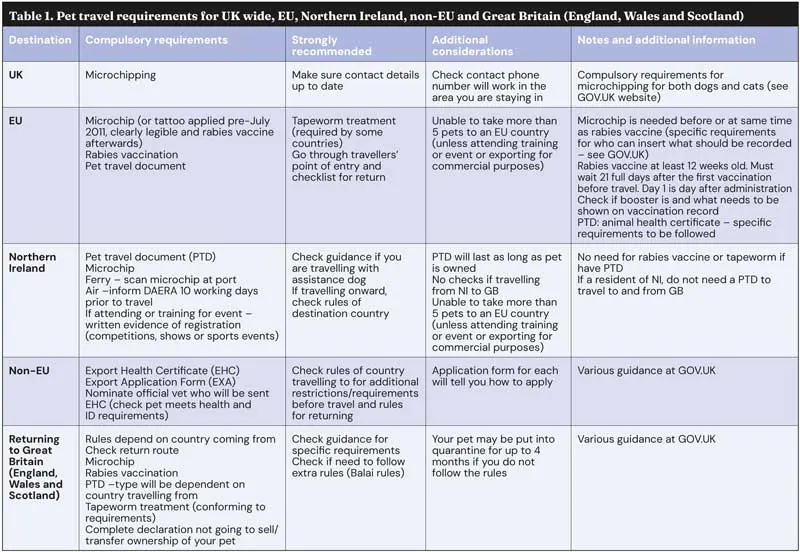
Table 1 includes a list of the basic, compulsory requirements. The common denominator is that the travelling pet must be microchipped. It is compulsory for both dogs and cats throughout the UK and they won’t get far without one. Make sure to advise your clients that the information should be both the most up-to-date, as well as the most accessible while they are away.
It is worth adding that a lot of countries have negated the need for the previously requested Pet Passport, recommending that “you should check if it’s accepted before you travel and find out if you need any other supporting documents” (European Commission), as “you can no longer use a pet passport issued in Great Britain (England, Wales and Scotland) to enter the EU” (when taking a pet dog, cat or ferret abroad). This may well be new information for your clients, given that the regulations changed in 2021.
Remember to look into the requirements for returning to the UK, as they can vary from those needed to leave. Failure to comply with these particular regulations can lead to your pet having to quarantine. “You do not need to put your pet cat, dog or ferret in rabies quarantine when it enters England, Scotland or Wales if … it’s travelling within the UK, [or] it meets the pet travel rules” (GOV.UK).
If in doubt, GOV.UK has all of the information, as well as additional links to external assistance. Now that those pesky legal rules and regulations are out of the way, let’s level this up.
It’s worth advising your clients to contact their pet insurance company to inform them of their travel plans, even if they’re not planning a long break. While not a legal requirement, it’s worth checking that their policy covers international travel (if going abroad) and to find out whether it includes overseas veterinary fees (possibly as an optional extra). It can also be helpful, if travelling within the UK, in case anything happens while away and veterinary attention is needed from a practice that isn’t their usual.
Once they know where they are going, and what’s required for them to get there, let’s look at gathering what they might need when they arrive.
If the travelling pet is on any long-term medication, owners need to have enough to last the holiday and at least a few days after returning. There’s nothing worse than running out when away and having to try to source some from another vet practice. Ordering it well in advance allows for any necessary health checks to be carried out beforehand, so it’s worth being familiar with your practices’ repeat prescription policy to be able to give owners a realistic timeframe.
As with medication, if pets are on a special diet, check they have enough. The last thing they will want is to be caught short either on their holiday, or immediately after they return. Allow for delivery time if ordering it online.
While on the topic of things to take from home, consider the use of a small pet first-aid kit. You could even put together some handy “travel first-aid kits” from “in practice” materials, and signpost your client to them. It wouldn’t be very expensive to make (or to re-sell) and could include the following:
These can all hide in a small, easy-to-carry bag (branded if your practice is marketing savvy), and can be essential if a pet gets into mischief while out. If you had someone in practice who is enthusiastic about first-aid care for pets, you could assemble a flyer to include basic advice for emergency situations.
Speaking of unplanned medical treatment, it’s always advisable to get your clients to research the closest veterinary practices to their accommodation – including the out-of-hours provisions. If they can, pop the number into their phone for easy, and quick, access.
Finally, the last thing to remind them is to consider sleeping/toileting requirements. Poo bags or a litter tray are essential items we have in our homes without really thinking about it. Do they have a favourite toy or blanket that could help them settle, especially on that first night or two? Pets get used to routine, so a holiday, even though it is fun, breaks it.
One final bit of prep and then they’ve advanced to boss-level holiday organisation.
Travelling anywhere requires some sort of route planning, pet or no pet. Whether it is the car to a ferry, the car to a plane, just train or just car, a journey will be involved so it is essential to plan it.
How will their pet travel during the journey? Rule 57 of The Highway Code in the UK states that “animals must be suitably restrained so they cannot distract the driver or others in an event of a sudden stop. A seat belt harness, pet carrier, dog cage or dog guard are ways of restraining animals in cars” (GOV.UK).
It’s important to stress the need for regular breaks throughout their journey, especially long ones. Beyond the obvious need for toileting, having a walk and access to food and water are essential, and can sometimes be overlooked; often in favour of the “let’s just get there” vibe.
If they know their pet hates travelling, either due to stress, anxiety or travel sickness, they need to prepare for that. While prescriptions are available, it could also be beneficial to seek advice from a behaviourist, who can offer some “travel training” that can be practised over time in the lead up to a holiday (PDSA).
Ultimately, a lot of these “tips” are probably things you already know and advise your clients already.
However, for those new to pet ownership, or even for those who want to prepare thoroughly for their break, these “simple” reminders can be incredibly helpful, so it is worthwhile having a means to pass them on.
Ask clients thinking about taking their pets away on holiday to consider the following:
All the aforementioned points could be formulated into a “pet travel checklist”, with the most up-to-date website links that signpost tips or helpful hints, and consider branding it with your clinic’s colours. Consider these points for a “travel clinic”, where the owner can visit (with or without their pet, hitting that socialisation check point), so these can be discussed in person. In a world so digital, and sometimes incredibly detached; what better way to solidify your bond with your clients?
Holiday prep complete.
Charlie Fisher has more than 16 years’ experience in the profession. With a BA(Hons) in English and an NCert in ECC, Charlie now works in digital marketing for independent veterinary practices. Passionate about writing and championing the skills of RVNs, Charlie is dedicated to elevating the visibility and value of the nursing profession within the wider industry.