Supporting adolescent dogs and their caregivers during this time
Kate Main BVSc, PGCertSAM, PgCert, MRCVS discusses how to help canines and their owners through what can be a difficult phase.
Kate Main
Job Title
Figure 1. Potential changes caregivers may notice during adolescence.
Adolescence – the developmental stage where a puppy matures reproductively, socially and cognitively into an adult (Harvey, 2019) – is a relatively long period of development, generally thought to occur between 6 and 24 months of age (Owczarczak-Garstecka et al, 2023). However, many internal and external factors can influence the timing of adolescence (Hollinshead et al, 2025); for example, smaller breeds tend to enter adolescence earlier than larger breeds (Serpell et al, 2016).
During this development period, the increase in synthesis and release of gonadotropin-releasing hormone from the hypothalamus, and the resulting secretion of luteinising hormone and follicle-stimulating hormone, results in gonadal development (Harvey, 2019; Hollinshead et al, 2025). Caregivers may notice outward physical changes – for example, vulval swelling – alongside behavioural changes, such as increased desire to roam/mount during this time.
Wide-ranging neurological changes also occur, not only impacting on the neural circuits associated with reproductive behaviour, but also emotional regulation, behavioural inhibition and risk/reward judgement (Harvey, 2019). This can result in impulsive responses to emotions such as fear and frustration; for example, a dog who previously responded to a caregiver “tickling their tummy” with appeasement gestures, such as lip licking to communicate unwillingness to engage, might now respond with repulsive behaviour, such as growling. Or a dog kept on a tight lead and unable to roam as desired might become frustrated, pull on and/or grab the lead, jump up at the caregiver and be unresponsive to attempted caregiver interaction.
Cases where emotional health is compromised can also impact physical and cognitive health due to the inextricable links between these three pillars of health (Heath, 2020), and veterinary behavioural medicine support may be required to support the welfare of these patients.
In combination, hormonal and neurological changes and the resulting impact on physical, emotional, cognitive health and behaviour occurring during adolescence, can be challenging for both dog and caregiver (Figure 1).
A participant in Dogs Trust’s longitudinal study Generation Pup painted a vivid picture of life with their six-month-old dog: “Best way I can describe this is that he’s being sassy. Just normal ‘teenager’ behaviour, as far as I am aware. Not following basic commands, he definitely knows like sit; recall has worsened; tearing up his bed; humping.” (Owczarczak-Garstecka et al, 2023).
Another potential threat to the caregiver-dog bond during adolescence is the caregiver’s expectation of how their dog should be behaving. Unless caregivers are aware of the complex changes occurring during adolescence, they may get frustrated if their dog is not responding to their verbal cues and behaving as they expect their “adult”-looking dog should. This could also lead to compromised welfare if punishment training techniques are implemented (Asher et al, 2020).
The way caregivers perceive problem behaviours may also change as dogs enter adolescence. Owczarczak-Garstecka et al (2023) found that caregivers described problematic behaviours in young dogs as mischievous and unintentional; however, similar behaviours in older dogs were seen as deliberate.
Physical change
The physical change in a dog’s size as they age may also impact how caregivers respond to behaviours; for example, caregivers might pat and stroke their puppy’s head if they jump up – however, when the dog gets larger, jumping up may cause discomfort or unbalance the caregiver, and lead to the dog being told off. This altered response to the same behaviour could lead to frustration and confusion for the dog.
With multiple complex changes occurring during adolescence, and the potential for these to impact animal welfare alongside the caregiver-dog bond, it is not surprising that dogs younger than two years of age are more likely to be relinquished to shelters (Salman et al, 2000), and behavioural abnormalities were the most common reason cited for deaths in dogs less than three years of age (O’Neill et al, 2013).
Therefore, ensuring caregivers are aware of the potential challenges they may face during this life stage and where and when to seek appropriate veterinary, training or behaviour advice is incredibly important.
The veterinary community is a key source of advice for caregivers and they are, therefore, instrumental in helping dogs stay in homes, so raising awareness is key.
How the veterinary clinic can support adolescent dogs
During life stage consultations
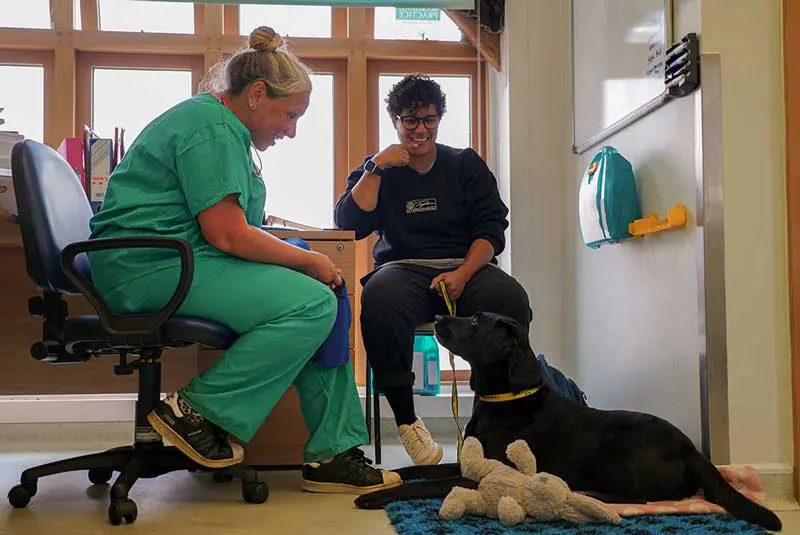
A specific adolescent life stage appointment (Figure 2) is recommended at approximately six months of age (Hughes, 2015), tailoring timing and content to the individual needs of the dog.
Figure 2. Adolescent life stage appointment.
Alongside a clinical examination, Hughes (2015) suggests topics that may be discussed during these consultations, including:
vaccination
parasite control
diet
travelling abroad
growth and development
weight and condition
neutering versus breeding
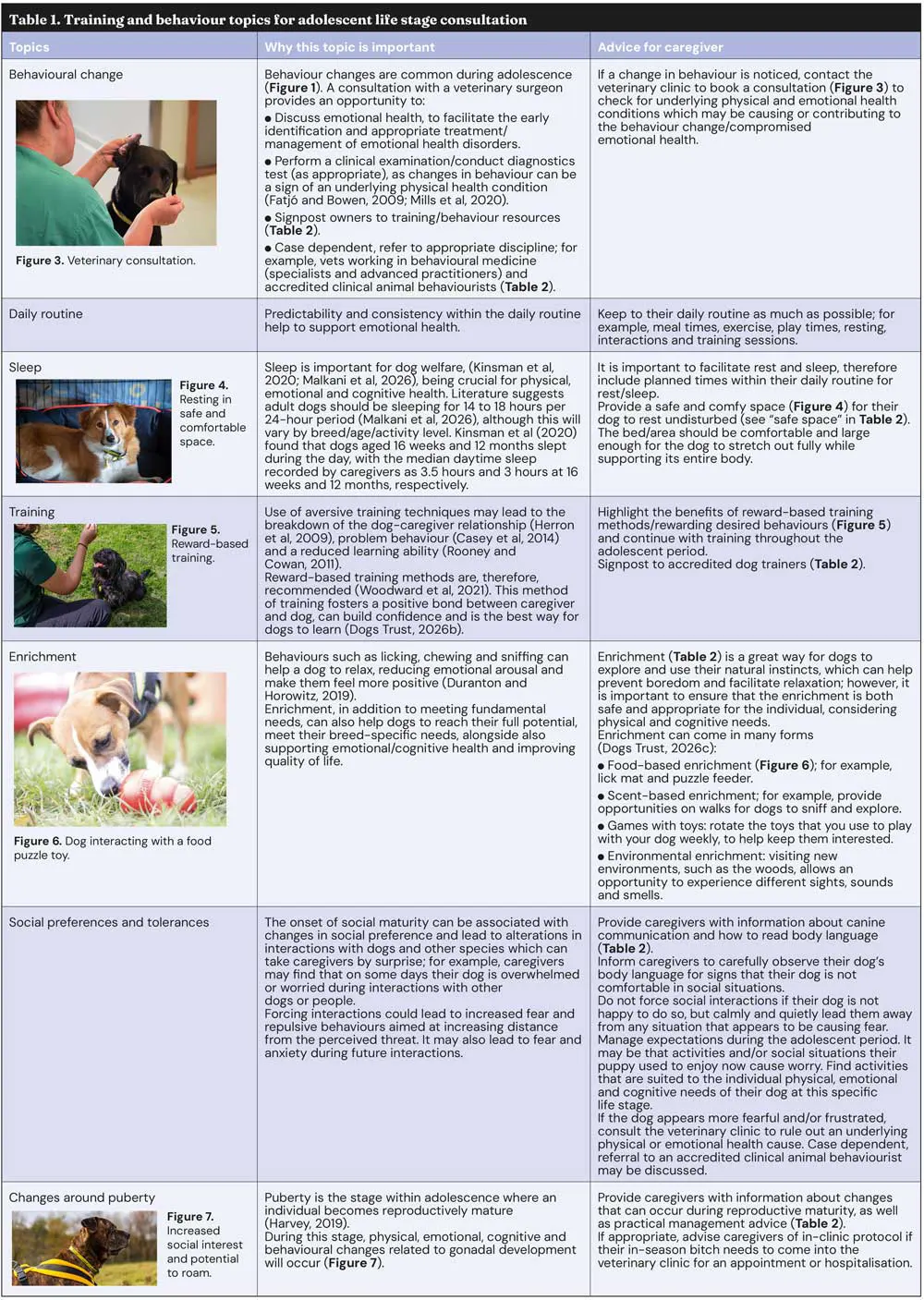
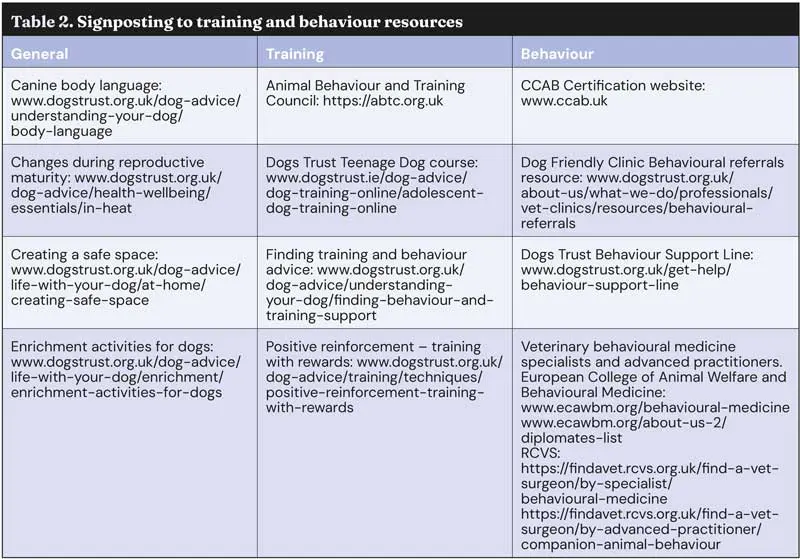
Another area for consideration is specific advice around changes in dog behaviour and training during the adolescent period (Owczarczak-Garstecka et al, 2023; Table 1).
Behaviour services
Many dogs are fearful of the veterinary clinic (Mariti et al, 2015; Riemer et al, 2021), and so building up the bank of positive veterinary visits from puppyhood is incredibly important to mitigate against this.
Interventions such as socialisation and habituation events and consultations are a fantastic way for clinics to develop positive relationships with both dog and caregiver, while also imparting valuable health and training advice.
Alongside being important for dog welfare, these visits can lead to a lifelong client-clinic bond. It is, however, important that these visits are carried out appropriately, as it is possible to sensitise young puppies to the veterinary experience and create, rather than prevent, future problems.
Information about how to set up appropriate socialisation and habituation events and consultations can be found on the Dog Friendly Clinic website.
The Dog Friendly Clinic scheme (www.dogfriendlyclinic.org.uk; Figure 8) is a collaborative project between Dogs Trust and the British Veterinary Behaviour Association (BVBA) which aims to make the veterinary experience as positive as it can be for all involved. To support this, each applicant completes more than 4.5 hours of behaviourally focused engaging and interactive lessons on its online platform Campus.
Figure 8. The collaborative project between Dogs Trust and the British Veterinary Behaviour Association.
The application curriculum sets out to achieve the following:
Introduce the fundamental aspects of canine behaviour (canine communication, canine development, how dogs learn and common misconceptions around canine behaviour).
Highlight why dogs may find the veterinary clinic challenging, the role of appropriate socialisation and habituation events and consultations, and how we can support emotional needs.
Provide practical suggestions for supporting the individual needs of patients throughout their lives, incorporating aspects such as a considered environmental design and positive in-clinic interactions.
Considered clinic environmental design
Practical suggestions for a considered clinic environmental design include:
Waiting area
Seating placed back to back to avoid potential intimidation from dogs sitting facing each other.
Use of free-standing notice boards as barriers between patients, to interrupt direct eye contact and help decrease emotional and physiological arousal.
Considered flow of patients within this area to reduce both intra and inter species interaction.
Prescription diets not on display within this area, as the scent of the food may lead to frustration.
Consultation room
Use of non-slip matting on the consultation table, scales and floor (if required) to reduce the chance of dogs slipping which, alongside causing physical injury, may also cause panic and future anxiety within this environment.
Positioning of the furniture to provide increased space for the dog to explore the room and have an examination on the floor (if appropriate).
Hospitalisation
Hospitalisation wards should ideally be species specific.
To prevent intra-species eye contact between patients, kennels should not be placed directly opposite each other; visual screening aids should be implemented if this is not possible.
The individual physical, emotional and cognitive needs of the patient should be captured in a personalised hospitalisation questionnaire, to ensure their unique needs are met; for example, a dog in pain with hip dysplasia should ideally be placed within a ground floor kennel so that it does not have to be lifted into and out of its kennel space, which could cause discomfort and anxiety. This patient would also benefit from an orthopaedic mattress and non-slip matting.
Hospitalisation wards should facilitate rest and sleep, with adjustable lighting and temperature and noise kept to a minimum.
Use of notes – for example, a behavioural care card on the front of the kennel door – can also ensure all members of the team are aware of how patients like to be interacted with. These should be descriptive; for example, “does not like left hindlimb touched”, rather than just “care” (Dzhugdanov and Orpet, 2023).
Positive in-clinic social interactions
Recognising and responding appropriately to canine communication (facial expressions, body postures, auditory cues), including protective emotions such as fear, frustration, pain and panic-grief (Heath et al, 2022), are key in supporting patient welfare and caregiver/staff safety.
Waiting area
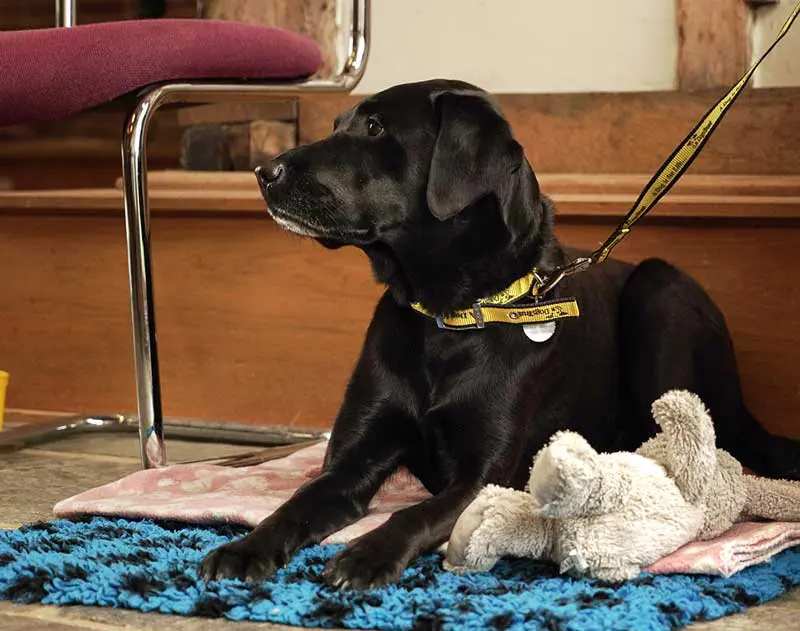
The reception team, empowered by their knowledge of canine communication, can recognise signs of distress and, if noted, take steps to support both patient and client. This may be advising that they can wait in the car or outside, or direct them through to a quiet consultation room while they wait for their appointment. Additionally, they can support caregivers in guiding their dogs to settle; for example, providing treats and a blanket to rest on, if the caregiver has not brought their own (Figure 9).
Figure 9. Dog settled in waiting room.
Consultation room
Dog-friendly interactions should be employed during the consultation, such as:
Encouraging the dog to walk into the consultation room at their own pace, using treats if appropriate.
Allowing the dog to explore the consultation room while a history is taken.
Conducting a consultation on the floor (if appropriate), with the use of non-slip matting or bedding to provide support and comfort.
Approaching the patient from the side and not head on.
Avoiding direct eye contact, unless carrying out an eye examination.
Monitoring the whole of the dog for clues as to how it is feeling during the consultation, and responding to signs of fear/distress.
Using chemical restraint if patient is very fearful and a clinical exam/diagnostic procedure needs to be carried out, then putting a plan in place for future desensitisation and counter-conditioning to this environment.
Hospitalisation
A detailed personalised questionnaire is key to guiding appropriate social interactions between clinic team and patient; for example, the inclusion of a touch acceptance diagram within the personalised hospital questionnaire can help guide appropriate social interactions and handling during a patient’s stay. Gentle, calming social interactions such as grooming can also support patient emotional well-being, and asking the caregiver about grooming preferences can provide valuable information to facilitate a positive hospital stay.
Summary
Adolescence is a challenging developmental period for both dog and caregiver, and a particularly vulnerable time for the dog-caregiver partnership. A holistic approach to supporting the adolescent patient starts in puppyhood, with positive veterinary clinic visits in an environment that optimises physical and psychological safety.
Specific life stage adolescent appointments provide an additional opportunity to impart valuable training and behaviour guidance and support, setting caregivers up for success, and helping the partnership to thrive through this transition.
Acknowledgements
The author would like to thank her colleagues at Dogs Trust and the Dog Friendly Clinic board members for their support with this article – particularly Tamsin Durston, Sara Owczarczak-Garstecka, Aideen O’Connor, Karen Reed, Malcolm Stagg, and Amy Yalland from Dogs Trust, Sarah Heath and Rachel Malkani from BVBA, and Carl Gorman from BSAVA.
This article appeared in Vet Times (21 July 2026), Volume 56, Issue 32, Pages 12-15
Kate Main graduated from Bristol Veterinary School in 2008 and, during her nine years in clinical veterinary practice, developed a particular interest in small animal medicine and clinical animal behaviour, achieving postgraduate certificates in both these areas. Being passionate about improving animal welfare has also led Kate into both the research field and, most recently, veterinary engagement, where she joined her team at Dogs Trust in 2021. Her focus is the Dog Friendly Clinic Scheme, a collaborative project between Dogs Trust and the British Veterinary Behaviour Association.
References
Asher L, England GCW, Sommerville R and Harvey ND (2020). Teenage dogs? Evidence for adolescent-phase conflict behaviour and an association between attachment to humans and pubertal timing in the domestic dog, Biology Letters16(5): 20200097.
Casey RA, Loftus B, Bolster C et al (2014). Human directed aggression in domestic dogs (Canis familiaris): occurrence in different contexts and risk factors, Applied Animal Behaviour Science152: 52-63.
Duranton C and Horowitz A (2019). Let me sniff! Nosework induces positive judgement bias in pet dogs, Applied Animal Behaviour Science211: 61-66.
Dzhugdanov LI and Orpet H (2023). Do ‘CARE’ labelled canine patients get a lower standard of nursing care?, The Veterinary Nurse14(4): 186-194.
Fatjó J and Bowen J (2009). Medical and metabolic influences on behavioural disorders. In: Horwitz DF and Mills DS (eds), BSAVA Manual of Canine and Feline Behavioural Medicine (2nd edn), BSAVA, Gloucester.
Harvey ND (2019). Adolescence. In: Vonk J and Shackelford T (eds), Encyclopedia of Animal Cognition and Behavior, Springer International Publishing, Cham: 1-7.
Heath S (2020). Environment and feline health: at home and in the clinic, Veterinary Clinics of North America: Small Animal Practice50(4): 663-693.
Heath S, Dowgray N, Rodan I et al (2022). 10 years of Cat Friendly – a new model and terminology for understanding feline emotions, Journal of Feline Medicine and Surgery24(9): 934-935.
Herron ME, Shofer FS and Reisner IR (2009). Survey of the use and outcome of confrontational and non-confrontational training methods in client-owned dogs showing undesired behaviors, Applied Animal Behaviour Science117(1-2): 47-54.
Hollinshead F, Sun X, Aono A and Singletary M (2025). Canine puberty, Veterinary Clinics of North America: Small Animal Practice55(5): 909-921.
Hughes A (2015). Preventative healthcare: a lifestage approach. In Hutchinson T and Robinson K (eds), BSAVA Manual of Canine Practice: A Foundation Manual, BSAVA, Gloucester.
Kinsman R, Owczarczak-Garstecka S, Casey R et al (2020). Sleep duration and behaviours: a descriptive analysis of a cohort of dogs up to 12 months of age, Animals10(7): 1,172.
Malkani R, Tooley C, Heath S et al (2026). Assessment of the relationship between sleep and welfare in dogs using AWAG data, Discover Animals3: 33.
Mariti C, Raspanti E, Zilocchi M et al (2015). The assessment of dog welfare in the waiting room of a veterinary clinic, Animal Welfare24(3): 299-305.
Mills DS, Demontigny-Bédard I, Gruen M et al (2020). Pain and problem behaviour in cats and dogs, Animals10(2): 318.
O’Neill DG, Church DB, McGreevy PD et al (2013). Longevity and mortality of owned dogs in England, The Veterinary Journal198(3): 638-643.
Owczarczak-Garstecka SC, Da Costa REP, Harvey ND et al (2023). “It’s like living with a sassy teenager!”: a mixed-methods analysis of owners’ comments about dogs between the ages of 12 weeks and 2 years, Animals13(11): 1,863.
Riemer S, Heritier C, Windschnurer I et al (2021). A review on mitigating fear and aggression in dogs and cats in a veterinary setting, Animals11(1): 158.
Rooney NJ and Cowan S (2011). Training methods and owner-dog interactions: links with dog behaviour and learning ability, Applied Animal Behaviour Science132(3-4): 169-177.
Salman MD, Hutchinson JM, Ruch-Gallie R et al (2000). Behavioural reasons for relinquishment of dogs and cats to 12 shelters, Journal of Applied Animal Welfare Science1(3): 207-226.
Serpell JA, Duffy DL and Jagoe JA (2016). Becoming a dog: early experience and the development of behavior. In: Serpell J (ed), The Domestic Dog (2nd edn), Cambridge University Press, Cambridge.
Wells DL and Hepper PG (2000). Prevalence of behaviour problems reported by owners of dogs purchased from an animal rescue shelter, Applied Animal Behaviour Science69(1): 55-65.
Woodward JL, Casey RA, Lord MS et al (2021). Factors influencing owner-reported approaches to training dogs enrolled in the Generation Pup longitudinal study, Applied Animal Behaviour Science242: 105404.