20 Jul 2026
When life gives you vet nursing: a different path
Striving for a desired career is common among the vet nursing community, but taking the leap to leadership is a very personal choice. Kate Williams talks to RVN Amy Martin who worked her way up from vet receptionist to head nurse, and beyond…

Kate Williams
Job Title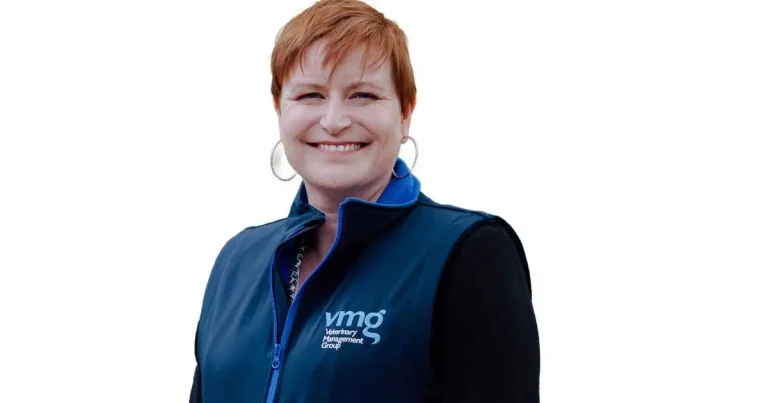
Having had a strong bond with animals from a young age, Amy Martin knew where her life would take her by the time she was the age of eight. She just wasn’t sure how.
The epitome of “working her way up”, the RVN’s career journey – from not achieving the required grades for vet school, later to taking a head nursing post and now holding the learning and development manager role for the Veterinary Management Group (VMG) – is an inspiring story proving path options are not always what you plan.
Growing up in rural south Derbyshire, Amy’s family, although not farmers, were encompassed into the farming community, keeping poultry and livestock on a smallholding. However, Amy was only allowed to keep animals that lived outside.
“Within those criteria, I managed to have rabbits and ferrets,” she recalled. “I desperately wanted a dog and a horse, which I think might have been what drove me into the veterinary profession.
“I loved animal husbandry and caring for our menagerie. I took in injured birds that needed help and hand-reared lambs. I think I knew I wanted to work with animals from the age of about eight. So, the first chance I got – work experience from school at 15 – I worked in a veterinary practice.
Work experience
As a popular career choice, Amy had to travel miles for that placement because all the local ones were full. Eventually, she managed to secure regular work experience in her local practice.
She explained: “I took GCSEs and A-levels to get me into vet school – I was laser-focused. Sadly, though, I didn’t get the grades and my practice couldn’t give me a job, which in those days was the only way you could train as a nurse.
“However, one of the vets handed me a copy of Vet Times where there was an advert for the new veterinary nursing degree jointly run by RVC, Middlesex University and CAW. I applied and got in.”
Because her work experience at the vets’ was entirely unpaid, Amy waited tables and did bar work, which she said gave her some great insights into customer service and shift work – particularly when she worked airside in an airport involving opening the bar at 4am.
“I think the vet practice felt sorry for me doing all that free work so when the opportunity came up to cover the weekend receptionist at the branch surgery, they offered it to me. I had a one-hour shift every other week that paid £2.50.
“I was committed from the start. Maybe I was born a vet nurse?”
Second cohort
Taking on the four-year veterinary nursing degree based in London, Amy was the second cohort to do a degree in veterinary nursing.
“I was based in north London between the RVC and the Enfield campus of Middlesex University,” she said. “However, the programme involved a lot of clinical placements, so I was frequently journeying across London to get to my practice – sometimes the commute would be two hours or more and we were in clinical practice every week as well as university classes.
“I did many of my clinical placements at the PDSA which really does utilise its nurses well and some of them even employed me in the holidays so, once I moved to London – from a tiny rural village – I almost never went home because all I wanted to do was nurse.
“Now when I look back, I know it’s the caring side that I really love about nursing, which should have been obvious from my love of husbandry, but at the time I didn’t know that veterinary nursing was an option. I’m glad that circumstances provided me with an alternative path.”
Amy’s journey from SVN to RVN included her completing the NVQ portfolio during her degree, enabling her to become listed with the RCVS. She qualified in 2003, so was eligible to transfer to the first voluntary non-statutory register of veterinary nurses from its inception in 2007 and call herself an RVN.
Fresh out of university, she secured a job at the RSPCA, which spoke to her love of charity practice and where she felt really utilised in her role.
“My family and partner were far away, and I ultimately made the decision to relocate to Leeds. Finding another charity job was tricky and I went back to private practice. Luckily, my new boss had also practised in PDSA and really knew how to utilise nurses’ skills. I became an A1 assessor (now a clinical coach) to help train the next generation of student veterinary nurses.”
After three years, the practice was growing and needed a head nurse. Amy, then 26, can’t even remember being interviewed for the position as she was the only qualified nurse working at the practice at the time, so she assumed the role – a story, she says, that is probably quite common.
After a brief spell at PDSA as a head nurse, she returned to that original practice as nursing manager, bringing some newfound skills with her.
New perspective
“I think one of the hardest things is to be promoted from within, so briefly working somewhere else gave me a new perspective on my role,” she said.
Amy found the transition from RVN to head nurse and the authority that comes with it tricky.
“I think I was ambitious and wanted the role but had absolutely no idea that being a great nurse does not qualify you as a great leader,” she admitted.
“I had to learn by getting it wrong, a lot – and being smart enough to realise I needed to undertake extra training in leadership because I was out of my depth.
“I had a tendency to do everything for everyone, struggled to delegate sufficiently and created a dependency on me as the person who could do everything. As the practice got bigger and busier that was unsustainable and created stress for me and the people around me.”
Having experienced the highs as well as the lows and difficulties of leadership, Amy is in an ideal position to share her advice to others looking to progress.
“Moving into leadership is a tricky business because many people are promoted before they have the knowledge and skills, as I was,” she said.
“I think if you know that you want to lead people, know that it is a different skillset and that you need to build the knowledge skills and behaviours – you can do that now.
“There are no barriers to learning about leadership and one of the most important skills to develop is self-leadership. It’s never too early to start working on yourself.”
Expertise
In her current full-time role as learning and development manager at VMG, Amy now uses her expertise to support leaders.
“My role with VMG helps to ensure they don’t have to figure it out alone like I did in my early days in leadership.
“Joining an organisation like the VMG gives you access to other members, information and leaders at the top of our profession who are passionate about helping others progress.”
Amy is thankful to her family for championing her career – her parents, partner and children, who she says have “put up with a lot in my unbridled pursuit of excellence in my career and I am eternally grateful and lucky”.
She also highlighted the importance of having colleagues cheerleading her journey.
“I’ve had a bunch of people who believed in me. My biology teacher, a couple of key PDSA nurses who showed me what good nursing was, my boss who sent me on loads of CPD and actually let me use the skills in practice to set up new services and ultimately encouraged me to undertake leadership training, and my colleagues who helped me to lead them when I had no idea what I was doing.
“The contacts I’ve made through various working parties and membership groups who always promoted the nursing voice, which I still sometimes call on today.
“Then as part of a corporate group, there are a few key people who really supported me personally, my ideas and my growth and development.
“There are still opportunities coming out of that network today and I try to pay that forward to the next cohort of veterinary leaders.”
- This article appeared in VN Times (July/August 2026), Volume 26, Issue 7/8, Pages 21-23