1 Sept 2026
Progression: the journey to equine dental technician
Options for career pathways for nurses are varied but can be so fulfilling, as editor Kate Williams finds out from talking to RVN Emelie Real about her recent jump into equine dentistry.

Kate Williams
Job Title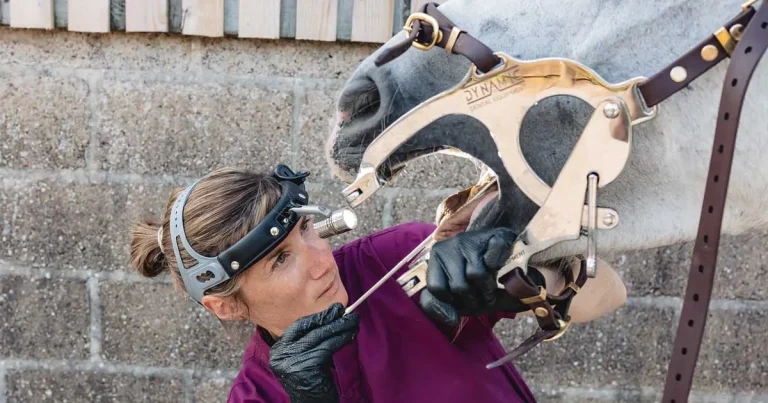
Emelie Real at work. Image: Emma Herrod
Striving for career progression is not uncommon in the veterinary nursing profession, and many pathways are available – some tougher than others.
Equine dental technician (EDT) is one of the more niche roads to take, with only 157 qualified with the British Association of Equine Dental Technicians (BAEDT) in the country, and although the training does not require nursing experience, it is a huge benefit and extremely rewarding journey, according to a newly qualified dental technician.
Emelie Real passed her exams earlier this year after two-and-a-half years of rigorous training and testing, but it has opened up a whole new world for her career.
Like many other RVNs, Emelie knew from an early age she wanted to be in the profession, taking a work experience placement at a veterinary practice at 14.
She explained: “I actually wanted to be a vet to begin with. But when I went into practice, I realised the nurses did all the things that I wanted to be doing.
“At that age, I don’t think I really realised how much the veterinary nurses did. And I didn’t really want to go off to university, so I looked at other options in the veterinary profession.”
Securing an apprenticeship position at her local mixed practice when she was 16, she had the opportunity to work in small animal, large animal and equine, and qualified as an RVN in 2010. A keen rider herself, she was interested in the equine aspect and enjoyed being outside.
After having her two children, Emelie was offered a role as a VN at an equine vets, at which owner-vet Stuart Altoft was one of few RCVS advanced practitioners in dentistry with the BAEDT qualification in the UK – and that’s where her dentistry journey began.
‘Passionate’
Emelie said: “We see a lot of interesting dentistry cases that get referred to us, and I was ready to move forward with my career in one way or another, and that was something that I really felt quite passionate about.
“So, the first step was to have a conversation with Stuart, who was really supportive and thought it was a great idea.
“To do your training, there’s a few options. The most recognised and sought-after qualification is with the BAEDT, which is a BVDA [British Veterinary Dental Association] and BEVA qualification.
“So, it’s the gold standard of the equine dental technician world, and the only way to do that is either to go to Hartpury University as a degree – which would be full-time, so that wasn’t going to work for me – or train almost like an apprenticeship. You have to build your case log and credentials, as long as you’ve got an approved mentor.”
At that point, the Devon-based VN spent a huge amount of time watching her mentor, learning about routine dentistry, going out on visits with him just to observe, then progressing to putting a gag on a horse and starting to identify pathology.
Emelie said: “It’s very intense, but having a nursing background is a massive gain because a lot of that is on anatomy and diseases, which are common knowledge to you.
“The next stage is to build up a massive caseload. You need 300 cases that you’ve done and treated yourself, and you also need to build 40 advanced cases which have to be under direct supervision with a vet.
“The examiners ask for references from vets that have worked with you, and from your mentor, and then you submit your charts to them to evaluate. They let you know if you’ve passed or failed your portfolio. If you don’t pass that bit, you have to wait until the following year to be able to submit more.”
Emelie also attended CPD sessions with BAEDT, as well as a BEVA course on dentistry at Newmarket, both of which she found extremely useful.
Once students have submitted and passed the portfolio section, they can sit the theory test at Hartpury University.
Following the written paper, students undertake the charting examination, which Emelie said is “not for the faint hearted”.
She added: “Even though you are a nurse and you’re used to dealing with dissections, it’s something different to see dead horses’ heads open on a table.”
To prepare for that situation, Emelie sought some CPD days with a local equine charity that has its own postmortem room and pathology lab, which she found an excellent training resource.
If a student passes these stages, they are allowed to move on to the pre-practical examination and then the final practical examination at Twemlows Stud Farm in Shropshire.
Emelie explained: “If they deem you as competent enough, then you head back up to Twemlows where they do the final practical examination, which is a very intense two-hour experience.”
She described the feeling of relief after sitting the final exam, and then finding out she had passed later, as enormous – but all worthwhile. The VN completed all her training and exams while working part-time, but she said it would be possible for a full-time nurse to undertake it, as long as they were prepared to put the work in.
Boosted salary
Since passing the final practical exam earlier this year, it has opened doors for Emelie, giving her more career choices. Because she wanted to continue nursing alongside the dentistry, she continues to work part-time at the practice, employed as a VN as well as a BAEDT, which has boosted her salary. She also takes on her own dental work on a freelance basis on her days off.
“I strongly believe that a qualified BAEDT member should be the one doing the dentistry, supporting the ambulatory nursing role well.
“I definitely feel like I’ve progressed in my nursing and I’m being used to my full potential. You do a lot more as a small animal nurse than in equine, which the nursing community is trying to change. BEVA and its council are doing a great job at trying to push for equine nurses to do more.
“I would highly recommend this pathway to other nurses, but you need to be physically fit and prepared to get hot and sweaty in summer, or cold and freezing in winter. It’s not the most glamorous of jobs, but if you are driven and passionate about dentistry and welfare, then it’s a fantastic route to follow.
“Although it was tough, I am so glad I did it for the career satisfaction and the avenues it has opened up for my future financially.”
Emelie’s tips for career progression
- Build your core nursing experience first.
- Discuss your ideas openly with colleagues, supervisors and bosses.
- Do your research. Check what is involved before signing up and ensure it is right for you.
- Be proactive in your training. Speak to others who have undertaken the course.
- Don’t be afraid to seek extra CPD in areas that complement your studying.
- Think about your long-term goals and what the qualification will bring to your career – in terms of satisfaction as well as financially.
- This article appeared in VN Times (September/October 2026), Volume 26, Issue 9/10, Pages 22-23