
8 Sept 2026
Celebrating primary care education
Greg Steele, MA, VetMB, MRCVS, reviews the General Practice Veterinary Educators pre-conference symposium held at Harper and Keele Veterinary School as part of VetEd 2026…

Greg Steele
Job Title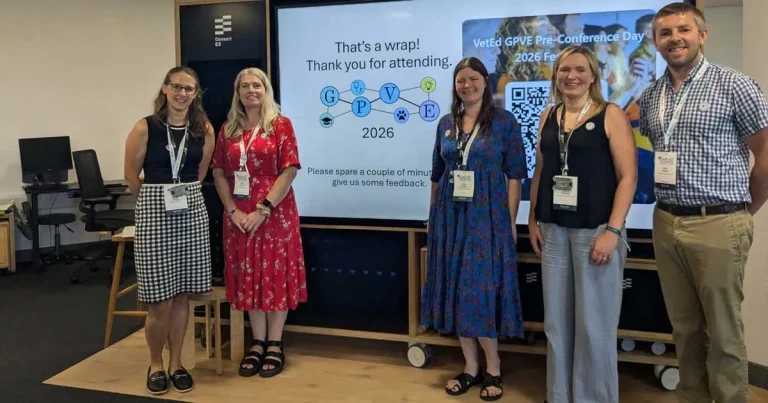
From left: Sophie McGill (University of Bristol), Katie Gazey (Nottingham Trent University), Zoe Lawlor (University of Nottingham), Lindsey Harland (University of Nottingham) and Greg Steele (Nottingham Trent University).
Veterinary education continues to evolve rapidly, but one constant remains: the majority of veterinary graduates will enter some form of general practice. Ensuring educational programmes reflect this reality is central to preparing graduates for the challenges, opportunities and complexities of modern veterinary work.
Against this backdrop, the General Practice Veterinary Educators (GPVE) group has been established with the indefatigable enthusiasm of Lindsey Harland (University of Nottingham) and continues to grow its role as a supportive community of educators involved in primary care teaching. GPVE hosted its first annual pre-conference symposium in June at Harper and Keele Veterinary School ahead of the Veterinary Education Symposium (VetEd 2026), spearheaded by the further dedicated hard work of Sophie McGill (University of Bristol).
The event brought together veterinary educators, clinicians and researchers from across the professions to discuss the future of general practice education, share innovations and strengthen professional networks.
The day demonstrated not only the breadth of work already taking place within veterinary education, both for vet students and veterinary nursing students, but also the enthusiasm that exists to ensure primary care remains firmly embedded within all veterinary curricula. Positive post-conference feedback was gratefully received, with all of attendees rating the day and the usefulness of the information provided as “excellent” or “good”.
Why GPVE?
The GPVE group was established to support those involved in teaching and clinical supervision within general practice settings. While specialist and referral environments have traditionally featured prominently in veterinary education, general practice offers unique educational opportunities that reflect the realities most graduates will encounter after qualification.
Students in primary care settings are exposed to myriad challenges within clinical uncertainty, continuity of care, client communication, financial limitations, preventive medicine and spectrum of care decision making. These experiences are difficult to replicate elsewhere and preparing for these is increasingly recognised as an essential component of veterinary training. This applies to both vet students and VN students.
GPVE provides a forum through which educators can share ideas, collaborate on educational projects, discuss challenges and advocate for the value of primary care within veterinary education. Regular online CPD events are also run to highlight areas of interest. The annual symposium has the capacity to become an important opportunity for these conversations to happen face-to-face.
Diverse programme
The 2026 symposium attracted educators working across a variety of settings, although most attendees were veterinary surgeons involved in small animal teaching and clinical supervision. Feedback indicated high levels of satisfaction, with respondents describing the day as both relevant and useful to their educational roles.
The programme reflected the breadth of contemporary veterinary education. Following registration and networking, attendees were welcomed by GPVE chair Lindsey Harland before a plenary session delivered by Jill Maddison (RVC) entitled “Clinical reasoning in general practice: is it a teachable skill?”
Clinical reasoning remains one of the most challenging aspects of veterinary education. It sits at the intersection of knowledge, experience, communication and decision making, yet can be difficult to define and assess. The session stimulated considerable discussion throughout the remainder of the day and was highlighted by several attendees as one of the most valuable presentations. One delegate commented that it was the first time they had seen the advantages and limitations of specialist and general practice teaching environments discussed by a speaker with experience of both.
Educational innovation
The morning programme continued with a series of short communications covering a broad range of educational topics. Presentations explored collaborative approaches to reflecting on teaching challenges, the impact of primary care clinical rotations on student perceptions of practice, the implementation of reasonable adjustments for students with mental health conditions and neurodivergence, graduate debriefing initiatives, and the practical use of artificial intelligence within case-based learning.
One of the strengths of these shorter presentations was their ability to provide delegates with ideas that could be rapidly transferred into their own teaching environments. Many of the projects described were developed within busy educational settings and addressed challenges commonly encountered across institutions. It was interesting and stimulating to have a range of different ideas, concepts, research and experiences brought to the audience.
Although presentations represented a range of educational contexts, a common theme evolved throughout: preparing graduates for contemporary practice requires educational approaches that are authentic, adaptable and centred around real-world learning.
Workshops and discussion
The afternoon programme shifted emphasis from presentation to participation.
Two concurrent workshops explored themes particularly relevant to primary care educators. Katie Gazey (Nottingham Trent University) and Zoe Lawlor (University of Nottingham) facilitated discussion around multidisciplinary learning and how educational experiences can better prepare graduates for collaborative practice.
This was primarily applied to collaborative teaching between vet students and veterinary nursing students, but the point was made that this could include working relationships with all paraprofessionals. Lindsey Harland led a further workshop examining the authenticity of general practice rotations and the opportunities created by student-led primary care teaching models.
Feedback suggested these workshop sessions were among the most successful elements of the day. Attendees consistently rated workshops highly and several delegates specifically highlighted discussions relating to general practice teaching models as being particularly valuable.
This is perhaps unsurprising. Veterinary educators often work in vastly different organisations yet face remarkably similar challenges. Workshops provide space to compare experiences, test ideas and learn from colleagues who may have approached the same problem from a different direction.
For many delegates, the opportunity to discuss practical educational challenges with peers appeared to be as useful as any formal presentation.
Spectrum of care
A panel discussion entitled “Integrating spectrum of care into veterinary education” brought together representatives from across the educational community to explore one of the most important contemporary themes within veterinary practice. A diverse and engaging panel brought a number of ideas and themes to the audience and discussion flowed naturally throughout.
The concept of spectrum of care (also referred to as contextualised care) has gained increasing prominence in the past few years and reflects the reality that appropriate veterinary care often exists across a range of situational, diagnostic and therapeutic options. Teaching students to navigate these choices safely and ethically is becoming an increasingly important educational objective. GPVE has a growing link to the American Association of Veterinary Medical Colleges (AAVMC) and drew on inspiration from the AAVMC Spectrum of Care Initiative to present our UK take on this highly topical and current approach.
Value of the swap shop
The day concluded with highly successful swap shop discussions. These were facilitated small-group discussions allowing delegates to bring challenges, ideas and experiences to the table in a less formal setting around central topics such as innovative teaching techniques and imposter syndrome within educators. Themes developed organically and were shaped by participant interests, creating an environment that encouraged honest discussion and practical problem solving.
For many attendees, the swap shop discussions were found to be a highly valuable session and there was specific praise for the quality of discussion, relevance of topics and supportive atmosphere. Several delegates recommended the format be retained and potentially expanded at future events.
One attendee described the discussions as involving “realistic, intelligent group members, sensitive moderation, relevant topics”, capturing something important about the ethos of GPVE.
While lectures and presentations remain important, some of the most meaningful learning and development occurs through conversation. In a profession increasingly aware of the value of communities of practice, the swap shop format appears to offer a practical mechanism for facilitating those connections.
Building a community
Perhaps the most important outcome of the symposium was not any individual presentation or discussion, but the sense of community it created.
General practice educators often work in relatively small teams and may be geographically dispersed. Many are balancing educational responsibilities alongside significant clinical commitments. Opportunities to meet colleagues with similar interests can therefore be limited.
Feedback suggested the symposium was particularly successful in facilitating discussion, networking and knowledge exchange, with respondents consistently rating these aspects positively.
Importantly, delegates did not simply enjoy the day; many reported intentions to apply ideas gained from the symposium within their own teaching, supervision and curriculum development activities.
Ultimately, educational conferences succeed when conversations continue after delegates return home. Early indications suggest this year’s symposium achieved exactly that.
Looking ahead
As veterinary education continues to evolve, the role of general practice within curricula is likely to become increasingly important. Graduates require not only clinical knowledge, but also the ability to work with uncertainty, communicate effectively, deliver contextualised care and operate within the realities of everyday clinical practice.
Primary care environments are uniquely placed to support these learning outcomes. Educators working within these settings therefore have an important voice in shaping the future direction of veterinary education.
The growth and success of GPVE demonstrates that this voice is becoming increasingly organised, collaborative and influential.
The 2026 symposium showcased innovative educational projects, stimulated thoughtful discussion and strengthened professional networks. Perhaps, most importantly, it reinforced a shared belief that general practice should occupy a central position within veterinary education rather than being viewed as an alternative to specialist training.
The veterinary profession benefits when educators share ideas openly and learn from one another. Events such as the GPVE symposium provide exactly that opportunity.
Planning for future activities is already under way and feedback from delegates will help shape the next symposium. If this year’s event is any indication, attendees can look forward to another day of practical discussion, educational innovation and enthusiastic advocacy for primary care teaching.
For educators involved in general practice teaching, whether in clinical placements, university clinics, outreach programmes or practice-based education, GPVE represents a welcoming community with a shared interest in developing the next generation of veterinary professionals.
Connect with GPVE via tinyurl.com/GPVE-Connect-Forum or email [email protected]
- This article appeared in Vet Times (8 September 2026), Volume 56, Issue 36, Pages 16-18