2 Dec 2025
Kin Vet Community’s chief executive Ciara McCormack takes a value-led approach to leadership, with a focus on building strong relationships and working to support the development of vet professionals and create a resilient industry. She shares how Saffron Barton’s structured mentorship, peer support and team culture shaped her first year at Swayne and Partners

Image: PBXStudio / Adobe Stock
The transition from student to independent clinician is a challenging one, and will often shape a vet’s future career – for better or worse.
The increased responsibility, growing workload and steep technical learning curve all put pressure on recent graduates – and that’s before you add the difficulties of entering a new workplace, navigating the team culture and dealing with your first round of challenging clients.
The 2024 RCVS Survey of the Veterinary Profession found that while 88 per cent of vets graduating since 2021 intend to remain in the profession for at least five more years, 12 per cent do not share this confidence – highlighting the ongoing risk of early attrition1. While the RCVS Veterinary Graduate Development Programme (VetGDP) provides a strong framework for workplace-based support and guidance for new graduates, it is reliant on a single bond between graduate and mentor.
Larger graduate schemes offer the opportunity for recently qualified vets to learn from clinicians from a variety of backgrounds, and can play an important role in helping young vets build sustainable, fulfilling careers.
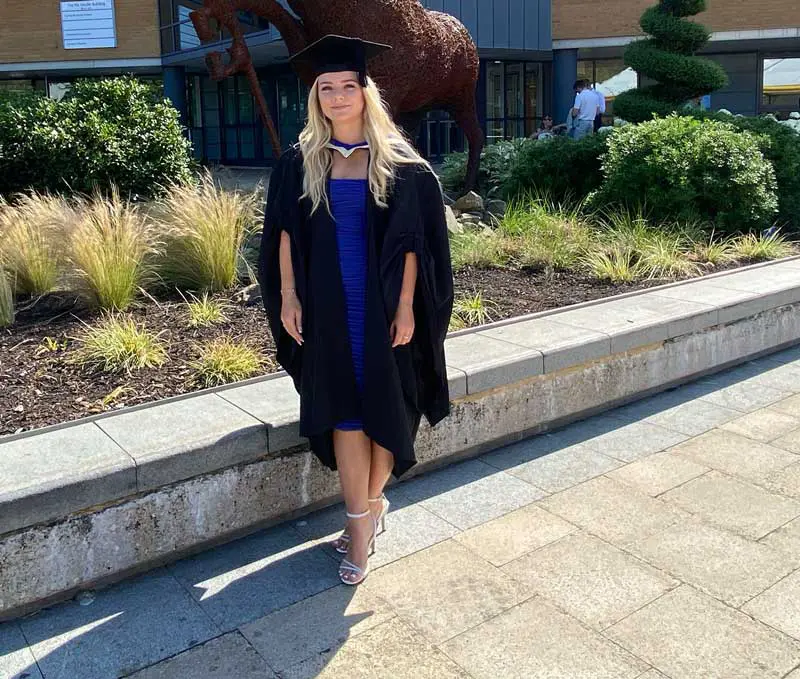
Saffron Barton studied Veterinary Medicine and Science at the University of Surrey and, after graduating in 2024, took her first role as a veterinary surgeon at Swayne and Partners in Bury St Edmunds, a small animal practice providing first opinion and referral services, which is part of the Kin Vet Community. She opted to join the Kin Vet Community Graduate Scheme to continue to boost her confidence.
Before heading to vet school, Saffron had already seen practice at Swayne and Partners – in fact, the work experience went towards her UCAS application. She also spent time as an EMS student at the practice during vet school.
Saffron explained: “I wanted to work at Swayne and Partners due to the amazing facilities of their new building, and also the familiarity of the friendly team. I knew I would be well supported here.”
Saffron’s early experience of life in practice has been positive. She said: “I am really enjoying my time in practice – I have learned a huge amount since starting and really enjoy the variety of my job.
“The practice is busy, and there is always something interesting happening.”
Saffron’s journey highlights the importance of early support for budding vets. EMS placements offer a valuable opportunity for practices and students to get to know one another, and determine whether they would be a good mutual fit.
It also helps to ease the transition into working life – the relief of already knowing what drugs are in the pharmacy or where the suture material is kept should not be underestimated.
During the busy holiday period, the number of consultations in practice stepped up for Saffron.
She said: “Seeing so many consultations a week, you are unfortunately bound to have some interactions with difficult clients. One thing I have struggled with is people commenting on my age and how I ‘look too young to be a vet’.
“Occasionally, a client will ask to see a senior vet, and this is when it can be really difficult not to experience imposter syndrome. At the end of the day, I just remind myself that I trained for five years to get to where I am today, and while I am not the most experienced veterinary surgeon in the practice, I am trying my best and will find out something if I do not know it.”
Her reflections highlight how vital it is for new graduates to feel supported – both through structured mentorship and through the everyday culture of the team around them. Mentorship, both formal and informal, plays a vital role in helping recent graduates grow in confidence.
Whether through a VetGDP advisor, colleagues in practice or in other branches, having someone to talk to can make a significant difference. Graduate schemes that actively encourage a culture of mentorship provide new vets with reassurance that they are not working in isolation, which can be especially valuable in the early stages of their career.
Equally important is the consistent support of the wider team. Recent graduates may bring the most up-to-date understanding in areas such as antimicrobial resistance, and a collaborative approach ensures that this knowledge is recognised and reinforced.
By aligning approaches and valuing the strengths of every team member, practices can provide clients with clear and consistent advice while also boosting the confidence of those at the start of their careers.
For Saffron, the wider team at Swayne and Partners has been key. She said: “I can discuss cases with the other vets before, during (‘out the back’) and after consultations. And there is always someone nearby ready to help if I need it during surgery.
“I do not have a particular interest at present, but think I may be heading down the surgery route.”
Saffron shared a worry that is common to many new vets: “My main concern when I first qualified was that I did not know enough to be a self-sufficient vet.
“I definitely suffered from imposter syndrome and felt like I had to double check everything I was going to do with a senior vet.”
Saffron reflects that the Kin Vet Community Graduate Scheme has been beneficial in this respect.
She added: “I am able to seek advice from senior vets when needed and also make use of resources such as the library.”
Rather than teaching more medical facts, the Kin Vet Community Graduate Scheme aims to help recent graduates apply the knowledge they gained at university more effectively in a first-opinion setting.
Case-based teaching by vets who are working in first opinion practice helps recent grads to develop their decision-making skills, and to understand when they can work independently and when they need to seek advice – a skill that never stops being important, no matter how experienced we become. It also blends clinical skills with important non-clinical concepts such as contextualised care, financial decision-making, and dealing with mistakes or near-misses. One of the potential challenges in moving from a vet school environment, with the support of a close-knit peer group, into practice for the first time, is a sense of isolation. Saffron feels that a series of specifically focused training days alongside other new grads from Kin Vet Community offered a valuable opportunity.
She said: “The training days involve seminar and workshop-style teaching, allowing for us to bounce our ideas off one another.
“It also allows me to interact with other new grads and share our experiences.”
Reflecting on her first year in practice, Saffron said: “Joining Kin Vet Community, and specifically, Swayne and Partners in Bury St Edmunds, has definitely provided me with opportunities. Working in a 24/7 practice, working late shifts and weekends, has meant I have had the opportunity to see and do a lot more in-patient and emergency work.”
Saffron would recommend to other new grads that they consider joining a graduate scheme, adding: “You will get a more structured support network, which will help you to settle into not only a new job, but a new and challenging career, much more easily than without one.
“The Kin Vet Community Graduate Scheme has helped to support me and ensure that I haven’t felt alone during the daunting journey of a new graduate vet.
“My mentor, and all the other staff, are always happy to answer questions and discuss cases with me. It was lovely to attend the new graduate training day, not only for the learning experience, but to network with other new grads from across the practice group.”
Thinking back on the experiences of her first year, Saffron feels it is important for new graduates to get a break away from the books before starting their first job.
She said: “There will be plenty of time to revise old things and learn new. And the best bit of advice I would give to new grads is to not be afraid to ask questions.
“Your colleagues should want to support you, and this is the easiest way to learn.”
1. RCVS (2024). The 2024 Survey of the Veterinary Profession report, tinyurl.com/2s3vt3y2