
25 Aug 2026
Why we urgently need to open up our profession
Rhian Littlehales, clinical governance and early careers director for Medivet and Partners, recounts the first steps of her own veterinary journey – and how she and colleagues are passionate about providing support to future vets.
Ask a room of primary school children who wants to be a vet one day, and you’ll see a host of raised hands. But as the years go by, this enthusiasm gradually diminishes as children get told that they are unlikely to be able to achieve this dream, or in some cases, that the profession simply isn’t for them.
I know this all too well because it happened to me. Discouragement followed me at every critical point in my pathway to becoming a veterinary surgeon. If it was not for the fact that I was extremely privileged to have a exceptionally supportive family and a small group of teachers who believed in me, there is every chance I wouldn’t be doing the career I love right now.
Despite attending the largest comprehensive school in Wales, no alumni before me had become a veterinary professional. Sadly, my story is not uncommon for aspiring vets.
How poor guidance starves our industry of future talent
I’ll never forget the day my school’s career advisor told me I wasn’t clever enough to be a vet. It was an earth-shattering moment that has stayed with me forever.
I can laugh at the comment now, but as a young person who had always respected the views of her teachers, part of me could have easily believed what I had been told. I was instead pushed towards a zoology degree that I didn’t really want to do.
This degree boosted my school’s university metrics, but it came with a catch. When I finally had the chance to take a veterinary course, the reality came crashing down when I discovered I couldn’t take out another student loan to cover my tuition fees, with it being my second degree. This was key information that hadn’t been discussed with me following my A-level results.
It was at that moment my parents and a local practice did something that changed my life forever. They put themselves in a position of financial hardship so I could afford to follow my dream. I couldn’t push through the discouragement without their encouragement and financial support.
We must face the reality that there are brilliant vets we’ll never meet. People who had the passion and the potential, but who never reached a veterinary course because no one ever showed them the pathway or told them they belonged on it.
Or, too many are simply priced out of the industry, unable to afford fees, books, a car to travel to rural placements or even pre-vet school work experience sessions, which are still a requirement at some organisations.
We must wake up to the realities that our profession is narrowed down to a small cluster of postcodes and educational backgrounds.
That is why I am proud to have played my part with Medivet and Partners and the University of Lancashire, as we seek to make a dent in the diversity crisis that holds back our industry.
Partnership approaches to widening access
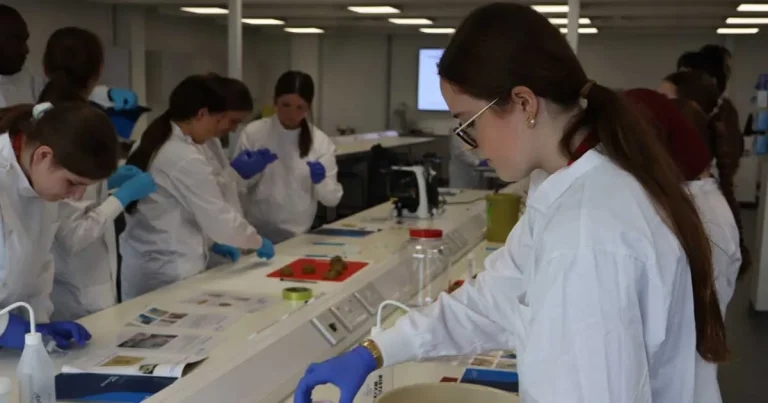
Addressing these early access barriers requires targeted and coordinated action between universities and veterinary firms. This type of partnership was piloted by a collaboration between Medivet and Partners and the University of Lancashire. Now in its second cohort, 20 students from under-represented backgrounds, aged 16 to 17, were invited to a fully funded one-week residential stay (pictured).
The summer school combined hands-on pet, livestock and reptile animal experience with focused career mentoring on veterinary career pathways and application processes.
We know those from under-represented backgrounds do not necessarily receive the same level of career coaching and guidance as those from private schools. These children are not told the tips to ensure their application makes it to the top of a pile, or advice on how to answer questions in often daunting interviews.
This is not necessarily the fault of schools or teachers – it just seems to be a well-propagated myth that veterinary courses are impossible to get into and that students aspiring to be vets should consider other options.
I would argue this part of the week was as valuable as the veterinary skills itself.
It was incredibly inspiring to see my Medivet and Partners colleagues from around the country share their advice for these career moments and also tell their stories of overcoming barriers into the profession.
The programme brought visible representation of veterinary surgeons who varied in race, sexuality and faith, and who are all great colleagues of mine. Their stories revealed that excelling in this profession was more than possible. They brought honesty of all the times the door had slammed in their face, accompanied with hopeful humour in their sessions.
The summer school was an opportunity, free of financial risk, which gave a cohort of exceptionally bright students the experience they otherwise would be isolated from.
It’s one example of the influence of collaboration and visible representation in tackling an industry-wide diversity problem – and something that could have made all the difference to me in my school years.
Long‑term risks of an unrepresentative profession
A day in the life as a vet places you in front of the entire community, leading delicate conversations and executing contextualised care around the clock. However, statistics reveal it’s one of the least diverse workforces. Without diversity, how can the profession expect to fully serve communities whose experiences and identities it rarely reflects?
BVA figures reveal only three 3% of the veterinary workforce is from minority ethnic backgrounds, compared with 17% of the UK population, which is a huge misrepresentation. On top of this, more than 25% of the UK’s vets are privately educated, shedding a light on a social mobility issue, too, where access to the profession remains closely tied to socioeconomic advantage.
It means many young people making long-term career choices rarely encounter someone in the sector who looks like them, who went to the same school, who shares their community spaces with them. This limited visibility, in my experience, is enough to fuel self-doubt and enough to prompt a completely different career choice.
Why veterinary school isn’t feasible for everyone
The barriers don’t stop when you secure a place on the course. Access to mandatory work experience is another early blockage. Placements often rely on family connections and rural proximity, or at least the income to travel to a rural location. And these placements are paired with hefty textbooks and PPE, which soon mounts costs.
I am proud Medivet and Partners is helping students see their future role as a veterinary professional. But, if my week at the summer school with the University of Lancashire has taught me anything, it is that we have much more to do as a profession.