
6 Oct 2026
Advances in veterinary diagnostic technology allow practices to balance fast in-house testing with specialist external laboratory expertise. Developing an effective strategy streamlines workflow, optimises costs, and enhances clinical decision-making, ultimately improving overall patient care…

Stacey Newton
Job Title
Image: AnnaStills / iStock
With the recent technological advances in diagnostic options available – both in in-house testing and external laboratory services – practices have got a wide choice of tools to meet some of the challenges of providing high-quality veterinary care.
Rising client expectations, coupled with increasingly complex caseloads and the need to ensure that every investment delivers value, means that developing an effective diagnostic strategy for the practice has become both a clinical and business necessity.
It’s not so much a question of in-house versus outsourced diagnostics, but rather how to create a service that delivers timely clinical decisions, high-quality patient care and sustainable financial performance.
The first step is to define what you are trying to achieve. What decisions are clinicians finding difficult to make? Which tests give information that could change clinical management and how quickly do clinicians need this information?
Consider services the practice would like to offer in-house and how diagnostic plans could be developed to suit clients with different levels of budget. Where could an instant turnaround offer added value or increase client confidence, and where could specialist expertise provide the greatest benefits?
Carrying out an audit of current practice can identify issues in clinical, operational or commercial areas that could be resolved by a different approach. For instance, having an integrated point-of-care diagnostic suite for a practice with a high volume of surgical cases and a workflow based around proactive testing could have advantages. However, if staff lack confidence in using the equipment or certain tests are underused, potential revenue could be missed.
Working out an approach should aim to find the best balance for the practice between investment, efficiency and clinical quality.
In situations where immediate results influence treatment and patient outcomes, in-house or portable point-of-care diagnostics can be immensely valuable. This includes emergencies where time is of the essence and patient-side tests enable rapid triage, decision-making and action.
Rapid in-house results can also streamline the patient journey, allowing some animals to proceed to surgery, begin treatment or be discharged without unnecessary delay. This may reduce hospitalisation and repeat visits, while also giving clients greater reassurance at a time when they may be facing difficult clinical, emotional or financial decisions.
The value of in-house diagnostics is not limited to emergency care and the same principle applies to in-house microscopy and cytology. For example, ear cytology can quickly confirm whether bacteria or yeast are present and help guide appropriate treatment during the consultation. This supports more targeted prescribing and can reduce reliance on empirical treatment based on clinical signs alone.
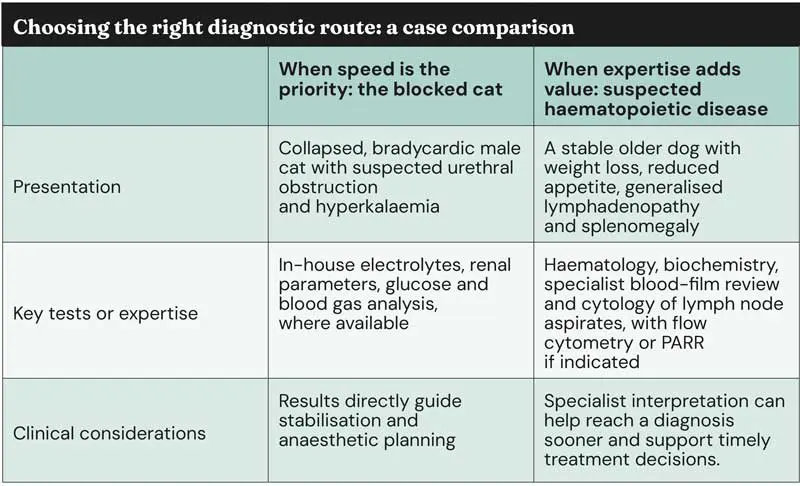
An external laboratory can offer more specialised tests than can be performed in practice, including histopathology, endocrine panels and genetic and breed testing. But even when a test could be run in-house, there can still can be advantages in sending the sample to an external lab. One of the key benefits is access to specialist veterinary and pathology advice.
For example, consider an older cat with weight loss, increased thirst, equivocal renal results and mild non-regenerative anaemia. An external laboratory can assess SDMA alongside creatinine, urine concentration and protein loss, while specialist review of the haematology and blood film can help determine whether the anaemia is consistent with chronic kidney disease or warrants further investigation. Interpreting the findings together can support earlier staging and more targeted management.
More broadly, pathologists can identify subtle abnormalities, distinguish genuine findings from analytical artefacts and advise whether additional testing is likely to be useful. This can be particularly valuable in borderline or conflicting cases, or when the laboratory results do not fit the clinical picture.
Another area where external laboratories can provide confidence for the practice team is in quality assurance. A commercial diagnostic laboratory will have external quality assurance (EQA), will use validated methods, ensure rigorous calibration and will ensure consistency in their testing and results.
There can also be efficiency benefits to an outsourced lab service, especially if the practice’s demand for tests fluctuates or larger volumes of testing are periodically required. The logistical support offered by an external lab can contribute to a smoother workflow and greater confidence for practice teams. Reliable sample collection and turnaround, online portals for tracking samples and results, advanced tracking of trends from historical data and responsive customer support can make the process straightforward for vet teams to navigate alongside complex case management.
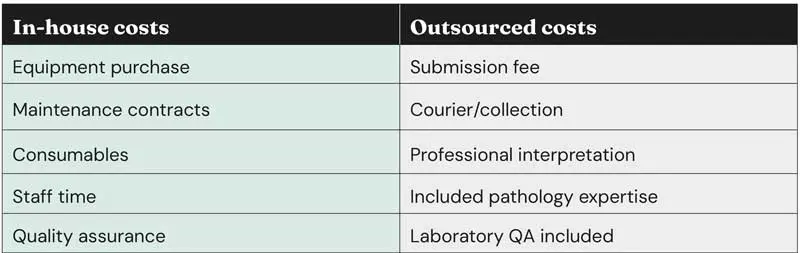
There’s more to calculating the costs of diagnostics than working out the cost per test. For in-house labs, the direct costs, such as the purchase of an analyser, reagents or service contracts, are only one element. There can be significant hidden costs around clinicians’ time, staff training and maintenance – not least running and cleaning up after multiple tests. A vet spending 20 minutes interpreting a blood film or cytology sample may represent a greater cost to the practice than submitting it for specialist review. There can also be unexpected costs associated with quality control and repeat testing, and the downtime when equipment – and precious practice space – is not being used.
Balancing this are some significant potential benefits. If in-house and patient-side testing is resulting in earlier diagnosis, fewer repeat appointments, improved client confidence and better case outcomes, the cost-benefit analysis could be looking quite rosy.
The value of a diagnostic strategy isn’t measured purely by the direct unit cost. The value it creates through faster decision-making, better use of clinical time, improved patient outcomes and stronger client relationships also needs to be considered.

The most effective diagnostic pathway often uses both in-house and outsourced testing using principles such as:
A diagnostic strategy is not just about choosing where tests are performed; it is also about ensuring the whole process runs efficiently. Every stage affects both staff time and the client experience, from sample collection and labelling to transport, reporting and communication of results.
Well-designed diagnostic pathways can reduce duplication, minimise delays, support better clinical outcomes and reduce administration to help clinical teams spend more time caring for patients.