
30 Jun 2026
Victoria Bowes-Keegan RVN discusses the importance to veterinary nurses, and the practice as a whole, of developing successful consulting clinics.

Victoria Bowes-Keegan
Job Title
The Veterinary Surgeons Act 1966 (Schedule 3 amendment) Order 2002 provides the opportunity for veterinary nurses to be delegated to complete nursing consultations. Some key elements need to be met for delegation.
The VN must be working within the legislative boundaries that allows performance of medical treatment and minor surgical procedures that do not enter a body cavity. The veterinary nurse must be on the register of veterinary nurses and students must be enrolled with the RCVS. RVNs must act under the direction of their veterinary surgeon employer providing procedures to animals under their employer’s care. The directing veterinary surgeon must be satisfied that the VN is qualified to carry out the medical treatment or minor surgery (RCVS, 2024a).
For SVNs it must be under the direction of a veterinary surgeon providing procedures to animals under their employer’s care. The procedures must be under direct, continuous and personal supervision by a veterinary surgeon or an RVN. The medical treatment or minor surgery must be carried out in the course of the student veterinary nurse’s training (RCVS, 2024). The veterinary nurse also must follow the RCVS Code of Professional Conduct for Veterinary Nurses, ensuring to maintain client confidentiality, completion of accurate and timely record keeping and ensuring informed consent is gained.
It is also important that the RVN is approached to ensure the clinics are within their personal scope of practice and they are comfortable and confident to complete the consultations. Veterinary nurses must work within their professional limits and ensure the advice they provide is impartial and considers any key conflicts of interest (RCVS, 2026).
The benefits of consulting clinics should not be discounted and should be considered as part of the planning process:
Client satisfaction. Veterinary nurses will be able to spend more time and provide more explanation to clients to ensure they fully understand, for example, any chronic disease management. They will also be able to discuss preventive health care, ensuring to support the client with their decision-making.
Effective team and time management. Using RVN clinics will enable the efficient use of staffing teams, especially the use of the veterinary surgeon. An example would be postoperative checks, where RVNs could complete the consultation and escalate or seek further veterinary care as necessary (Farrant, 2023).
Staff retention and morale. With the careful use of nursing clinics this could increase staff satisfaction. The use of VNs to complete procedures within Schedule 3 of the Veterinary Surgeons Act 1966 will provide them with the recognition for the skillset and education they possess. This, in turn, should increase staff morale and retention (Woodward, 2025).
The VN who is completing the clinic must make the client aware of whether they are registered or a student acting under a veterinary surgeon’s direction or supervision. Veterinary practices that fully embed the use of SVNs must ensure the client is aware of the right to withdraw consent for those who are in training (RCVS, 2024b).
Many veterinary practices will produce a poster as part of the informed consent process. This can be supported with careful use of staff badges detailing roles. A staff photo board may also be used to draw clients’ attention to staff roles. The practice website should also be updated to ensure staff roles are accurately developed.
The practice will need to consider the most appropriate nurse clinics that they would want to support. This consideration should look at the interests of their current nursing team and any possible training that may need to be completed. It is important to remember that for nursing clinics to be effective, fluid communication between the team is vital to maximise patient care.
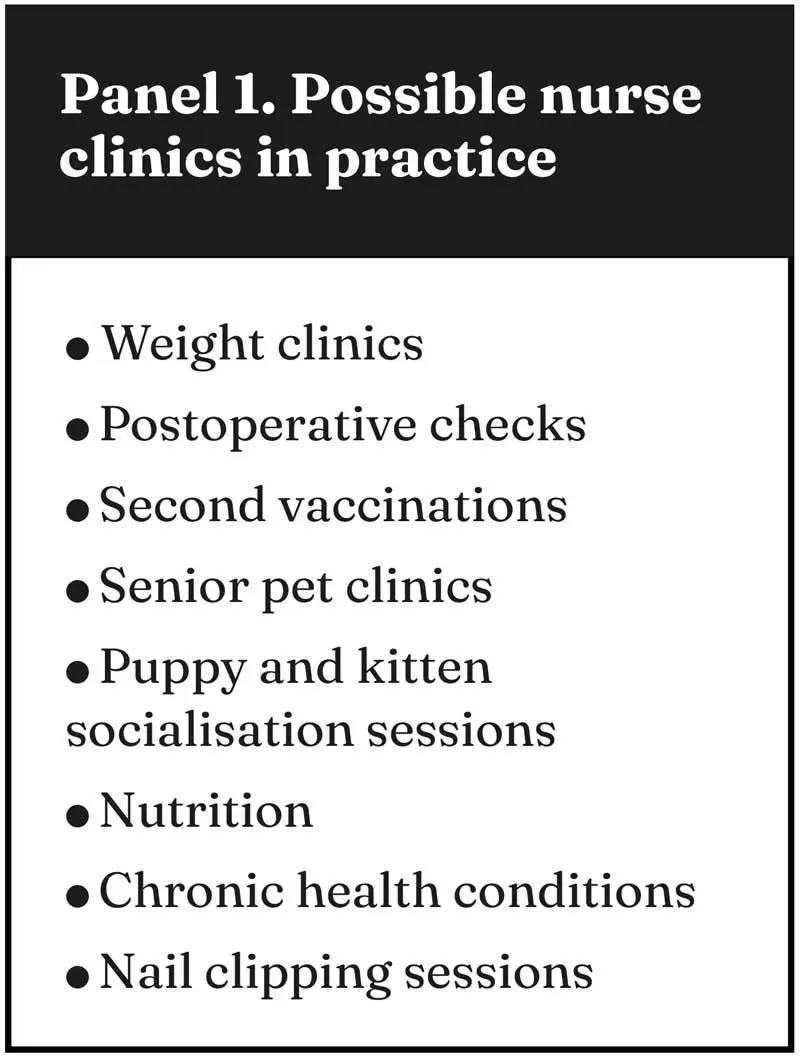
When the clinics have been chosen, the practice should advertise their provision, which could be via social media or pictorial boards within the practice. The team should consider which nurse is best suited to the clinic to ensure and support staff morale and skill building.
It is also at this point where the practice will need to consider the pricing system for nursing clinics. Careful consideration needs to be given to which clinics are used as a free service, as the client may consider they have no value. This, in turn, may impact the recognition of the role of a veterinary nurse (Macdonald, 2018).
It can be beneficial for the veterinary nurse to complete additional studies to support the transition into consulting. Veterinary nurse educational programmes will commonly contain information about VN consultations and communication methods. This is a really good starting point. The practice must acknowledge that further training should be provided to support depth and knowledge gain.
VNs should always consider evidence-based theory and nursing as part of their practice, so using this tool to support nursing consultations is key. RVNs have an annual requirement to complete 15 hours’ CPD. This also has a requirement for reflection on the skill gain. The consulting VN may benefit from completing specific courses on supporting the consultation process and communicating effectively with clients. The RCVS Knowledge website can provide valuable information along with various webinars and articles.
Most consultation courses will recommend the use of the Cambridge-Calgary consulting model, which has been adapted to fit the needs of veterinary models (Ackerman, 2022). This model provides a clear guide and proforma for use in the practice, ensuring consistency between patients and staff.
Communication skills are imperative to have efficient consulting VN clinics. Effective communication is important to ensure clients feel valued and the correct information is being considered. When owners are clear with the information gained and shared this in turn should improve client concordance with home care plans and treatment regimes.
Veterinary nurses must be aware of the two key methods of communication – verbal and non-verbal communication. When greeting clients, communication should be developed to make them feel welcome and valued as they enter the consultation room. Ensure animals are greeted as much as possible, along with the client, and always consider patient and staff safety.
Verbal communication is when the information is shared by mouth. This is one of a VN’s main methods of communication. When the VN is communicating with an owner, it is important they are careful with word choices, especially avoiding medical jargon. When asking questions, VNs should consider the tone, rhythm and volume (Osuna Leon, 2023). The tone should not be judgemental or accusatory. One of the key guiding principles for VNs within the VN code of conduct is that VNs must maintain independence and impartiality, ensuring decisions are based on clinical judgement (RCVS, 2024).
Some owners may feel more open to speaking with VNs due to the compassionate bonds that may have been developed (Petplan, 2025). The VN-client relationship is commonly considered trust and rapport based, leading to an openness in communication (Petplan, 2025).
Non-verbal communication looks at various body changes that may be voluntary or non to include facial expressions, arm positions, gestures, eye contact and body posture (Kedrowicz, 2023). The VN should be careful with their non-verbal communication, giving conscious thought to postures and responses to client information. The client will also provide non-verbal communication, which should be monitored, acknowledged and considered by the VN. All RVNs should make sure they are empathetic, which will, in turn, enable the client to feel valued.
To maintain a clear consultation process, VNs should ensure they actively and reflectively listen to their clients’ response to the questions. This will add depth to the consultation and also provide more information to the consulting veterinary nurse. With careful use of open questions this information gained will provide key facts and possible insight within the consultation.
When the consultation is completed it is important to close effectively. This may include confirmation of the points that have been discussed, or provision of paper-based information such as leaflets or consent information. It is important, if appropriate, to book the next appointment before the client leaves so a future plan is in place.
The client should be offered the opportunity to ask any further questions if needed and clarify key points. The VN should always acknowledge both the owner and the patient, ensuring they try to make patients feel comfortable and safe during the consultation.
The involvement of VNs in managing and completing consultations should be considered by all veterinary practices. One of the key reasons for this is that it will not only strengthen the role of the VN, but will also enhance the practice’s efficiency with staffing.
VNs should ensure their knowledge is current and that they continue to apply evidence-based theory and nursing. It is important as recognised members of a profession for VNs to work collaboratively and continuously within their legal and ethical limits.
Victoria Bowes-Keegan has been working in the animal care and veterinary nursing industry since 1997. She qualified as a veterinary nurse in 2003 and became the nurse training manager in her general veterinary practice and had the opportunity to support various students through their nurse training. She also started working for Vets Now as a senior emergency nurse. She has a specific interest in evolving the role of the veterinary nurse, weight management and emergency veterinary nursing. She has been working for WCG as a veterinary nursing course manager since 2007. With this role, she hopes to impart her passion for veterinary nursing and the importance of supporting clients as you would want to be supported. She works as the external examiner for veterinary nursing at Vetskill. This, alongside her role as examiner for the RCVS, allows her to examine and support the next generation of veterinary nurses.