
14 Apr 2026
The veterinary profession is in the middle of a period of significant structural change. Following years of rapid corporatisation and a prolonged CMA investigation, practices now face a raft of mandated operational changes. Here, executive coach and VMG director Helen Mason makes the case for coaching-led leadership during periods of change...

Image: koldo studio / iStock
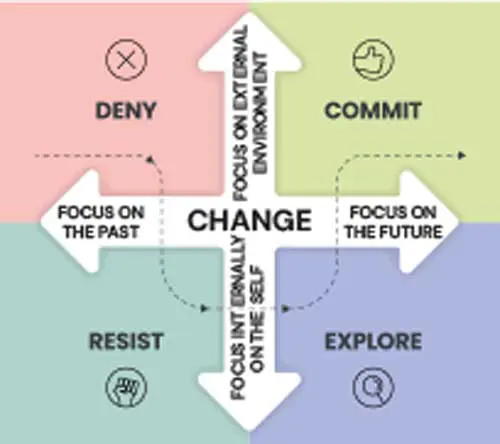
Not everyone processes change at the same pace. The change curve was developed by Scott and Jaffe, based on the Kübler-Ross grief model. It describes four stages people move through: denial, resistance, exploration and commitment1.
Your job as a leader is to notice which stage each team member is in and adjust your approach accordingly. People move through these stages at different speeds and they rarely move as a group. Your receptionist may be quietly energised by a new pricing transparency framework while your senior vet is still in denial that anything needs to change at all. Research confirms that actively managing the emotional state of teams during times of change produces more positive reactions2.
The practical implication: don’t just communicate what is changing, actively notice and respond to the emotional stage your people are in.
Leaders in clinical environments are trained to fix problems. But rushing to solutions when people need to be heard first is one of the most common leadership mistakes during change.
The link between emotional intelligence and transformative leadership has been gaining momentum3, and Amy Edmondson’s landmark Harvard research identified psychological safety, the belief that you can speak up without repercussion, as a significant factor in collaborative work when teams face uncertainty and change4. In other words, making it safe for people to voice concern is not a nicety, it’s operational necessity.
In practice: start team meetings by asking how people are doing with the changes, not just what’s on the agenda. Acknowledge before you advise.
The instinct to project certainty during turbulent times is understandable – but counterproductive. Brené Brown’s research demonstrates that leaders who acknowledge what they don’t know build significantly more trust than those who perform confidence they don’t have5. The key word is appropriate: this is not about sharing every anxiety with your team. It is about being willing to say, when it is true: “I don’t have all the answers yet. Here is what I do know, and here is how we’ll work through the rest together.”
Teams led by leaders who demonstrate intellectual humility show greater problem-solving capacity and hold more intrinsic motivation during organisational change6.
When pressure mounts, the instinct is to direct. The evidence suggests asking works better. A coaching-oriented leadership style, leading with questions rather than solutions, consistently produces better engagement and performance outcomes7. David Marquet’s work on intent-based leadership shows that shifting from
“I give orders” to “I ask, you think, you act” creates more resilient, self-directed teams8.
Try replacing “Here is what we are doing about X” with “We need to meet this requirement by [date] — what are your ideas?” The outcome is the same; the ownership and quality of solution are typically better. When someone raises a concern, respond with a question before an answer. It signals that their thinking matters.
Useful questions during change:
Here is something counterintuitive: maintaining clear standards and expectations is one of the most stabilising things you can do during a period of disruption. Teams cope better when their environment contains reliable anchors, and your professional standards are exactly that.
Some leaders relax all expectations during difficult periods, believing it to be a kindness. In practice, ambiguity about standards creates additional anxiety. Be flexible about how your team achieves outcomes but stay clear about what those outcomes, are and why they matter. Purpose is a genuine buffer against stress: teams with a clear sense of meaning in their work show greater resilience9.
Explicitly name what is not changing: “Our commitment to clinical excellence and how we treat clients remains exactly what it has always been.” That continuity matters.
People tolerate uncertainty better than communication vacuums. When information is absent, teams fill the gap with assumption and during change, assumption tends towards the negative10. The change management research suggests that communicating more frequently than feels necessary is the way forward. Be honest about what you know and don’t know and give people a coherent narrative; where you’ve come from, why this is happening, where you’re going. A short, honest and weekly update is worth more than a comprehensive one that arrives rarely.
Leaders carrying a team through change need support, too. Research on leader burnout is clear: community and reflective spaces (a coach, peer group, or supervisor) are an antidote to burnout11. If you don’t already have this, now is the time to build it. You cannot reliably hold space for others if nobody is holding space for you. The VMG’s ShareSpace sessions provide exactly this – and it’s free for members.
For more information on the issues discussed in this article, visit the VMG website.
Helen Mason is an executive and team coach with more than 20 years of experience working in the veterinary sector, including senior leadership roles at IVC Evidensia and MSD Animal Health. She is a board director at VMG and works with leadership development consultancy Ambito Partners, as well as her own private practice.