
13 Aug 2026
CPD and congresses can provide the spark for ideas that fundamentally reshape how practices work. By aligning with business goals and backing development with mentoring, those sparks of inspiration can lead to lasting change and transform CPD from an expense into strategic advantage…

Rebecca Robinson
Job Title
Image: monkeybusinessimages / iStock
Veterinary teams are fascinating. We will happily spend an hour debating a subtle clinical decision yet spend remarkably little time talking about how we develop the people making those decisions.
The practices that continue to grow rarely do so by accident. They invest in equipment, technology and facilities, of course, but they also invest in curiosity, confidence and capability. They understand that sustainable success comes from developing people as deliberately as they develop services.
Clinical excellence remains the foundation of every great practice. But leadership, communication, resilience, commercial awareness and the ability to adapt are becoming just as important.
That is why CPD, congresses and conferences matter. They are not simply opportunities to collect hours for compliance. At their best, they become places where ideas collide, assumptions are challenged, and people return with fresh energy. The trick is making sure that spark survives the journey home.
The veterinary world changes quickly. New evidence appears, technology advances, and client expectations shift. Keeping pace requires continual learning.
But there is another reason events matter. They interrupt routine. They create space to think. Away from consulting rooms and operating theatres, people have permission to reflect on bigger questions: could we do this differently?
Scientific congresses provide access to emerging evidence. Association conferences create communities around specialist interests. Trade exhibitions introduce products and services that may reshape workflows. Virtual learning offers flexibility when time is tight.
Each has value, but only if attendance leads to action rather than another certificate in a drawer.
Development should never feel disconnected from strategy. When leaders explain where the practice is heading, individuals can see how their own growth contributes to that journey.
Good development conversations explore aspirations, strengths, opportunities and practical next steps. They should not become annual rituals that disappear into filing cabinets until the next appraisal season.
It is also worth remembering that people rarely create extraordinary value by fixing every weakness. They create it by spending more time using their strengths brilliantly.
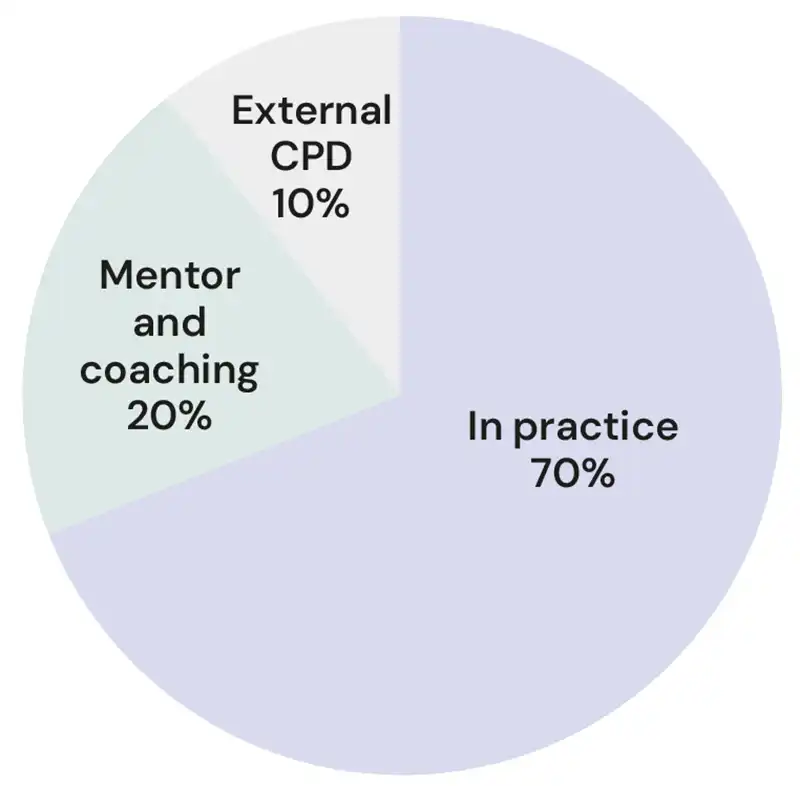
The familiar 70:20:10 model (Figure 1) reminds us that most learning comes from experience and coaching rather than formal courses. Congresses provide inspiration, but everyday work is where capability is built.
We have all met the enthusiastic delegate who returns from congress carrying a branded notebook, a reusable coffee cup and enough brochures to wallpaper the staff room. Everything was “fantastic.” Change is definitely coming… Then Monday arrives.
Consults are busy, surgeries overrun and the notebook quietly disappears beneath laboratory reports.
That is not a motivation problem. It is a systems problem.
Mentoring and coaching provide the bridge between inspiration and implementation. A simple follow-up conversation before and after an event can transform interesting ideas into lasting improvements because someone is expected to reflect, adapt and act.
Skilled mentors do far more than revisit course notes. They help people develop the confidence and competence to turn learning into action, navigate the inevitable challenges of trying something new and adopt fresh ways of thinking that stick long after the conference has ended. Coaching-style conversations encourage curiosity and ownership rather than dependency, helping individuals translate knowledge into meaningful change.
Over time, that ongoing support can be the difference between attending another CPD event and genuinely transforming the way a practice works.
New services, improved clinical approaches and innovative ideas are far more likely to emerge when learning is reinforced through discussion, reflection and continued mentoring, rather than being left to gather dust in a notebook.
One of the biggest missed opportunities in CPD is treating clinical and non-clinical development as separate conversations.
A surgeon with advanced technical skills will have even greater impact if they can communicate confidently with clients and influence colleagues. A head nurse undertaking leadership development may unlock far more value from their clinical expertise because they become better equipped to inspire change across the team.
Communication builds trust. Leadership creates culture. Commercial awareness helps good ideas become sustainable services. Emotional intelligence improves teamwork under pressure.
The highest-performing practices understand that these capabilities reinforce one another rather than compete for budget. Clinical excellence remains the foundation, but pairing it with leadership, business and interpersonal skills often multiplies the return from every development investment.
It is surprisingly easy for CPD to become reactive. Someone spots an interesting course, an email advertises an early bird discount or a colleague recommends a congress and attendance is approved because it looks useful. Useful is not always strategic.
The best practices ask a different question: what problem are we trying to solve and will this help solve it?
Instead of measuring success by attendance, define what success should look like six months later. Better outcomes, new services, stronger competencies, new partnerships, improved protocols and knowledge shared across the team are all meaningful measures of impact.
Thinking this way transforms CPD from an expense into an investment with a clear purpose.
The best development plans are intentional rather than accidental.
A structured CPD request process encourages people to think beyond attendance. Why this event? Why now? How will the learning be implemented?
Good requests should outline personal objectives, alignment with practice priorities, expected benefits and a practical implementation plan.
Preparation matters too. For congresses and conferences, prioritise sessions, arrange networking meetings in advance, and explore exhibitors with purpose. The conversations between lectures often become the most valuable part of the event.
Perhaps the simplest, but most effective, question is to ask attendees to identify three actions they will implement before they even leave for the conference. It shifts thinking from passive learning to active change.
The goal was never simply to attend a conference. The goal is to come back different.
Clinical expertise deserves investment, but some of the greatest returns often come from non-clinical skills.
Communication influences compliance. Leadership shapes culture. Emotional intelligence improves teamwork. Business understanding helps great clinical ideas become financially sustainable rather than permanently aspirational.
The most influential veterinary professionals rarely succeed because they know more than everyone else. They succeed because they can bring people with them.
It is also worth remembering that not all CPD needs to involve travelling to a conference or external course. In-house development around skills such as communication, emotional intelligence and assertiveness can be an extremely cost-effective investment. Better still, when teams learn together, they develop a shared language and understanding that strengthens collaboration, enhances the client experience and ultimately improves patient care.
Learning flourishes where people feel psychologically safe enough to experiment.
Not every new idea survives contact with a Monday morning emergency list, and that is perfectly normal. Improvement is messy. Innovation involves trial and error.
Leaders who celebrate learning rather than perfection create organisations that adapt faster because people are willing to test, reflect and refine instead of protecting the status quo.
Simple questions such as “What should we stop, start and continue doing?” often generate surprisingly powerful conversations.
Knowledge trapped inside one person’s notebook creates very little organisational value.
Encourage feedback sessions, peer-to-peer teaching, protocol updates and practical guides after every event. Small investments in sharing multiply the return from every conference place purchased and help newer colleagues develop more quickly.
Learning becomes culture when it is visible.

Success is not attendance. Success is implementation.
Perhaps a new service is introduced. Perhaps communication improves. Perhaps a new supplier relationship saves money or a protocol changes patient outcomes.
Defining success before travelling changes the mindset from passive learning to active opportunity.
The best conversations at conferences rarely happen under the lecture slides.
They happen over coffee, while wandering through exhibition stands or waiting for the next session to begin. They are the conversations where someone casually mentions a workflow that transformed their practice or introduces a technology that solves a problem you have been wrestling with for months.
Professional relationships are strategic assets. They provide reassurance, perspective and access to expertise long after the event has finished. Recruitment opportunities, collaborations and referrals often begin with informal conversations rather than formal networking sessions.
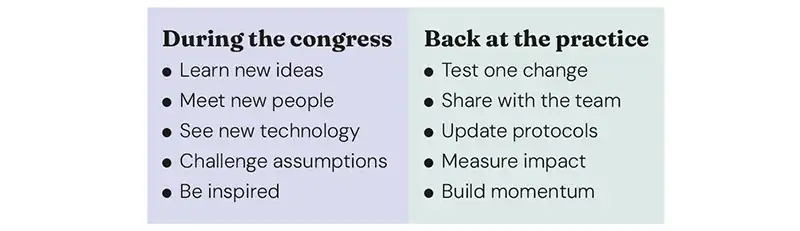
That is one of the hidden values of attending congress. You return with more than information. You return with context, confidence and connections (Figure 2).
For practices committed to long-term success, attending CPD and congresses should not feel like time away from the business. It should feel like investing in the future of the business and the people who make it possible.
The real value of CPD is realised long after the conference has ended. Practices that plan development thoughtfully, invest in both technical and human skills, and create a culture where learning is shared and new ideas are encouraged, are the ones most likely to thrive.
When people are given autonomy to pursue areas they are passionate about, supported to put that learning into practice and recognised for the progress they make, engagement grows, retention improves and the whole practice moves forward together.

Great conferences create something increasingly rare: space to think. They expose us to different perspectives, encourage curiosity and remind us that progress is rarely achieved in isolation.
In fact, the most valuable thing you bring home from a conference probably will not fit inside your rucksack. It may be a conversation that changes how you lead your team. An idea that improves patient care. A partnership that creates future opportunities. Or simply renewed energy from stepping outside the daily whirlwind of practice life and remembering why you entered the profession in the first place.
The CPD hours matter. The clinical knowledge matters. But the conversations, ideas, and momentum generated often become the real competitive advantage.
The event itself lasts a few days – what happens afterwards can shape a practice for years.
Rebecca Robinson graduated from the University of Cambridge in 1999 and started in mixed practice before focusing on small animals. She became a practice director in 2016 and co-founded Vet Academy with Vet Dynamics. She joined the VMG board as junior vice-president in 2023 and now serves as president while working full-time as a Vet Dynamics business consultant.