
3 Nov 2026
Transforming first-opinion veterinary dermatology requires moving from reactive care to a structured, team-wide approach. By utilising nurses, standardising diagnostics, and engaging clients, practices can build a sustainable, highly effective service...

Deborah James
Job Title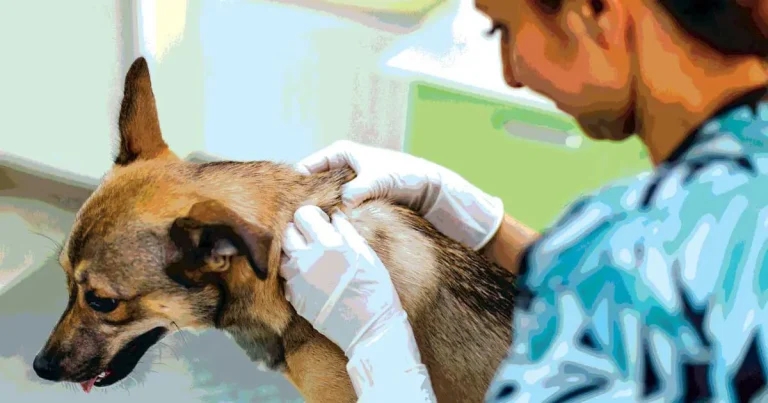
Image: razyph / iStock
Skin and ear disease are an extremely common occurrence in first opinion veterinary practices. In fact, a UK survey of 3,707 consultations found that 795 (21.4%) of them involved a dermatological problem (Hill et al, 2006).
Many of these dermatology cases are chronic, but acute cases can also be seen; however, all require follow-up appointments. This creates an opportunity for veterinary practices to utilise for diagnostics, and successful management of these cases can create long-term client relationships with the vet and the practice as a whole.
It is already well known that dermatology consultations are commonplace. But what specifically? A study found that in dogs and exotics, pruritus was the most common condition (30% to 40%), with cutaneous swellings accounting for 36% of cat skin consultations (Hill et al, 2006). Clinical audits are a fantastic way of determining this information, and vets or veterinary nurses could carry this out in practice.
As well as being a part of the quality improvement process, audits enable clinical effectiveness to be measures and allows for practices to continually improve the quality of patient care (Mosedale, 2019). You probably already have a dermatology service that exists in practice; you just haven’t measured it.
The audit should take place over three to six months, allowing enough data to be correlated. Then start with how many consultations involve:
Plus any other cases the practice sees which would create an overall personalised picture of your practice.
Then look at:
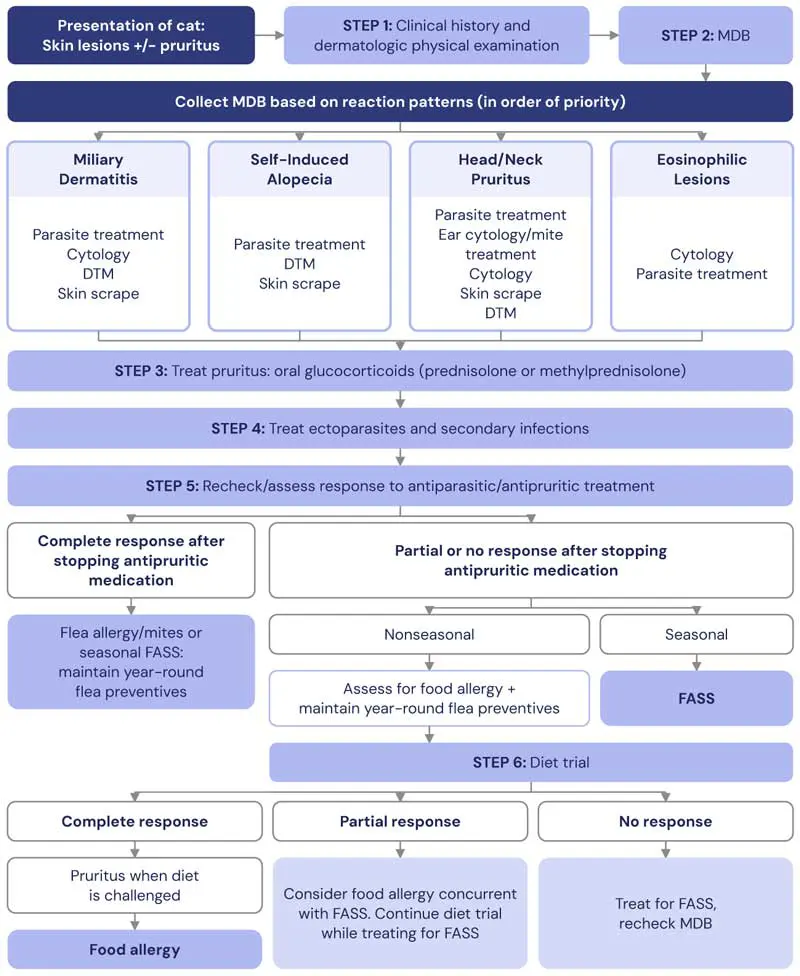
Now comes the large clinical section. Dermatology becomes a more efficient service for clients and veterinary surgeons alike when practices move away from the “try this and see, and if it doesn’t work come back” approach and, instead, move towards a more structured diagnostic pathway.
In 2023, the American Animal Hospital Association (AAHA), published guidelines recommending a detailed history, physical examination and creating a minimum dermatological database for each patient you see to include skin cytology, flea combing, skin scrapes and ear cytology, where appropriate. The BSAVA Manual (Jackson and Marsella, 2021), similarly emphasises the importance of a systematic approach, as the success of the treatment is dependent on identifying the underlying disease correctly and as efficiently as possible for the pet’s welfare, and for meeting client expectations.
Not all diagnostics have to be incredibly complicated or expensive. Cytology, for example, is accessible and relatively inexpensive, as it can be performed in-house. BSAVA resources specifically highlight the importance of appropriate sampling and the role of cytology when conducting dermatological investigations, from tape strips, impression smears and ear cytology to identifying rods, cocci, Malassezia and inflammatory cells (Monti and Cian, 2016).
But diagnostics are not just an opportunity to generate revenue; they are vital in the veterinary surgeon’s role in antimicrobial stewardship. In a study by Hill et al (2006), 576 (72%) of cases had a diagnosis or treatment plan created from clinical signs and physical examination alone, with only 219 (28%) of cases having diagnostic tests performed prior to reaching a definitive diagnosis and appropriate treatment plan created.
The International Society for Companion Animal Infectious Diseases published guidelines in 2025, recommending cytology in canine pyoderma cases prior to using antimicrobials, with further recommendations being for topical antimicrobials for surface and superficial pyoderma, with systemic antimicrobials being reserved for deeper pyoderma or superficial or surface pyoderma where topical treatments are not effective (Loeffler et al, 2025).
In 2026, the International Committee on Allergic Diseases of Animals created new guidance for cases of canine atopic dermatitis which distinguishes between reactive treatments which aims to resolve the current pruritus/lesions, and using proactive treatment which aims to maintain the state of remission and reducing any future flare-ups from occurring (Mueller et al, 2026).
Developing dermatology does not necessarily require recruiting a dedicated dermatology clinician. In many practices, an important first step is to make better use of the existing team’s skills and establish clear responsibilities for each stage of care.
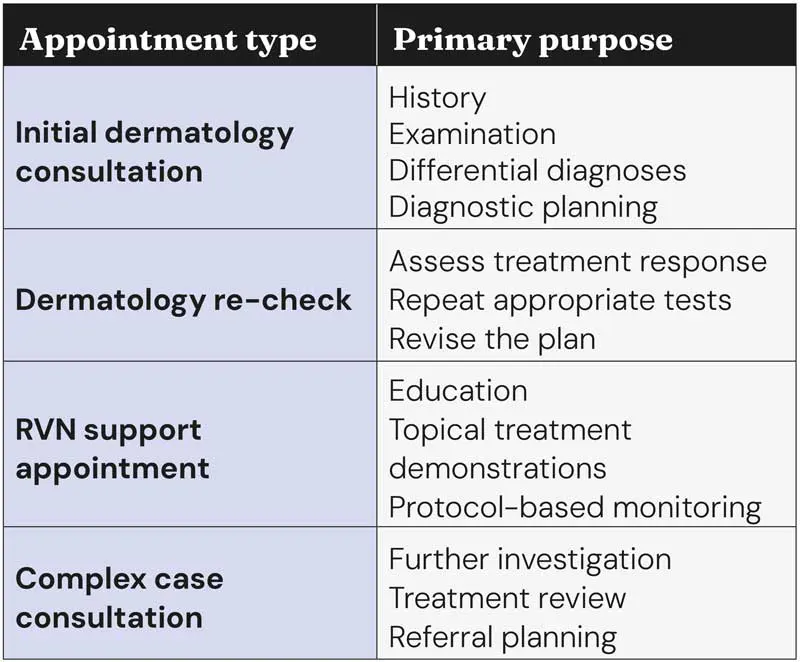
RVNs can contribute significantly to continuity, owner education and monitoring, by working within their professional competence, agreed protocols and the veterinary surgeon’s clinical plan. Their involvement can also help ensure that consultations are not limited to diagnosing disease and dispensing treatment, but include the support owners need to implement that treatment successfully at home. RVNs can be utilised with the following:
This can create better job satisfaction for RVNs while simultaneously allowing the veterinary surgeon to concentrate on diagnostics, decision making, treatment selection and referral decisions. Dermatology does not need to mean adding a specialist or another vet; it can just mean using the whole team more effectively.
Referral should not be seen as lost revenue. AAHA guidelines recommend referral when adequate control cannot be achieved and in order to improve outcome and reduce frustrations or cost implications with unsuccessful management, recognise that specialist involvement can improve outcomes all round, and can even allow a practice to create a structured positive relationship with a specialist (AAHA, 2023).
If the practice has cases that are failing to respond appropriately; recurrent infections despite appropriate management; unusual, autoimmune diseases; severe or refractory otitis; complex food allergies; complex feline dermatology; or even cases where advanced diagnostics would be required, then these are all opportunities for referral and recognising where the care a first opinion veterinary practice can provide ends and specialist care needs to take precedence.
Dermatology is frustrating for many clients. Often, owners will attend visits with an expectation of, “I need something to stop the itching” as a one off, when the clinical reality is that “we need to identify why this has happened, control the current flare-up and establish a longer-term solution to prevent future flare-ups”.
AAHA (2023) specifically highlights client communication and expectation management of the utmost importance as these cases often require life-long management.
Giving owners a roadmap can help them understand the requirements of having a pet with dermatological disease:
Appointment structures can also be used and given to owners in a handout to help them navigate the dermatology service the practice offers and what option is appropriate for their pet:
This can ensure that clients stop thinking “why do I need to keep coming back?” and instead consider that, together, each stage of their pet’s treatment plan is being considered carefully.
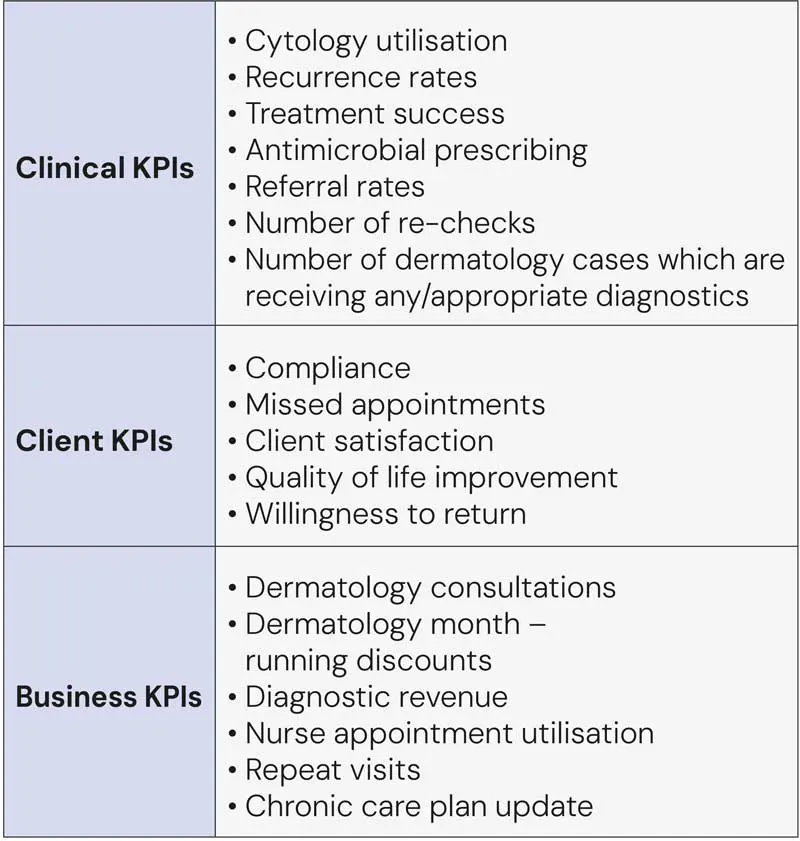
A practice can monitor many aspects to determine if the dermatology service is working from a business or practice management perspective. Using key performance indicators (KPIs) will give managers a quantifiable measurement to evaluate how well the service is running, points to improve and if they can meet a specific target. Ultimately, the goal should not be to generate more revenue.
The goal is better client outcomes leading to improved client retention which in turn leads to better use of the whole veterinary team which overall will generate a more sustainable revenue.
Dermatology offers first opinion practices an opportunity to combine improved clinical care with thoughtful service development. The most effective starting point is not necessarily a dedicated clinic or a major investment in equipment, but a consistent approach to diagnosis, follow up and long-term management.
By standardising investigations, making re-checks purposeful, involving RVNs appropriately and communicating treatment expectations clearly, practices can move away from repeated crisis-driven consultations towards proactive chronic disease care.
For practice leaders, success means building a service that is clinically effective, operationally realistic and financially sustainable. The goal is not simply to see more dermatology patients, but to manage them better.
The principle is straightforward: diagnose systematically, treat appropriately, monitor consistently and act early when disease returns. When these steps become part of everyday practice, dermatology can deliver lasting value for patients, owners and the veterinary team.
The key five steps are:
The future of first opinion dermatology is not necessarily about becoming a specialist practice; it is about becoming better at the dermatology that practices are already seeing every day.
AAHA (2023). 2023 AAHA Management of Allergic Skin Diseases in Dogs and Cats Guidelines. Available at www.aaha.org/resources/2023-aaha-management-of-allergic-skin-diseases-in-dogs-and-cats-guidelines/ (accessed 9 October 2026).
Hill PB, Lo A, Eden CAN, Huntley S, Morey V, Ramsey S, Richardson C, Smith DJ, Sutton C, Taylor MD, Thorpe E, Tidmarsh R and Williams V (2006). Survey of the prevalence, diagnosis and treatment of dermatological conditions in small animals in general practice, Veterinary Record 158(16): 533–539.
Jackson H and Marsella R (2022). BSAVA Manual of Canine and Feline Dermatology (4th edn), Wiley.
Loeffler A, Cain CL, Ferrer L, Nishifuji K, Varjonen K, Papich MG, Guardabassi L, Frosini SM, Barker EN and Weese JS (2025). Antimicrobial use guidelines for canine pyoderma by the International Society for Companion Animal Infectious Diseases (ISCAID), Veterinary Dermatology 36(3): 234–282.
Monti P and Cian F (2016). Diagnostic cytology, BSAVA Manual of Canine and Feline Clinical Pathology 21: 398-434.
Mosedale P (2019). Clinical Audit in Veterinary Practice — the Role of the Veterinary Nurse, The Veterinary Nurse 10(1): 4-10.
Mueller RS, Banovic F, Bensignor E, Santoro D and Nuttall T (2026). Treatment of Canine Atopic Dermatitis: Updated Guidelines From the International Committee on Allergic Diseases of Animals (ICADA), Veterinary Dermatology.
Deborah James qualified from Hartpury College in 2017 with a BSc in veterinary nursing science and works as team leader at Vet’s Klinic. She has completed an ISFM certificate in feline nursing and is in her second year of her MSc in veterinary nursing at the University of Glasgow. She has two cats at home: Tipsy, a 10-year-old hand-reared cat, and six-year-old Frank. In her spare time, you can find Deborah snuggled with a book or teaching and participating in pole fitness and aerial arts.