16 Oct 2026
Officials told BVNA Congress a new Veterinary Surgeon’s Act is “much further advanced” a year on from their update at the last edition of the conference.

Chris Simpson
Job Title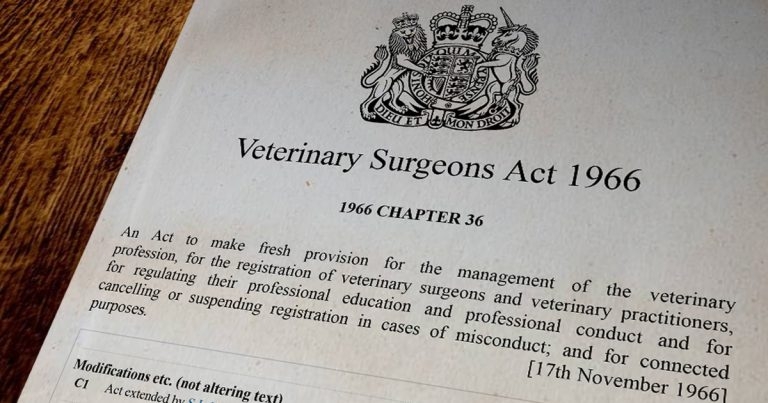
The Veterinary Surgeons Act 1966 – the legislation that regulates the profession in the UK.
Defra’s head of veterinary policy said he is confident proposed reform of legislation governing the sector will be written into law.
Jimmy Lindqvist offered updates on the progress of a new Veterinary Surgeon’s Act at BVNA Congress, following the release of a Government white paper this summer.
Mr Lindqvist described the white paper as a “major step” but “not the final word”, with Defra now translating those proposed reforms into detailed policy instructions.
He said the legislation is “much further advanced” than when Defra gave an update at BVNA Congress last year, adding: “Together, these reforms will create a modern, coherent system that protects animal welfare, supports professionals and holds businesses accountable.”
Mr Lindqvist said Defra has bid for a bill slot in the third session of this Parliament, but no slot or introduction date has been confirmed.
He continued: “The biggest threat is simply that a crowded legislative programme displaces a reform that is seen as desirable but not urgent.
“That is why a unified, constructive sector voice matters. Clear evidence that the reforms are workable, proportionate and broadly supported strengthens the case.”
Mr Lindqvist concluded: “I feel confident, but then one never knows about these things.”
On what the reforms would mean for veterinary nurses, he said: “The direction of travel is significant.”
Speaking alongside him, BVA president Gwen Rees described protection of the VN title and greater professional recognition as the “key marker of success” for the legislation and said the veterinary profession will become “greater than the sum of its parts”.
On where the boundary between vet and VN should remain, Dr Rees said determining that will be a “long process”, adding: “I would start with the principle rather than a prescriptive list.
“In principle, what we want to see is that RVNs are able to work to the full extent of their education, their training and their demonstrative competence.”
Asked how to get vets to trust nurses with more autonomy, she said “having clarity will be hugely important for everyone”, noting the need for appropriate education, CPD and workplace protocols to be in place.
She continued: “It’s kind of unfair to increase someone’s professional responsibility without also increasing the structures and support that are in place…
“For me it’s about just being really careful that we don’t end up in a situation where vet nurses are thrown under the bus.
“You give them more responsibility and more accountability for what you do in practice, but without the support in place or without the training in place, without feeling confident in that, that could be a worrying place to be.”
On reassurances she would give vets concerned about reforms blurring boundaries between the professions, Dr Rees said: “In general, there is enough work to go around, and we don’t feel that this is a territorial debate.”
She said having a “clear definition” will be vital and a benefit for both professions, describing the reforms as a “massive leap forward for everyone”.
She concluded: “The devil’s in the detail of exactly what this looks like and when it comes to working out what that scope looks like, but it’s not a bun fight for work.”