
11 Aug 2026
“Our approach was to just think big and try to create the most positive change for both animals and communities.” This simple ambition has earned a team of three veterinary students a £100,000 global award to fund a new project in Uganda.

Vet Times
Job Title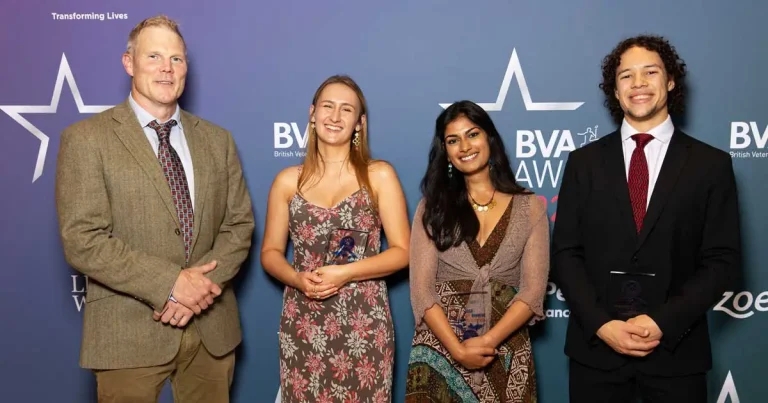
The winning team at BVA Awards with Luke-Gamble.
Francesca Haldane, Shreya Patel and Rudi Bruijn-Yard, were announced as the winners of the first WVS Global Veterinary Challenge Award at the BVA Awards in Birmingham in June.
The team from the University of Cambridge, alongside government and academic partners, have developed a project to help address a threat to food security in low and middle-income countries.
Francesca, Shreya and Rudi’s proposed project aims to tackle peste des petits ruminants (PPR) in goats, through a self-sustaining vaccination and education campaign in Uganda. Funding of up to £100,000 and the expertise of UK veterinary charity Worldwide Veterinary Service (WVS) will enable the students to implement this project, bringing their vision to life.
The Global Veterinary Challenge Award was launched in June 2025 by WVS in partnership with the BVA.
Luke Gamble, chief executive and founder of WVS, said: “We asked students to submit a project proposal that could make a meaningful and lasting impact. We wanted students to design initiatives that would champion a cause they are passionate about.” He added the aim was to encourage students to design bold, innovative solutions to pressing animal welfare issues.
Four teams of vet students were chosen as finalists where they worked with a WVS mentor and local organisations to develop their initial ideas. The other finalist teams, from the University of Bristol and the University of Surrey, featured proposals to help equids and camelids in North Africa, livestock in western Kazakhstan and free-roaming dogs in Argentina.
Francesca, Shreya and Rudi are fifth-year students who came together to form a team.
“When I initially came across the WVS challenge by complete chance, I couldn’t believe that an organisation I looked up to was offering this opportunity to students,” said Francesca.
“I started researching immediately and pitched my idea to the two busiest people I know, Shreya and Rudi.” Between them, they have held a range of leadership and ambassadorial positions and they brought together this experience and their veterinary knowledge to form a proposal that impressed the judges.
Beyond their veterinary training, they were drawn to the opportunity to explore how veterinary professionals can tackle wider global challenges. All three of the team had been drawn to the bigger-picture idea that, as a vet, they could have an impact far beyond clinical practice.
Rudi added: “It showed us that veterinary skills can be applied in ways to address complex issues affecting both animals and people.”
The team were also inspired by the work of WVS and Dr Gamble. They cited the charity’s boldness and commitment to animal welfare as key influences.
Shreya said: “The imagination and vision that we tried to maintain throughout the process, matches what Luke has achieved.
“Designing projects that are completely outrageous on the face of it, but when you break the pieces down, they could have a huge impact on communities.”
Francesca, Shreya and Rudi’s proposal aims to tackle PPR, a highly contagious disease affecting small ruminants, primarily goats and sheep, with a mortality rate of up to 90%. The disease poses a serious threat to food supplies and incomes across Africa, the Middle East and Asia. The team explained that “PPR has a massive impact on smallholder communities – farmers who only have a few goats or sheep rely heavily on these animals”. They decided to focus on this disease because it is vaccine preventable. “This is a devastating and fast-moving disease. But there is an effective, lifelong vaccine that is relatively cheap in terms of vaccines,” added the students.
The Cambridge students have developed a project aimed to protect goats and reduce the economic burden on smallholders in Uganda.
“We initially chose Uganda due to Shreya’s local connections,” the students explained. “It was only through meeting our collaborator, Abel Wilson Walekhwa, that the urgent need for intervention there was highlighted.”
Current outbreaks, which at the time had not been published online, were sweeping through the region causing widespread goat mortality.
The team cited Abel Wilson Walekhwa, who is a PhD candidate at the University of Cambridge and the founder and director of the Infectious Disease Epidemiology and Modelling Unit at Makerere University, as having played a pivotal role in developing this project proposal, particularly in shaping how it will be implemented on the ground.
The proposal was a collaborative effort with the team working alongside government and academic partners. Each finalist team was assigned a WVS mentor, who used their expertise and experience to help the teams develop their project. Francesca, Shreya and Rudi worked with Frederic Lohr, director of operations at WVS, who supported the team in creating their winning proposed project.
The team built relationships with experts and institutions in Uganda, learning from people who understand the challenges within the country.
Working with the Ugandan Ministry of Agriculture, Animal Industries and Fisheries (MAAIF), College of Veterinary Medicine, Animal Resources and Biosecurity (COVAB) Makerere University, this project proposal received support from the Uganda government for implementation.
The students’ proposal was also shaped by The Pirbright Institute and professor James Wood at the University of Cambridge.
The students believe their willingness to listen to others was a key factor in their success. They sought out the guidance of collaborators and experts to strengthen their project.
“When we reached the final, we knew we needed to make our proposal as robust as possible,” they said. “We achieved this by speaking to people with more experience than us and learning from them.”
While conducting research, Francesca, Shreya and Rudi uncovered that The World Organisation for Animal Health and the UN Food and Agricultural Organisation, highlighted an infrastructure and funding gap as the main barriers to eradicating PPR.
This proposal aims to overcome these barriers, with a long-term goal for the project to be self-sustaining by bolstering local capacity to control the disease.
“Our project aims are to provide relevant information and training on how to manage the disease, facilitate vaccine importation into the country and bolster vaccine infrastructure,” they explained.
“Once this is established, we technically wouldn’t need to be involved anymore, because the vaccines could be brought to and transported across the region safely, and the project would have facilitated training on vaccine cold storage maintenance and PPR prevention and management, and vaccine administration for local veterinary paraprofessionals.”
The students’ awareness of the need for the campaign to be sustained stood out to the judges.
For the students, the long-term aim is to stop smallholders relying on unreliable aid from governments and non-government organisations, empowering them to seek out vaccination for their animals. The goal is ultimately to incentivise smallholders to regularly access vaccination for their goats long after the lifespan of the project.
BVA vice-president Elizabeth Mullineaux, who helped judge the award, said: “The project’s combination of strong stakeholder engagement and its potential to deliver measurable, large-scale impact, made it stand out.
“What impressed us most was the team’s ability to create a real-world practical solution to this devastating disease. This project stood out because of its combination of strong government and academic partnerships, clear delivery framework, and its scalable pathway to reducing significant animal suffering.”
The judges were encouraged by the project’s clear large-scale impact potential on not only animals but whole communities.
The award will see the students’ proposal implemented by the charity and Dr Gamble said the organisation was excited to work with the winning team to turn their vision into reality.
He said: “We’re absolutely delighted to be taking Francesca, Shreya and Rudi’s idea forward. It perfectly reflects the kind of work we believe in at WVS – practical, sustainable solutions that build local capacity and create lasting improvements for animals and the communities that depend on them. It’s going to be incredibly rewarding to see this develop into a project that delivers real impact in Uganda.” He added that the innovation and quality of the finalists’ proposals demonstrated the important role veterinary students can play in tackling global animal welfare challenges.
“The WVS/BVA Global Veterinary Challenge is about much more than identifying great ideas – it’s about giving the next generation of veterinary professionals the opportunity to turn those ideas into meaningful action. The passion, creativity and ambition shown by all of this year’s finalists has been genuinely inspiring, and we’re proud to help transform one outstanding proposal into a project that will make a lasting difference.”
Applications for the next challenge award will be opening later this year and students interested in getting involved can register their interest at wvs.org.uk/globalchallenge