
23 Jul 2026
AR glasses were found to improve precision and speed of specific tasks.

Chris Simpson
Job Title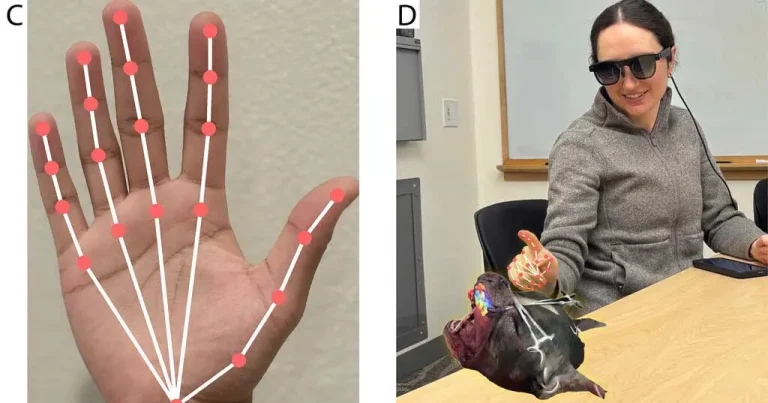
External cameras on the augmented reality (AR) glasses can track the user’s hand movements, which are displayed as vector line overlays. Their pointer finger can be used to control virtual objects, and complete three separate tasks related to spatial accuracy: practice drawing, plot points, and transfer outlines on a holographic canine head.
Augmented reality (AR) glasses have the potential to aid vets’ precision during complex surgeries, a new study has shown.
Scholars from the University of California, Davis (UC Davis) School of Veterinary Medicine recruited 22 colleagues from the institution’s dentistry and oral surgery, neurology and neurosurgery and orthopaedic surgery services to test AR glasses capable of projecting holograms directly into the wearer’s field of view.
The researchers utilised a holographic image of a dog’s head and compared the accuracy of their colleagues’ spatial annotation on the oral cavity surface, comparing manual 2D to 3D transference from a separate screen with seeing the targets directly on the head with AR.
When plotting coordinates, the mean distance error for the transfer coordinates (3.42mm) was significantly higher than for the direct coordinates (2.73mm), while the completion time was significantly greater too (11.2 vs 8.19 seconds).
The authors noted: “These results demonstrate that visualising coordinates in one’s field of view improved both precision and efficiency in terms of distance errors.”
When tracing outlines of regions of interest (ROI), the direct ROI annotations with AR guidance covered significantly more of the target ROI (83.7% vs 63.3%), although there was no significant difference in speed.
The authors concluded: “AR devices may deliver better outcomes during surgeries, especially when incorporated with diagnostic imaging overlays of pathology and anatomy, and may prove to be a strong asset in the future.”
Lead author Stephanie Goldschmidt, associate professor of dentistry and oral surgery at UC Davis, added: “Augmented reality technology has the potential to enhance surgical precision by overlaying 3D diagnostic imaging and biologic information directly onto the animal patient.”