
21 Apr 2026
GENERAL INTEREST: Desert dairy farming in Qatar
Rupert Sheppard BVSc, CertAVP, MRCVS explains how cattle management works in the Middle East as he recalls his time at a major dairy producer.

Rupert Sheppard
Job Title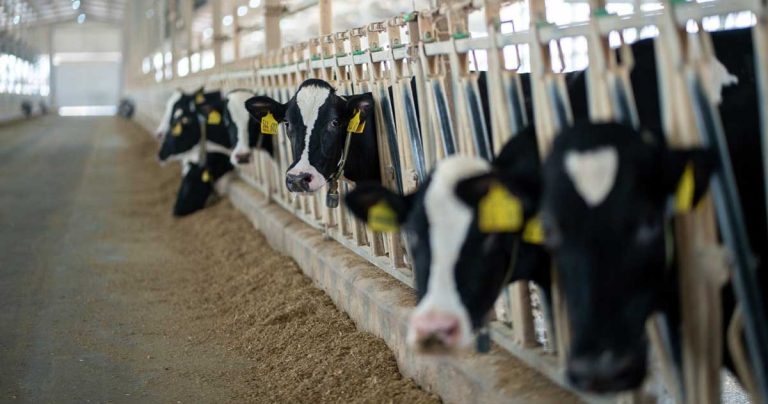
After leaving clinical practice in south Wales, I took a leap of faith into the adventure of a lifetime and went to work with a group of very large dairies in Saudi Arabia. A couple of years later, I continued my adventures and went on to do a season in New Zealand. Then in early 2023, I got a call from the farm manager in Qatar, and a few weeks later with my bags packed again, I was back off to the Gulf.
Baladna (“our land” in Arabic) is a desert dairy farm home to 22,000 animals located on the Qatari east coast, just a 30-minute drive north of the capital city, Doha. For the past two years, I was fortunate to work as the head veterinarian, overseeing all aspects of herd health, biosecurity, animal health treatments, as well as a herd team of 55 highly skilled stockmen and veterinarians. As of summer 2025, Baladna produced 95 per cent of all the fresh milk consumed in Qatar and expanded its product lines to include everything from low-fat Greek yoghurt to protein shakes. However, less than 10 years earlier, this area of northern Qatar was bare sand desert – until 5 June 2017, when everything changed.
Blockade
In 2017, a diplomatic crisis between Qatar and other Arab league states culminated in the physical blockade of goods moving across the border into Qatar.
To put milk back on to the supermarket shelves, a dairy farm and processing facility was established and cows, equipment and expertise were flown into the country. Within a matter of weeks, fresh milk was once again available.
From these frantic beginnings, Baladna dairy farm has emerged with a 10,000-strong milking herd, 12,000 followers, four rotary milking parlours and a dedicated team of more than 400 farm staff to make it all happen.
Okay, but why are there cows in the desert, anyway?
Prior to the blockade, Qatar was well supplied by fresh milk deliveries from Saudi and Emirati farms. Large-confinement desert dairy farming was pioneered in the US south-west and brought to the Arabian Gulf by the Irish in the 1970s.
With the inflow of petrochemical cash from the middle of the last century, these countries rapidly urbanised and their populations boomed. As seen globally, when incomes rose, so did the protein demand, and with it a lucrative opportunity to provide a reliable local supply of fresh high-quality milk.
With no culture of cattle dairy farming, there were no small farms to consolidate, as has occurred in Europe and North America. Instead, large modern and purpose-built cow dairies were built in Saudi Arabia and later in the UAE.
The fresh milk market in the region has always been dominated by several large companies operating on fully integrated production models. The same company owns and farms the cows, milk processing plants, marketing and sales teams.
Dairy farming in extreme weather
Establishing a dairy farm in a hot climate is not a new concept; however, the real challenge in Qatar is prolonged periods of high humidity which, when combined with high temperatures, can be deadly.
Qatar is a small, rocky peninsula sticking out into the Persian Gulf. Never more than 20 miles from the coast, the summer humidity really tested the facility design team to develop novel ways to help keep cows cool.
Cows primarily cool themselves through evaporative cooling, which relies on a humidity differential between wet animal coats and drier air. As humidity levels rise and the air becomes saturated, this difference reduces, making the evaporation process increasingly ineffective. Frequent large droplet soaking of the cattle and high air speeds in the barns are needed throughout the summer months to artificially create humidity gradients and allow for evaporative cooling.
Water use in the desert is rightly a sensitive issue, but with the help of emerging technologies, new ways to reduce and recycle are becoming viable. Baladna installed both “smart” motion sensor feed lane soakers, which reduced water use by 60 per cent, and a whole-farm membrane bioreactor water recycling plant that returns cow slurry to potable water.
Deep sand-bedded cubicles provide fantastic comfort and hygiene for large Holstein cows, even in high humidity times, with a sand-manure recycling system in place. With the baking sun ideal for drying recycled sand, the beds were refreshed anywhere from three times a week to daily, depending on the season.
Milking time
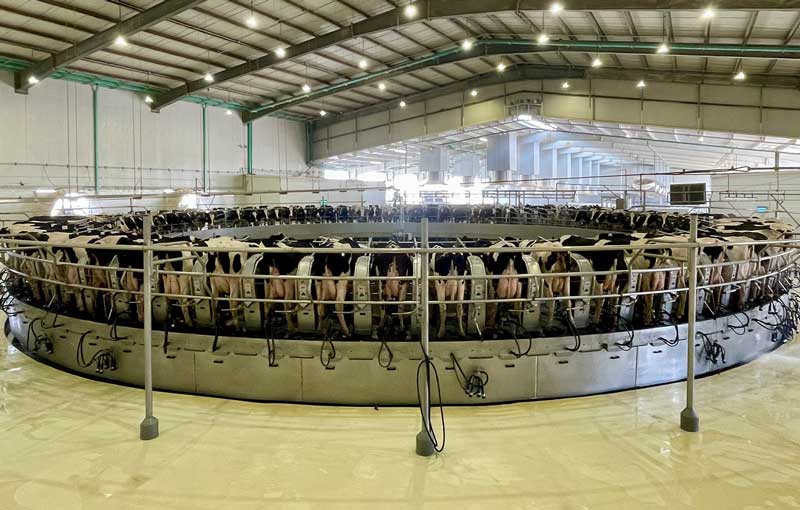
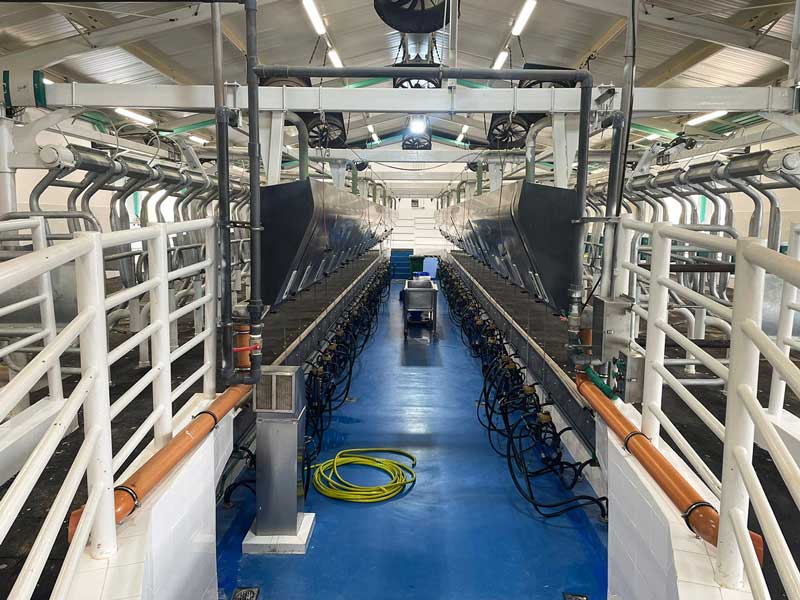
The farm relies on four large rotary parlours to milk the cows quickly and efficiently. With the recent addition of teat-scrubbing pre-prep robots, seven men could milk 3,500 cows in a seven-hour shift. Each shift has one hour to wash the milking parlour and allow the milking team to have a meal and rest until the whole process starts again.
A fifth, smaller hospital parlour is used to milk all freshly calved animals and those under active veterinary treatment. This allows a dedicated maternity and hospital team to handle the 50 new calving cows a day plus a small hospital group.
Herd management at scale
I would tell visitors that we had a Saudi-style management philosophy, US Midwest-designed barns, and Arizona diets. What does that all mean exactly?
Firstly, all of the feed and forage is imported by container ship bought by quality and price on the global commodity market. A typical milking cow ration would be alfalfa hay, chopped straw, flaked maize corn, soya, protected fats, cotton seed and a mineral pre-mix. There were no wet ensiled forages fed, so rations have a very different look and texture to typical grass or maize silage-based diets.
Saudi management meant all cows were milked either four times or three times per day depending on lactation stage and fed just as often to keep feed fresh and stop it overheating in the hot weather. Cows were housed in groups of 300 and kept together as cohorts throughout the entire lactation. Milking heifers and mature cows were housed separately to promote feed intakes.
All cows were fitted with an ear tag to monitor temperature, health, rumination and heat activity. This system was fully integrated into the rotary milking parlours and sorting gate facilities; for example, a cow might show a health alert at 3am and be sorted automatically by 6am the next morning for examination without anyone pressing a button.
Herd health in an increasing connected world
Middle Eastern dairies sit in a bit of a hotspot for transboundary disease, with foot-and-mouth disease (FMD), lumpy skin disease, Brucellosis and bovine ephemeral fever, to name but a few, that are endemic to the region. Unfortunately, outbreaks of FMD are not uncommon, even with rigorous vaccination programmes.
The whole farm site is surrounded by 3m-high boundary fence and gatehouses manned with a dedicated, 24/7 security team. Vehicle wheel baths, personnel disinfection stations and a strict no-entry policy for anyone in contact with other ruminants in the previous three days were biosecurity essentials.
With vast amounts of livestock moving into the Gulf each year from the Horn of Africa and south Asia, to meet spiking red meat demands during pilgrimages and religious festivals, new incursions of infectious disease are an annual occurrence.
Overlaid with changing weather patterns, the one health challenge for the region is immense. A further strengthening of collaboration between governments, NGOs, labs and private farms will be needed to tackle these technical and political challenges.
The future of the herd
All heifer replacements for the farm are raised on site, with bull calves sold at weaning into the local beef market and the 12,000 youngstock being cared for by a dedicated team.
Baby calves were fed pasteurised colostrum before continuing on to a high-fat powdered milk replacer mixed with pasteurised transition milk for the first few days.
Housing in pairs helps promote starter pellet and chopped straw intakes, with subsequently higher weaning weights and a healthier transition into groups of 10. Breeding with sexed semen would begin at 13 months old, with more than 90 per cent of heifers calving before their second birthday.
Teamwork
Getting all the jobs done, which involves looking after 22,000 animals every day, takes an enormous amount of planning and teamwork. We had more than 15 nationalities working in the farm, from milkers to accountants, electricians and lab technicians. In the herd teams, Nepali, Kenyan, Pakistani, Bangladeshi and Syrians were the main nationalities I worked with daily.
Many of these come to the Gulf farms as young men with limited education and no dairy farming experience.
As they gain skills and experience, they progress through the ranks from entry-level jobs such as milking to skilled work positions as stockmen, artificial insemination technicians and hoof trimmers. The best and the brightest emerge as supervisors overseeing whole departments of dozens of men, changing the life chances of their families they work so hard to support.
Where next?
With Baladna having now grown to meet the fresh milk market in Qatar, it is looking overseas for continued growth.
A new ventures division looks to leverage the farming expertise gained to take the model to new markets throughout Africa and south-east Asia.
The proposed Algeria project, a joint venture with the Algerian government, would be the largest integrated dairy business in the world once operational. Watch this space.
Back to the beginning
With the expected arrival of our first child later in the year, my wife and I decided the pull of family support was too great and we relocated back to the UK at the end of the summer.
This spelled the return to independent clinical farm practice with Shropshire Farm Vets. It’s great to be back working with proactive farmers across the whole dairy system spectrum and applying some large desert dairy management principles in new ways.
- This article appeared in Vet Times (21 April 2026), Volume 56, Issue 16, Pages 13-15