
14 Jul 2026
Fraser Broadfoot BVetMed, MRCVS looks at where the various sectors involved with this issue are and asks what the future holds.

Fraser Broadfoot
Job Title
Image: byrdyak / Adobe Stock
Antimicrobial resistance (AMR) occurs when bacteria, viruses, fungi or protozoa no longer respond to antimicrobial agents that would be expected to kill them or inhibit their growth, and results in infections becoming difficult or impossible to treat.
This increases the risk of disease spread, severe illness and death in both animals and humans. Antibiotic-resistant bacteria can also spread from animals to people and vice versa, with many studies showing that we share Escherichia coli with our pets, for example1.
The primary driver of AMR is antibiotic use, which is why we seek to reduce inappropriate antibiotic use and disease prevention.
This article will look at the extensive efforts that are taking place in the UK and across Europe to monitor how antibiotics are being used in animals, drawing on insights and data from the UK-VARSS2 and ESUAvet3 reports.
How can we better understand how antibiotics are being used in animals? We use two sets of data, which we refer to as “antibiotic sales” and “antibiotic use”. Antibiotic sales data (for veterinary medicines that are indicated or intended for use in animals4) is commonly obtained from marketing authorisation holders (such as, the pharmaceutical companies), or veterinary wholesalers, and presented in the form of “mg/kg”, where mg represents the weight of antibiotic active ingredient and kg the weight of the animal population. This metric is, therefore, a measure of antibiotic sales relative to the overall population. The latest 2024 antibiotic sales data from UK and Europe using this metric can be found in Table 1.
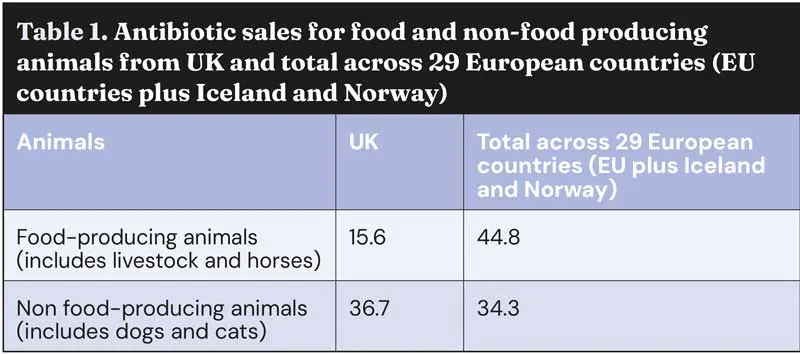
While the numbers are important, caution should be exercised when comparing between countries, as animal demographics, production systems and disease incidence vary widely. However, the trends over time are particularly important, as they help us to tell whether antibiotic stewardship initiatives are successful. In the UK, thanks to strong engagement from the vet profession and agriculture sectors5, use of antibiotics in food-producing animals has fallen by 57% since 20142. The EU has also recorded a 24% reduction since 20183.
However, limitations exist with antibiotic sales data; for example, just because an antibiotic is sold in a particular year, it does not mean that is when it is actually used and, in addition, many antibiotics are authorised for use in multiple species. This means that you cannot effectively monitor use in individual species/sectors without antibiotic use data.
Antibiotic use data refers to the amounts of antibiotics administered or to be administered to animals (such as prescribed, dispensed, or delivered)4 and, unlike sales data, relates to particular species/sector. In the UK and across Europe, the majority of use data is collected using veterinary records2,3.
In the UK, the vet profession and farmers work together on a voluntary basis to collate and share this data with the sector bodies, which include the AHDB, British Poultry Council, British Egg Industry Council, Salmon Scotland, British Trout Association and the Game Farmers Association.
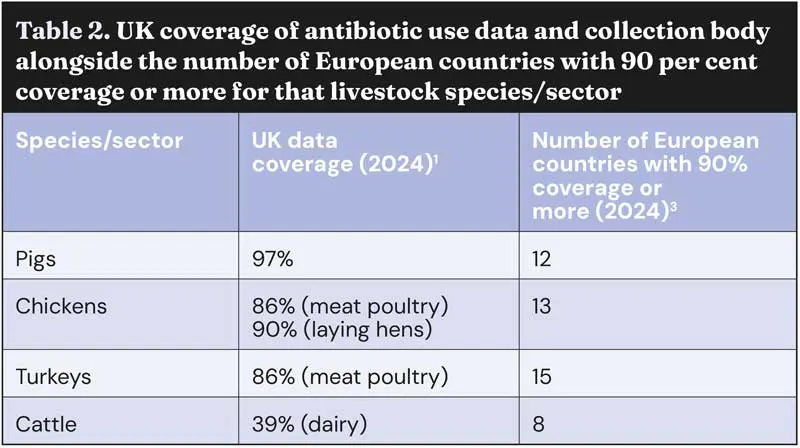
This is then anonymised, aggregated and shared with the VMD for inclusion in the UK-VARSS report2. Industry coverage (such as the percentage of animals within a sector where antibiotic use data is collected) is more than 85% for the majority of food producing sectors (Table 2).
However, the ruminant sectors (in particular, beef and sheep) have low coverage, despite an industry system (Medicine Hub) being launched in 2022 and heavily promoted. Challenges to collecting and sharing this data that have been highlighted include resource constraints, a lack of incentives and data sharing concerns6.
In the EU, antibiotic use recording has been a legal requirement in cattle, pigs and chickens for the past two years, although many countries do not yet have coverage of 90% or more (Table 2). This suggests that while the introduction of a mandatory requirement has significantly increased reporting levels in the EU, antibiotic use data collection can be challenging even when it is legislated for. The legal requirement in the EU will extend to all other food animals and horses by 2027, and to dogs and cats by 20307.
When considering GB legislation, the new Veterinary Medicines Regulations include powers for the VMD to make antibiotic use data collection a legal requirement8. Therefore, if the voluntary model for antibiotic use collection we have here does not lead to high enough levels of antibiotic use data reporting, the option of legally requiring vets, keepers of food-producing animals and/or feeding stuffs manufacturers to provide this information is available.
In the UK, no collation of antibiotic use data for dogs and cats exists, although options for doing this are being explored9. However, the UK-VARSS report2 does include use estimates using sales data, and these are showing an encouraging trend, with sales reducing by 54% in dogs and 17% in cats since 2014.
The latest UK-VARSS report also includes antibiotic use data from horses for the first time, covering 25% of the UK population. This is collected as part of the MonitorMe initiative organised by BEVA. As part of this, the equine sector has worked with the practice management system Eclipse to ensure that it could create a custom antibiotic use report which could be easily shared and collated10.
As well as monitoring trends, antibiotic use data is also useful for developing antibiotic use targets. These have been set by the UK livestock sectors since 201711 and the dog and cat sectors since 20259, and are developed with input from the vet profession and agriculture stakeholders, with coordination by the Responsible Use of Medicines in Agriculture Alliance (RUMA) and the more recently formed RUMA Companion Animal and Equine group.
However, without a reliable baseline figure, the ruminant sectors have found it challenging to set antibiotic use targets. To help improve this, they are now developing a ruminant antibiotic stewardship roadmap12 through a new sector-wide collaborative initiative.
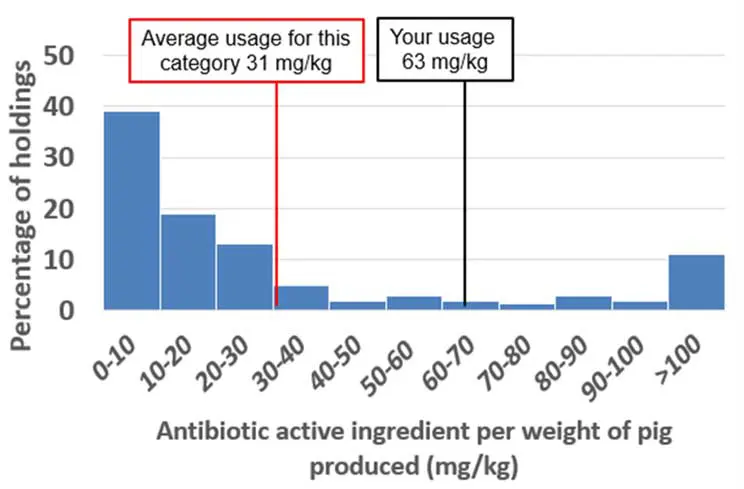
Another key benefit of monitoring antibiotic use data is that it allows for farm benchmarking, which involves comparing use between similar farm types4. This is particularly useful for promoting the vet-farmer conversation relating to antibiotic use based on actual figures and providing a stimulus for change (Figure 1), and is thought to have been instrumental in contributing to the 69% reduction in UK antibiotic use in pigs since 20151.
Publishing and monitoring antibiotic use data is also vital for reputation management, as transparency helps maintain trust with consumers and society. In recognition of this, supply chains are increasingly asking farms to provide their antibiotic use data6.
Finally, linking sales, use and resistance data helps us to understand whether we are being successful in our ultimate aim of containing and controlling AMR; for example, a statistically significant association has been demonstrated between the reduction in UK sales for food-producing animals and the reductions in the detection of multi-drug resistant E coli seen in healthy pigs and poultry over the same period13 (Figure 2).
In conclusion, the latest figures show that, across UK and Europe, antibiotic use data collection is increasing2,3.
This will help everyone to understand how antibiotics are being used and allow scrutiny to ensure they are only prescribed and used when appropriate.
In turn, this will help to reduce the development of AMR, and alongside similar actions in the human health sectors, ensure that antibiotics remain effective for treating diseases in animals and people.
In the UK, the VMD is committed as part of the five-year national action plan14 to work collaboratively with the veterinary and farming professions to improve the accuracy, availability and coverage of antibiotic use data in livestock and companion animals.
In the food-animal sectors, this data is also increasingly likely to be required by supply chains and trade partners8.
Given the many benefits highlighted in this article, we would, therefore, encourage all veterinary practices where possible to engage with and, with relevant permissions, share their data with voluntary antibiotic use data collection initiatives.
Fraser Broadfoot is head of the antibiotic stewardship and usage team within the surveillance division at the VMD. He leads the work on antibiotic sales, use and stewardship in the animal health sector, working closely with veterinary and farming stakeholders to support the responsible use of antibiotics and help tackle antimicrobial resistance.